
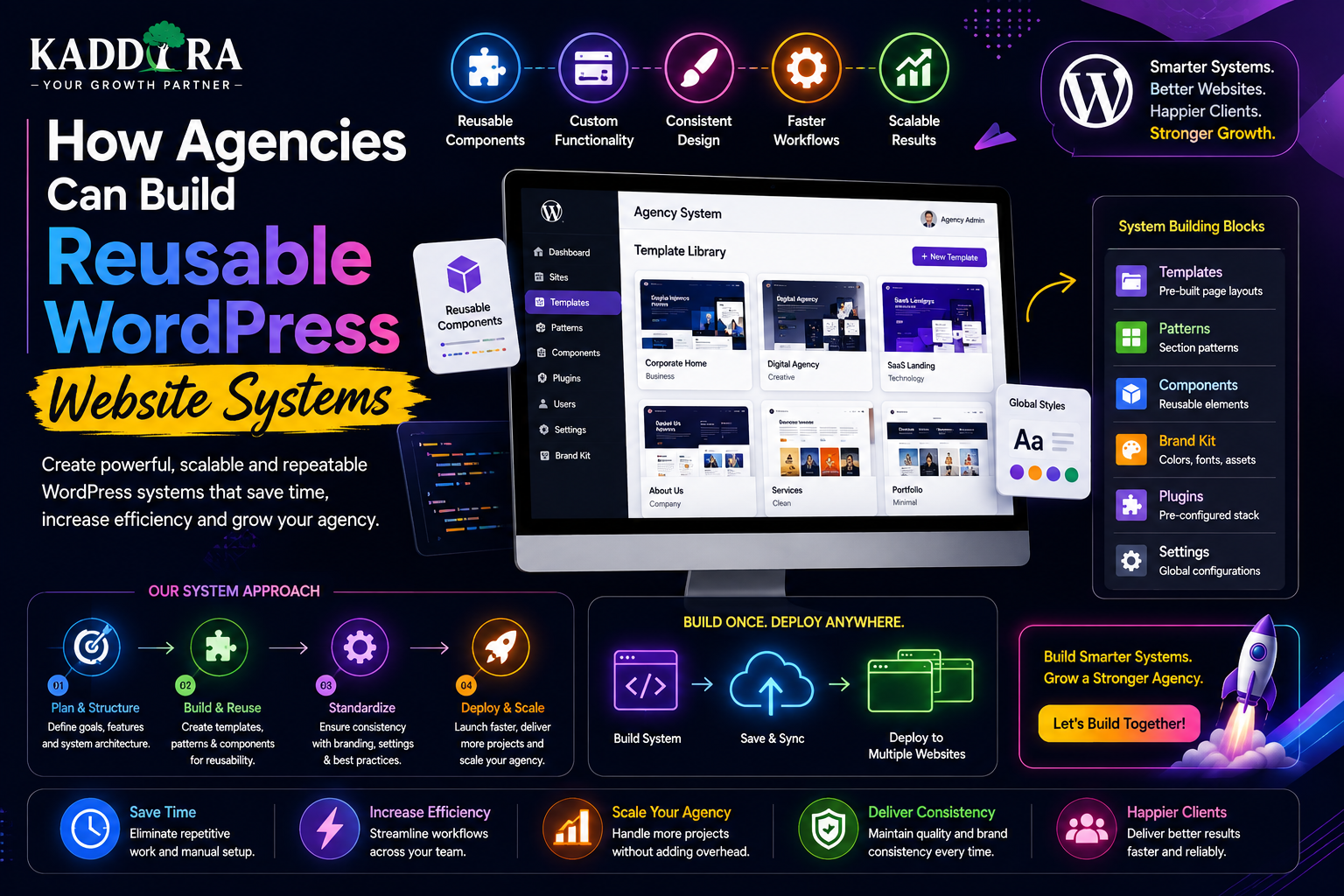
How Agencies Can Build Reusable WordPress Website Systems
Introduction
Building every client website from a completely blank WordPress installation can consume significant time.
Agencies often repeat the same tasks:
Installing plugins
Configuring settings
Creating page layouts
Building navigation
Setting typography
Creating forms
Configuring SEO
Optimizing performance
Setting security
Preparing documentation
Testing responsive layouts
Doing these tasks repeatedly can make projects slower and harder to maintain.
A better approach is to create a reusable WordPress website system.
Instead of rebuilding the foundation for every project, an agency can establish reusable components, templates, plugins, design systems, workflows, and deployment processes.
A simplified architecture looks like:
Agency System ↓ Reusable Foundation ↓ Client Customization ↓ Website ↓ Testing ↓ Launch
The goal is not to make every client website identical.
The goal is to make the underlying development process repeatable while allowing the final website to remain customized.
In this guide, you'll learn how agencies can create reusable WordPress systems, design a starter foundation, organize themes and plugins, build reusable blocks and templates, create design systems, automate repetitive tasks, manage content, improve QA, handle client customization, maintain sites at scale, and create a more efficient WordPress production workflow.
What Is a Reusable WordPress Website System?
A reusable WordPress website system is a collection of standardized components, configurations, templates, development practices, and workflows that an agency can use across multiple client projects.
It may include:
Starter Theme Plugins Block Patterns Design System Templates Security SEO Performance Deployment Documentation
The client website is then built by combining these components with project-specific requirements.
Why Should Agencies Build Reusable Systems?
A reusable system can help agencies:
Reduce development time
Improve consistency
Reduce repetitive work
Standardize quality
Simplify maintenance
Speed up testing
Reduce configuration mistakes
Improve team collaboration
Scale project volume
Instead of solving the same technical problem repeatedly, the agency solves it once and reuses the solution.
Don't Confuse Reuse With Copying
A reusable system should not mean:
"Duplicate the last client's entire website."
That creates problems when projects contain:
Client-specific code
Unnecessary plugins
Old dependencies
Custom database content
Security settings
Branding
Tracking codes
Instead, maintain a clean reusable foundation and customize each project from that foundation.
Create a Standard Project Foundation
A standard agency foundation might include:
WordPress ├── Agency Theme ├── Core Plugin ├── SEO Configuration ├── Security Baseline ├── Performance Baseline ├── Analytics └── Documentation
The foundation should contain only functionality that is genuinely reusable.
Avoid filling it with every plugin the agency has ever used.
Build an Agency Starter Theme
A starter theme can provide:
Base typography
Layout system
Header
Footer
Navigation
Design tokens
Responsive behavior
Accessibility foundations
The goal is not to create one giant theme containing every possible feature.
Instead, keep the theme focused on presentation.
Keep Functionality in Plugins
Business functionality should generally live in plugins rather than the theme.
For example:
Theme → Layout + Visual Design Plugins → Forms → SEO → Analytics → Business Features
This keeps the functionality independent from the site's presentation layer.
Create a Core Agency Plugin
An agency may maintain a reusable internal plugin for functionality used across multiple projects.
For example:
Agency Core ├── Custom Blocks ├── Utility Functions ├── Admin Tools ├── Client Features └── Integration Helpers
Only include features that are genuinely shared across projects.
A core plugin should be modular rather than becoming an unmaintainable collection of unrelated features.
Use Unique Namespaces and Prefixes
Reusable agency code must avoid conflicts.
Avoid generic names like:
function save_settings()
Prefer a unique namespace or prefix associated with the agency or product.
For example:
Kaddora_
or an appropriate project-specific prefix.
This becomes especially important when multiple plugins and themes coexist.
Create a Design System
A design system defines reusable visual rules.
For example:
Colors Typography Spacing Buttons Forms Cards Tables Modals Navigation
This helps designers and developers work from the same foundation.
Design Tokens
A design system can define tokens for:
Primary color
Secondary color
Font sizes
Spacing
Border radius
Shadows
Breakpoints
For example:
Spacing Small Spacing Medium Spacing Large
The actual values can be customized per client without changing the component architecture.
Reusable WordPress Block Patterns
Block patterns are useful for recurring marketing sections.
For example:
Hero Feature Grid Testimonial Pricing FAQ CTA Contact
An agency can maintain a library of approved patterns and reuse them across projects.
This is particularly useful when using modern WordPress block-based workflows.
Reusable Custom Gutenberg Blocks
For recurring functionality, custom blocks can provide reusable components.
Examples include:
Testimonial Team Member Pricing Card Feature Card Logo Grid FAQ Call to Action
The same block architecture can be reused across multiple client sites.
Only the branding and content change.
Create Reusable Page Templates
An agency can maintain templates for common pages:
Home About Services Case Studies Blog Contact Pricing FAQ Landing Page
Templates should provide structure without preventing customization.
Build Reusable Header and Footer Systems
Headers and footers are often rebuilt repeatedly.
A reusable architecture can define:
Header ├── Logo ├── Primary Navigation ├── CTA └── Mobile Menu Footer ├── Navigation ├── Contact ├── Social Links └── Legal Links
Client-specific options can then change:
Logo
Colors
Navigation items
CTA
Social links
without rewriting the component architecture.
Create Reusable Form Components
Agencies frequently need:
Contact forms
Lead forms
Newsletter forms
Demo forms
Quote requests
Booking forms
Instead of designing each form from scratch, maintain a reusable form system with standardized:
Fields
Validation
Error messages
Success states
Spam controls
Accessibility
Create a Standard SEO Foundation
Every project can have a baseline SEO configuration covering:
Site titles
Meta descriptions
Canonical URLs
XML sitemaps
Robots directives
Open Graph metadata
Structured data where appropriate
Clean URLs
The exact SEO strategy should still be customized according to the client's goals.
Create a Standard Performance Baseline
A reusable performance checklist can include:
Image Optimization Caching Asset Optimization Font Strategy Lazy Loading Database Review Third-Party Scripts CDN
This gives every client project a minimum performance standard.
Create a Standard Security Baseline
A reusable security baseline can include:
Strong administrator accounts
Least-privilege roles
HTTPS
Regular updates
Secure backups
Plugin review
File permissions
Login protection
Monitoring
Avoid treating security as something added after the project launches.
Standardize Plugin Selection
Agencies should maintain criteria for choosing plugins.
Evaluate:
Maintenance
Security
Compatibility
Performance
Documentation
Support
Licensing
Data ownership
Don't automatically install the same plugin on every project.
A reusable system should provide approved options, not forced dependencies.
Avoid Plugin Bloat
A common agency mistake is creating a huge default stack:
30 Plugins + 10 Add-ons + 5 Tracking Scripts
Every additional dependency increases:
Maintenance
Conflict risk
Security surface
Performance overhead
Install only what the client actually needs.
Create a Reusable Content Model
Agencies often build websites with similar content structures.
For example:
Services Team Testimonials Case Studies Locations FAQs
Define reusable content models and templates for these common structures.
Use Custom Post Types Where Appropriate
For structured content such as:
Case Studies Team Members Locations Projects Events Testimonials
custom post types can provide a consistent data model.
This allows templates and components to remain reusable.
Create a Reusable Component Library
A frontend component library might include:
Button Card Badge Modal Accordion Tabs Table Form Alert Pagination
These components can become the foundation for multiple client projects.
Establish Component Naming Standards
Use predictable naming conventions.
For example:
KKButton KKCard KKModal KKAccordion
Consistent naming reduces confusion across projects.
Version the Reusable System
An agency foundation should have versions.
For example:
Agency System 1.0 Agency System 1.1 Agency System 2.0
This allows the team to understand which projects are using which foundation.
Don't Automatically Update Every Client
A reusable system can evolve.
But changing a shared foundation can affect production websites.
A safer process is:
New System Version ↓ Test ↓ Pilot Project ↓ Compatibility Review ↓ Selected Client Updates
Don't push major architectural changes blindly across every client website.
Maintain Changelogs
For reusable components, document:
New features
Bug fixes
Breaking changes
Security fixes
Deprecated functionality
This is particularly important when multiple developers maintain the agency system.
Create a Reusable Development Workflow
A standardized agency workflow might be:
Discovery ↓ Planning ↓ Design ↓ Foundation Setup ↓ Customization ↓ Content ↓ Testing ↓ SEO ↓ Performance ↓ Launch
This gives the team a repeatable process.
Automate Project Setup
Agencies can automate repetitive setup tasks.
For example:
New Project ↓ Create WordPress ↓ Install Approved Foundation ↓ Create Theme ↓ Configure Environment ↓ Install Required Plugins ↓ Run Baseline Checks
Automation reduces manual setup errors.
Use Version Control
Every custom agency project should ideally use version control.
A standard workflow can be:
Feature ↓ Branch ↓ Code Review ↓ Merge ↓ Testing ↓ Deploy
This provides a history of changes and makes collaboration safer.
Use Separate Environments
Agencies should maintain:
Development ↓ Staging ↓ Production
This allows testing before changes reach the live website.
Standardize Deployment
Create a deployment checklist covering:
Database backup
Code deployment
Database migrations
Asset build
Cache clearing
Environment configuration
Smoke testing
The exact deployment system can vary by hosting environment.
Build a Quality Assurance Checklist
Before launch, verify:
Navigation Forms Mobile SEO Accessibility Performance Security Analytics 404 Pages Redirects
A standardized checklist reduces the chance of missing important details.
Cross-Browser Testing
At minimum, test the browsers and devices relevant to the client's audience.
Check:
Navigation
Forms
Layouts
Interactive components
Checkout
Login
Dashboard
Don't assume a website that works in one browser works identically everywhere.
Accessibility as a Standard
A reusable system should include accessibility from the beginning.
Components should support:
Keyboard navigation
Focus states
Labels
Semantic HTML
Screen readers
Color contrast
Accessible forms
This is much easier than retrofitting accessibility after dozens of projects have already been built.
Standard Documentation
Every reusable component should have documentation.
For example:
Component Purpose Usage Options Examples Accessibility Notes Dependencies
This makes onboarding new developers much easier.
Create an Internal Agency Knowledge Base
A reusable system should have documentation covering:
Setup Development Components Plugins Deployment Security SEO Troubleshooting Client Handover
This prevents knowledge from being locked inside one developer's memory.
Client-Specific Customization
The reusable system should make customization easy.
For example:
Agency Foundation ↓ Client Brand ├── Logo ├── Colors ├── Typography └── Content
The developer shouldn't need to rewrite the architecture simply because the client has a different visual identity.
Theme Configuration
Reusable themes can expose controlled customization through:
Global styles
Theme settings
Block styles
Design tokens
CSS variables
Avoid providing hundreds of unnecessary settings.
More options don't automatically mean better customization.
Client-Specific Plugins
Not everything belongs in the shared agency foundation.
A project-specific feature can live in:
Client Plugin
This keeps client-specific functionality isolated from the reusable core.
Separate Shared and Client Code
A healthy architecture is:
Shared Foundation + Client-Specific Features ↓ Final Website
Avoid editing shared foundation code directly for a one-client requirement.
That creates maintenance problems for future projects.
Managing Third-Party Integrations
Common integrations include:
CRM
Email marketing
Payment systems
Analytics
Booking
Social platforms
Maps
AI services
Create reusable integration patterns where practical.
For example:
Form ↓ Validation ↓ Integration Adapter ↓ CRM
This makes changing the external service easier.
Integration Adapters
Instead of hardcoding one CRM throughout the project:
Lead Form ↓ CRM Adapter ↓ HubSpot / Salesforce / Other
An adapter layer can keep business logic separate from the external provider.
Create Reusable Email Templates
Agencies often need similar transactional emails:
Contact notification
Form confirmation
Password reset
Booking confirmation
Invoice notification
Create reusable templates with client-specific branding variables.
Standardize Analytics
Each project may use different analytics tools, but tracking implementation should be consistent.
Define:
Page View CTA Click Form Submit Purchase Signup Download
Then map those events to the client's analytics platform.
Consent and Privacy
Reusable tracking systems should account for applicable privacy requirements.
Don't deploy every tracking script automatically.
Determine:
What data is collected
Why it is collected
Which users need consent
Which services receive data
How consent is stored
Privacy configuration should remain adaptable to the client's jurisdiction and business model.
Standardize Forms
A reusable agency form system can support:
Contact Lead Quote Demo Newsletter Booking
Each form can share:
Validation
Spam prevention
Accessibility
Success/error states
CRM integration
Analytics events
Reusable Documentation Templates
Client handover documentation can follow a standard structure:
Website Overview Login Information Content Management Forms SEO Analytics Backups Updates Support Troubleshooting
This makes client onboarding easier.
Never include plaintext passwords in ordinary documentation.
Use a secure credential-sharing mechanism instead.
Maintenance Packages
A reusable agency system can also standardize maintenance.
For example:
Maintenance ├── Updates ├── Backups ├── Security Monitoring ├── Performance Review ├── Uptime Monitoring └── Support
This creates a predictable post-launch service.
Standardize Maintenance Reports
Monthly reports can include:
Updates Completed Security Checks Backup Status Performance Traffic Issues Recommendations
Clients can understand what the agency is maintaining.
Reusable Hosting Strategy
Agencies managing multiple sites can standardize parts of their hosting strategy:
PHP versions
SSL
Backups
CDN
Caching
Monitoring
Staging
Don't force every client onto identical infrastructure if their requirements differ.
WordPress Multisite for Agencies
Multisite can sometimes help when an agency manages a network of related websites.
For example:
Network ├── Client Brand A ├── Client Brand B └── Client Brand C
However, independent client websites often need stronger separation for billing, security, ownership, and deployment.
Don't use multisite solely because it makes setup convenient.
White-Label Agency Systems
An agency can build reusable systems that are branded for different clients.
For example:
Agency Platform ↓ Client Branding ↓ Customer Experience
White-label systems can be useful for:
SaaS
Client portals
Reporting
CRM
Marketing dashboards
Reusable WordPress Systems and AI
AI can speed up parts of an agency workflow.
For example:
Client Brief ↓ AI Content Draft ↓ Human Review ↓ WordPress
AI can also assist with:
Content outlines
Metadata drafts
Component documentation
Test case generation
Code analysis
Support responses
Human review remains important for accuracy, quality, and client-specific requirements.
AI Website Content Workflow
A responsible process is:
Client Information ↓ AI Draft ↓ Human Editing ↓ Fact Check ↓ Brand Review ↓ Publish
Don't publish large amounts of unreviewed AI-generated content simply to increase production volume.
Reusable Systems for WooCommerce Agencies
A WooCommerce agency can maintain reusable components such as:
Product Cards Filters Cart Styling Checkout Components Order Dashboard Customer Account Analytics
This can make eCommerce projects faster to build while leaving room for each store's unique requirements.
Reusable Systems for SaaS Websites
A SaaS-focused agency may maintain:
Hero Feature Sections Pricing Testimonials Integrations Comparison FAQ Documentation Signup CTA
This creates a consistent system for SaaS marketing websites without forcing every project to look identical.
Common Agency Mistakes
Copying Old Client Websites
Old code and dependencies can follow the new project.
Building One Giant Theme
Everything becomes tightly coupled.
Putting Business Logic in Themes
Changing the theme can break functionality.
No Versioning
Teams don't know which foundation each project uses.
Updating Everything Automatically
A shared change can break client websites.
No Documentation
Knowledge becomes dependent on individual developers.
Too Many Plugins
Maintenance and conflict risk increase.
No Automated Testing
Repeated components can break across projects.
No Staging
Changes reach production too early.
Best Practices for Reusable WordPress Agency Systems
Agencies should:
Maintain a clean starter foundation.
Separate themes from business plugins.
Build reusable components.
Use block patterns where appropriate.
Standardize coding conventions.
Use unique namespaces.
Version shared systems.
Maintain changelogs.
Use source control.
Automate project setup.
Standardize QA.
Maintain staging environments.
Document components.
Review third-party dependencies.
Keep client-specific code separate.
Test shared updates before rollout.
Maintain security and performance baselines.
A Professional Agency Development System
A mature workflow may look like:
Agency Foundation ↓ Project Generator ↓ Client Configuration ↓ Reusable Components ↓ Custom Features ↓ Automated Tests ↓ QA ↓ Staging ↓ Production ↓ Maintenance
This transforms WordPress development from a sequence of individual builds into a repeatable engineering process.
Measuring Agency Efficiency
Agencies can track:
Average project development time
Reusable component percentage
Bug rate
Deployment frequency
Support hours
Maintenance cost
Time to launch
For example:
Before System: 10 Weeks After System: 7 Weeks
The goal isn't simply to work faster.
It is to deliver more consistent quality with less repetitive effort.
Why choose ThemeKaddora?
ThemeKaddora provides WordPress plugins and digital products designed for website owners, developers, agencies, and businesses.
Its product categories include solutions for:
WooCommerce
AI
Analytics
Marketing
Automation
Productivity
Business growth
ThemeKaddora focuses on practical functionality, modern WordPress development, performance, compatibility, and professional website requirements.
When searching for a WordPress plugin alternative, businesses should evaluate the actual problem first and then choose a solution that provides long-term value.
Conclusion
Agencies can dramatically improve WordPress development by building reusable systems instead of starting every project from scratch.
A strong agency foundation can include:
Starter Theme
→ Core Plugins
→ Design System
→ Block Patterns
→ Reusable Components
→ SEO Baseline
→ Security Baseline
→ Performance Baseline
→ Deployment Workflow
→ Documentation
The key is to separate the reusable foundation from client-specific customization.
The agency should reuse solutions, not old client websites.
A mature WordPress agency system can reduce repetitive development, improve quality, make maintenance easier, and help teams deliver projects more consistently.
For ThemeKaddora, this approach can also strengthen development across plugins, themes, WooCommerce products, Gutenberg blocks, SaaS interfaces, AI tools, and other digital products.
The ultimate goal is simple:
Build once where repetition makes sense. Customize where the client needs something unique.
That balance gives agencies the efficiency of standardization without sacrificing creativity or business-specific requirements.
Frequently Asked Questions
What is a reusable WordPress website system?
It is a standardized collection of themes, plugins, components, templates, configurations, workflows, and development practices that an agency can reuse across multiple projects.
Why should WordPress agencies build reusable systems?
Reusable systems can reduce repetitive work, improve consistency, speed up development, simplify maintenance, and make team collaboration easier.
Should agencies use the same theme for every client?
Not necessarily. A reusable starter foundation can provide common architecture while still allowing each project to have its own design and functionality.
Should business functionality be placed in the theme?
Generally, business functionality is better separated into plugins so it remains independent from the visual theme.
Can Gutenberg block patterns be reused across client websites?
Yes. Block patterns can provide standardized page sections while still allowing client-specific content and styling.
Can agencies create reusable custom Gutenberg blocks?
Yes. Custom blocks are useful for recurring components such as testimonials, pricing cards, team sections, FAQs, and business-specific interfaces.
How can agencies automate WordPress project setup?
They can create project templates, scripts, configuration files, deployment processes, and approved dependency sets to automate repetitive setup tasks.
Should every client use exactly the same plugins?
No. Agencies should maintain approved plugin options but select dependencies based on each client's actual requirements.
How should agencies manage shared foundation updates?
Use version control, changelogs, testing, staging, and controlled rollout. Don't automatically push major changes to every production site.
Can reusable WordPress systems improve SEO?
They can provide a consistent technical SEO baseline, but each client still needs a customized content and search strategy.
Can reusable systems include AI?
Yes. AI can assist with content drafting, documentation, testing, code analysis, and workflow automation, with appropriate human review.
Can agencies build reusable WooCommerce systems?
Yes. Agencies can create reusable components for product pages, checkout experiences, dashboards, analytics, filters, and customer accounts.
Why choose Themekaddora?
Themekaddora provides lightweight, responsive, SEO-friendly WordPress themes with fast performance, WooCommerce compatibility, flexible customization, accessibility-conscious design, modern templates, regular updates, and professional support—providing a strong foundation for businesses building digital products and product-focused websites.
Comments (0)