
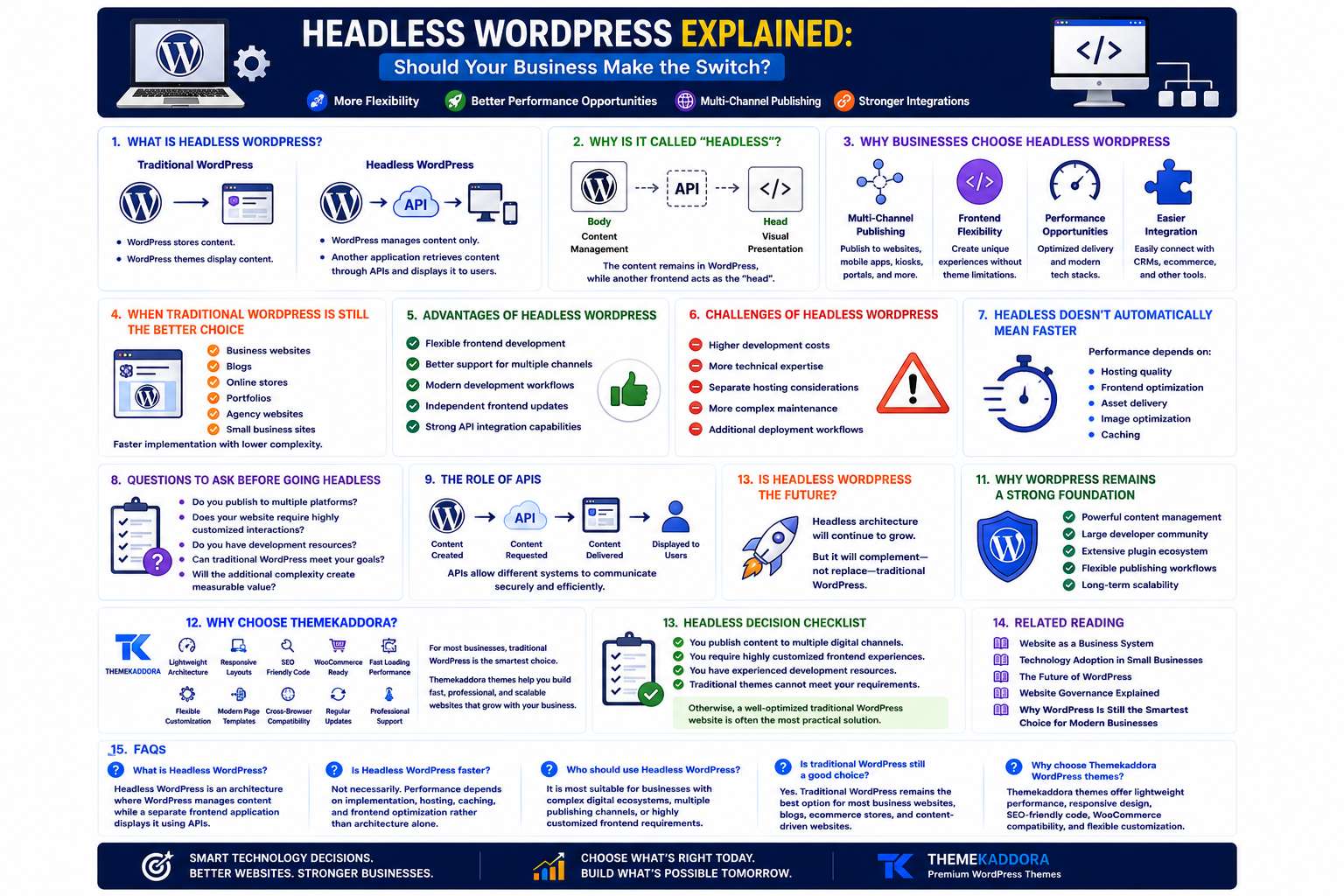
Headless WordPress Explained: Should Your Business Make the Switch?
Introduction
WordPress has powered websites for more than two decades because it combines content management, design, and publishing in one platform.
Traditionally, WordPress handles two major responsibilities:
Managing content in the dashboard.
Displaying that content through a WordPress theme.
This traditional approach works well for millions of websites.
However, modern businesses sometimes need greater flexibility to deliver content across websites, mobile apps, digital kiosks, smart TVs, customer portals, and other digital channels.
This need has led to the rise of Headless WordPress.
While the term may sound technical, the concept is simple: WordPress continues to manage content, but a separate application is responsible for displaying it.
Understanding this architecture helps businesses decide whether Headless WordPress is an opportunity or unnecessary complexity.
What Is Headless WordPress?
In a traditional WordPress website:
WordPress stores your content.
WordPress themes display your content.
In a Headless setup:
WordPress manages content only.
Another application retrieves that content through APIs and displays it to users.
WordPress becomes the "content engine" while another frontend handles presentation.
Why Is It Called "Headless"?
Think of WordPress as having two parts:
Body: Content management.
Head: The visual presentation.
Headless WordPress removes the presentation layer from WordPress itself.
The content remains inside WordPress, while another frontend acts as the "head."
Why Businesses Choose Headless WordPress
Organizations adopt Headless WordPress for several reasons.
Multi-Channel Publishing
One content source can publish to:
Websites
Mobile apps
Digital displays
Customer portals
Smart devices
Greater Frontend Flexibility
Developers can create highly customized user experiences without being limited by traditional theme architecture.
Improved Performance Opportunities
Well-designed headless implementations may improve performance by optimizing how content is delivered.
Performance still depends on implementation quality.
Easier Integration
Large organizations often integrate content with:
Ecommerce platforms
Internal applications
Marketing tools
Headless architecture can simplify these workflows.
When Traditional WordPress Is Still the Better Choice
Most businesses don't need Headless WordPress.
Traditional WordPress remains an excellent option when you need:
Business websites
Blogs
Online stores
Portfolios
Agency websites
Small business sites
It provides faster implementation with lower complexity.
Advantages of Headless WordPress
Potential benefits include:
Flexible frontend development
Better support for multiple digital channels
Modern development workflows
Independent frontend updates
Strong API integration capabilities
These advantages appeal primarily to larger or technically advanced projects.
Challenges of Headless WordPress
Headless architecture also introduces complexity.
Businesses should consider:
Higher development costs
More technical expertise
Separate hosting considerations
More complex maintenance
Additional deployment workflows
The technology should match business requirements.
Headless Doesn't Automatically Mean Faster
Many businesses assume Headless WordPress automatically improves performance.
In reality, performance depends on factors such as:
Hosting quality
Frontend optimization
Asset delivery
Image optimization
Caching
Architecture alone does not guarantee speed.
Questions to Ask Before Going Headless
Before adopting Headless WordPress, consider:
Do you publish to multiple platforms?
Does your website require highly customized interactions?
Do you have development resources?
Can traditional WordPress meet your goals?
Will the additional complexity create measurable value?
Business needs should guide technical decisions.
The Role of APIs
Headless WordPress relies heavily on APIs.
An API allows different systems to communicate securely.
For example:
WordPress stores a blog article.
The frontend requests that article.
WordPress delivers structured content.
The frontend displays it to visitors.
This separation increases flexibility.
Is Headless WordPress the Future?
Headless architecture will likely continue growing.
However, it will complement—not replace—traditional WordPress.
Millions of businesses continue succeeding with standard WordPress because it provides an excellent balance of flexibility, usability, and cost-effectiveness.
Why WordPress Remains a Strong Foundation
Whether traditional or headless, WordPress continues offering:
Powerful content management
Large developer community
Extensive plugin ecosystem
Flexible publishing workflows
Long-term scalability
These strengths make WordPress suitable for organizations of every size.
Why Choose Themekaddora?
For the vast majority of businesses, traditional WordPress remains the smartest choice.
Themekaddora WordPress themes are designed to maximize the strengths of the traditional WordPress experience.
Our themes include:
Lightweight architecture
Responsive layouts
SEO-friendly code
WooCommerce compatibility
Fast loading performance
Flexible customization
Modern page templates
Cross-browser compatibility
Regular updates
Professional support
Whether you're launching a startup website, business portal, ecommerce store, or corporate website, Themekaddora provides a professional foundation that grows with your business.
Headless Decision Checklist
Consider Headless WordPress if:
✅ You publish content to multiple digital channels.
✅ You require highly customized frontend experiences.
✅ You have experienced development resources.
✅ Traditional themes cannot meet your requirements.
Otherwise, a well-optimized traditional WordPress website is often the most practical solution.
Related Reading
Continue exploring:
Website as a Business System
Technology Adoption in Small Businesses
The Future of WordPress
Website Governance Explained
Why WordPress Is Still the Smartest Choice for Modern Businesses
These resources help businesses understand both the strategic and technical sides of building modern WordPress websites.
Conclusion
Headless WordPress represents an exciting evolution in web architecture, especially for organizations that manage complex digital experiences across multiple platforms.
However, it is not the right solution for every business.
The best technology choice is the one that aligns with your goals, budget, and operational needs—not simply the newest trend.
For most organizations, a well-built traditional WordPress website remains the fastest, most cost-effective, and easiest-to-manage solution.
With performance-focused themes from Themekaddora, businesses can build professional WordPress websites that are scalable today while remaining adaptable for tomorrow.
Frequently Asked Questions (FAQs)
What is Headless WordPress?
Headless WordPress is an architecture where WordPress manages content while a separate frontend application displays it using APIs.
Is Headless WordPress faster?
Not necessarily. Performance depends on implementation, hosting, caching, and frontend optimization rather than architecture alone.
Who should use Headless WordPress?
It is most suitable for businesses with complex digital ecosystems, multiple publishing channels, or highly customized frontend requirements.
Is traditional WordPress still a good choice?
Yes. Traditional WordPress remains the best option for most business websites, blogs, ecommerce stores, and content-driven websites.
Why choose Themekaddora WordPress themes?
Themekaddora themes combine lightweight performance, responsive design, SEO-friendly code, WooCommerce compatibility, and flexible customization to help businesses build fast, professional, and scalable WordPress websites.
Comments (0)