
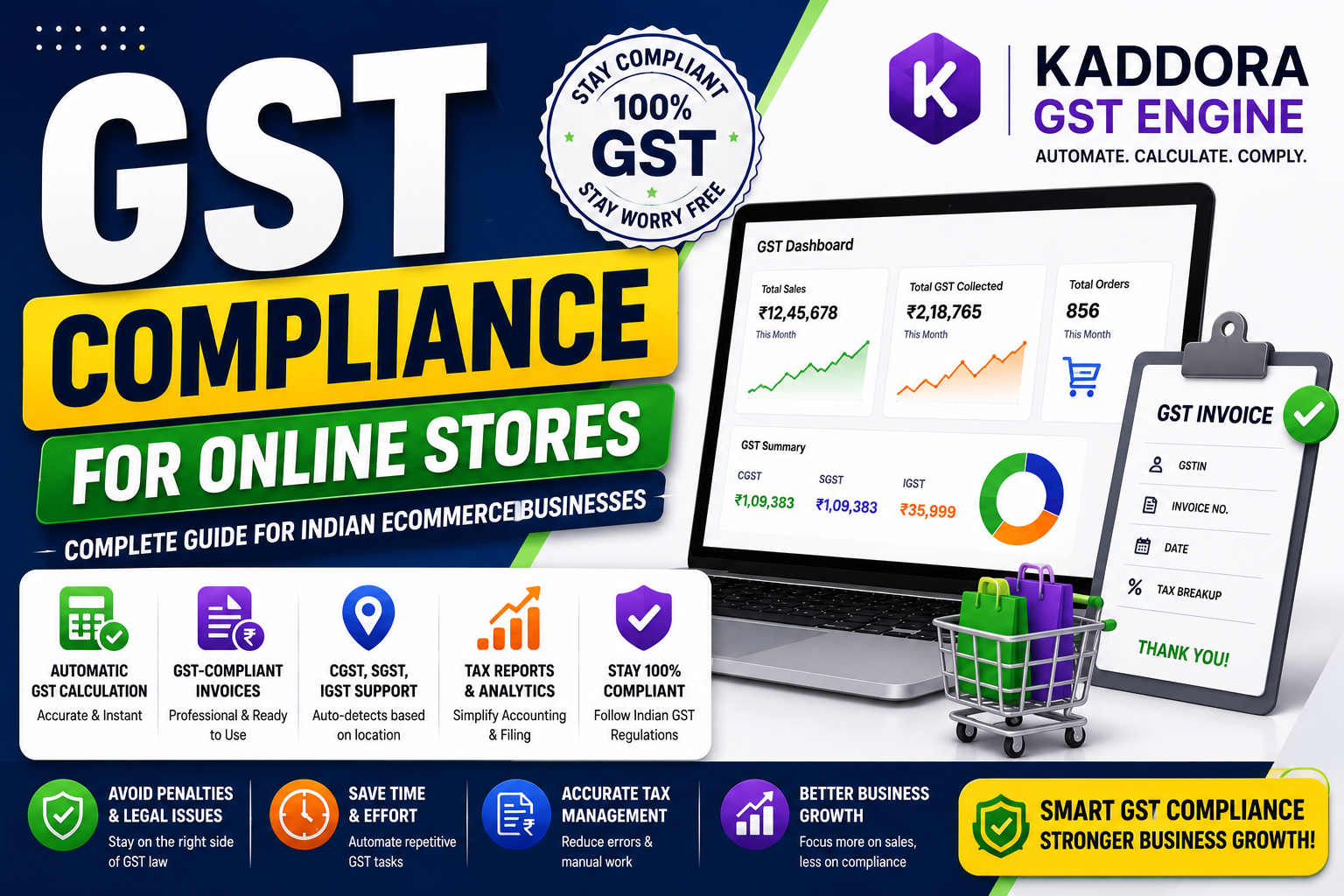
GST Compliance for Online Stores
Running an online store in India offers tremendous growth opportunities, but it also comes with important tax responsibilities. One of the most critical is ensuring your business remains compliant with the Goods and Services Tax (GST) regulations.
Whether you sell through your own WooCommerce website, a D2C store, or multiple sales channels, incorrect GST handling can lead to penalties, accounting issues, customer disputes, and unnecessary manual work.
The good news is that maintaining GST compliance becomes much easier when your WooCommerce store is configured correctly and tax calculations are automated.
In this guide, you'll learn what GST compliance means, why it matters, the common mistakes to avoid, and how to simplify compliance with the right WooCommerce solution.
Quick Answer
What is GST compliance for an online store?
GST compliance means following all applicable GST rules while selling products or services online. This includes registering for GST (when required), charging the correct GST rate, applying CGST/SGST/IGST correctly, issuing GST-compliant invoices, maintaining tax records, and filing GST returns accurately and on time.
Why GST Compliance Is Important
Ignoring GST requirements can have serious consequences for an online business.
Proper compliance helps you:
Avoid penalties and notices
Improve financial accuracy
Build customer trust
Simplify bookkeeping
Prepare GST returns faster
Scale your business confidently
Compliance is not just a legal requirement—it's also a sign of a professionally managed business.
Who Needs GST Compliance?
GST compliance is important for:
WooCommerce stores
Shopify stores
D2C brands
Marketplace sellers
B2B businesses
Digital product sellers
Service providers
Multi-state businesses
If your business falls under GST regulations, maintaining accurate tax records should be part of your daily operations.
Key Elements of GST Compliance
1. GST Registration
Eligible businesses must obtain a valid GSTIN before collecting GST from customers.
Always verify whether your business meets the latest GST registration requirements.
2. Correct GST Calculation
Every order should apply the correct GST percentage based on:
Product category
Customer location
Applicable GST slab
Shipping charges
Incorrect calculations may create filing issues later.
3. CGST, SGST & IGST
Understanding these GST components is essential.
Intrastate Orders
Apply:
CGST
SGST
Interstate Orders
Apply:
IGST
Correct customer location detection is critical for accurate taxation.
4. GST-Compliant Invoices
Every invoice should include:
GSTIN
Invoice Number
Customer Details
Product Details
Tax Breakdown
Total GST
Invoice Date
Professional invoices make accounting significantly easier.
5. Record Keeping
Maintain organized records for:
Orders
Invoices
Refunds
Credit Notes
Tax Reports
Accurate documentation simplifies audits and GST return preparation.
6. Timely GST Return Filing
Collecting GST is only one part of compliance.
Businesses must also file applicable GST returns within the prescribed deadlines.
Consult a qualified tax professional for filing requirements relevant to your business.
Common GST Compliance Mistakes
Many online businesses accidentally make mistakes such as:
❌ Charging incorrect GST rates
❌ Missing GST on shipping
❌ Wrong product tax classifications
❌ Incorrect interstate tax application
❌ Manual invoice errors
❌ Poor record management
❌ Outdated tax settings
Even small mistakes can create significant accounting complications over time.
Best Practices for GST Compliance
Review GST Rates Regularly
Tax regulations may change, so review your tax configuration periodically.
Categorize Products Correctly
Assign every product to the correct GST slab.
Verify Tax Calculations
Test both interstate and intrastate transactions before going live.
Maintain Digital Records
Store invoices and reports securely for future reference.
Automate GST Management
Automation minimizes manual work while improving accuracy and consistency.
Benefits of GST Automation
Automating GST compliance offers several advantages.
Accurate Tax Calculations
Every order receives the correct GST amount automatically.
Faster Checkout
Customers see transparent pricing during checkout.
Better Compliance
Automation reduces human errors and supports consistent tax application.
Simplified Accounting
Reports and invoices are generated in an organized format.
Business Scalability
Automation handles growing order volumes without increasing manual effort.
How Kaddora GST Engine Helps with GST Compliance
Managing GST manually becomes increasingly difficult as your online business grows.
Kaddora GST Engine is designed to simplify GST compliance for Indian WooCommerce stores by automating repetitive tax tasks.
Key Features
Automatic GST calculation
CGST, SGST & IGST support
GST-compliant invoice generation
Product-wise GST configuration
Automated tax reports
WooCommerce integration
User-friendly dashboard
Fast performance
Instead of manually checking every order, Kaddora GST Engine helps businesses maintain accurate tax calculations and organized GST records while reducing administrative workload.
Automated GST Calculation in WooCommerce
GST Compliance Checklist
✅ GST Registration (if applicable)
✅ Correct GST Rates
✅ Product Tax Classes
✅ CGST / SGST / IGST Setup
✅ GST-Compliant Invoices
✅ Shipping Tax Configuration
✅ Tax Reports
✅ Record Maintenance
✅ Regular GST Reviews
✅ Automated GST Management
Frequently Asked Questions
What is GST compliance for online stores?
GST compliance means following Indian GST regulations by charging the correct tax, generating compliant invoices, maintaining records, and filing GST returns on time.
Why is GST compliance important?
It helps businesses avoid penalties, maintain accurate financial records, improve customer trust, and simplify tax filing.
Can WooCommerce handle GST compliance?
WooCommerce provides basic tax settings. However, businesses often use dedicated GST automation solutions to simplify calculations, invoices, and reporting.
How can automation improve GST compliance?
Automation reduces manual calculations, minimizes tax errors, generates compliant invoices, and organizes tax reports automatically.
Which WooCommerce plugin helps with GST compliance?
Solutions like Kaddora GST Engine are designed to automate GST calculations, invoice generation, and reporting specifically for Indian WooCommerce businesses.
Final Thoughts
GST compliance is an essential part of running a successful online business in India.
While manual tax management may work for a small store, growing businesses benefit significantly from automation. Accurate tax calculations, compliant invoices, organized reports, and streamlined workflows not only reduce errors but also save valuable time.
Manage GST Compliance with Kaddora GST Engine
Comments (0)