
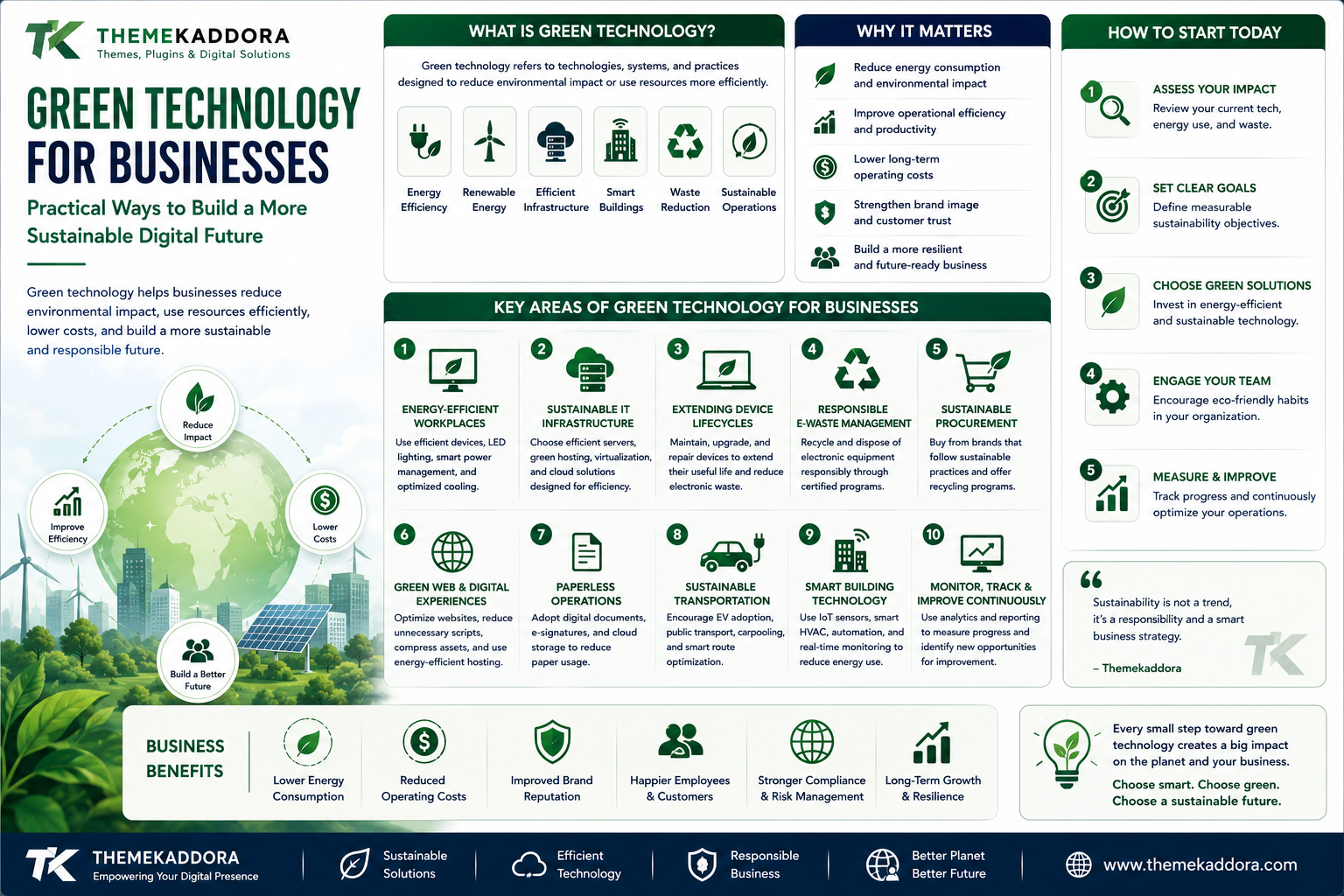
Green Technology for Businesses: Practical Ways to Build a More Sustainable Digital Future
Introduction
Sustainability is no longer limited to environmental organizations and large corporations.
Businesses of every size are beginning to examine how their technology, operations, products, and workplaces affect the environment.
Computers consume electricity.
Data centers require energy.
Electronic devices eventually become electronic waste.
Websites and digital services depend on physical infrastructure.
Even everyday business activities can contribute to resource consumption.
This creates an important question:
How can businesses use technology while reducing unnecessary environmental impact?
Green technology offers part of the answer.
It focuses on using technology more efficiently while reducing waste, energy consumption, and environmental impact.
For businesses, sustainability does not necessarily mean completely rebuilding existing operations.
Often, it begins with practical improvements.
What Is Green Technology?
Green technology refers to technologies, systems, and practices designed to reduce environmental impact or use resources more efficiently.
It can involve:
Energy-efficient devices
Renewable energy
Efficient data centers
Smart buildings
Electric transportation
Sustainable manufacturing
Resource monitoring
Waste reduction
Digital optimization
Green technology can therefore affect many areas of a business.
Why Green Technology Matters for Businesses
Sustainability can influence more than environmental performance.
Efficient technology can also help businesses improve:
Energy usage
Operational efficiency
Resource management
Long-term costs
Brand reputation
Business resilience
A company that wastes fewer resources may also become more efficient operationally.
Green Technology Is Not Just About Solar Panels
When people hear "green technology," they often think about:
Solar panels
Wind turbines
Electric vehicles
These are important examples.
But sustainability also exists inside everyday digital operations.
For example:
Efficient servers
Optimized websites
Energy-efficient devices
Digital documentation
Smart building systems
Remote collaboration
Hardware recycling
Green technology is a much broader concept.
Energy Efficiency in the Workplace
Office technology consumes electricity every day.
Businesses can reduce unnecessary consumption through simple practices.
Examples include:
Energy-efficient monitors
Efficient laptops
Automatic sleep settings
Smart lighting
Efficient cooling
Power management
Turning off unused equipment
Small improvements across hundreds of devices can create meaningful savings.
Sustainable IT
Sustainable IT focuses on reducing the environmental impact of information technology.
It can include:
Hardware
↓
Software
↓
Infrastructure
↓
Data
↓
Energy
Businesses can evaluate the entire technology lifecycle rather than focusing on only one component.
Extending Device Lifecycles
One of the simplest sustainability strategies is to avoid replacing technology unnecessarily.
A device that still performs well may not need immediate replacement.
Businesses can extend hardware lifecycles through:
Maintenance
Repairs
Upgrades
Better storage management
Software optimization
Keeping useful devices in service longer can reduce unnecessary electronic waste.
Electronic Waste
Electronic waste, often called e-waste, includes discarded electronic devices and components.
Examples include:
Computers
Smartphones
Monitors
Printers
Networking equipment
Batteries
Accessories
Businesses should avoid simply throwing old technology away.
Responsible recycling and disposal programs can reduce environmental impact.
Sustainable Procurement
Sustainability begins before a device enters the office.
Businesses can consider:
Product lifespan
Repairability
Energy efficiency
Warranty
Upgrade options
Recycling programs
Supplier sustainability practices
The cheapest product may not always be the most sustainable option over its entire lifecycle.
Green Data Centers
Digital businesses depend heavily on data centers.
Data centers operate servers and networking equipment that require electricity and cooling.
More efficient infrastructure can reduce energy consumption.
Efficiency improvements can involve:
Better cooling systems
Efficient hardware
Virtualization
Resource optimization
Renewable energy
Improved infrastructure management
The growth of cloud services and AI makes infrastructure efficiency increasingly important.
Cloud Computing and Sustainability
Cloud computing can potentially improve resource utilization by allowing infrastructure to be shared across many customers.
However, cloud computing is not automatically sustainable.
Cloud infrastructure still consumes:
Electricity
Cooling resources
Hardware
Networking resources
Businesses should therefore focus on efficient cloud usage rather than assuming that moving everything to the cloud automatically solves environmental concerns.
Website Performance and Sustainability
Websites require physical infrastructure to operate.
Every page request can involve:
User Device
↓
Network
↓
Server
↓
Database
↓
Content Delivery
More efficient websites can reduce unnecessary processing and data transfer.
Website optimization can therefore support both performance and resource efficiency.
How Website Optimization Can Help
Businesses can improve digital efficiency by:
Compressing images
Reducing unnecessary scripts
Optimizing code
Using caching
Removing unused plugins
Improving server configuration
Reducing unnecessary page elements
These practices can also improve user experience.
Sustainable WordPress Websites
WordPress websites can contain many components.
For example:
Themes
Plugins
Images
Videos
Scripts
Fonts
Analytics
Advertising systems
Poorly optimized websites can load unnecessary resources.
Businesses can improve efficiency by regularly reviewing their WordPress setup.
Useful practices include:
Removing unused plugins
Optimizing images
Using efficient themes
Limiting unnecessary scripts
Keeping software updated
Implementing caching
Green Hosting
Website hosting is another consideration.
Businesses can research hosting providers based on factors such as:
Infrastructure efficiency
Renewable energy use
Data center practices
Hardware lifecycle
Environmental reporting
Green hosting should be evaluated carefully rather than relying only on marketing claims.
Digital Documents and Paper Reduction
Technology can reduce physical paperwork.
Businesses can use digital systems for:
Contracts
Invoices
Reports
Forms
Internal documentation
Collaboration
Reducing unnecessary printing can lower paper and consumable usage.
However, digital systems also have environmental costs.
The goal is not simply:
Paper → Digital
It is:
Use resources efficiently.
Remote Work and Sustainability
Remote work can potentially reduce some commuting and office-related resource consumption.
If employees do not travel to an office every day, transportation-related emissions may decrease.
However, remote work also shifts some energy consumption into homes.
Therefore, the environmental impact depends on many factors.
Remote work should be evaluated as part of a broader sustainability strategy.
Smart Buildings
Technology can make buildings more energy efficient.
Smart systems can monitor and control:
Lighting
Heating
Cooling
Occupancy
Electricity usage
Equipment
Instead of running systems continuously, smart technology can adjust them according to actual requirements.
IoT and Sustainability
The Internet of Things connects physical devices to digital systems.
Sensors can collect information about:
Temperature
Energy usage
Equipment condition
Occupancy
Water consumption
Businesses can use this information to identify waste and improve efficiency.
For example:
Sensor
↓
Collect Data
↓
Analyze Usage
↓
Identify Waste
↓
Optimize System
Artificial Intelligence and Sustainability
AI can support sustainability efforts by analyzing large amounts of information.
Potential applications include:
Energy forecasting
Equipment monitoring
Supply chain optimization
Traffic management
Resource planning
Predictive maintenance
AI itself requires computing resources, so businesses should also consider the energy requirements of AI systems.
Green Technology in Manufacturing
Manufacturing businesses can use technology to improve resource efficiency.
Examples include:
Automated monitoring
Predictive maintenance
Smart sensors
Energy management
Production optimization
Waste tracking
Technology can help identify where resources are being consumed unnecessarily.
Sustainable Supply Chains
A company's environmental impact may extend beyond its own offices.
Businesses often depend on:
Suppliers
Manufacturers
Logistics providers
Warehouses
Delivery networks
Digital systems can help businesses track and analyze supply chain information.
This can improve visibility into:
Transportation
Inventory
Supplier performance
Resource consumption
Waste
Digital Tools for Sustainable Operations
Businesses can use technology to monitor sustainability metrics.
For example:
Energy Dashboard
↓
Electricity Usage
↓
Waste Dashboard
↓
Material Consumption
↓
Operations Dashboard
↓
Resource Efficiency
Data makes sustainability easier to measure.
Measuring Sustainability
A business cannot improve what it never measures.
Organizations can monitor areas such as:
Electricity usage
Fuel consumption
Waste
Water consumption
Device lifecycle
Data center usage
Business travel
The exact metrics should depend on the company's operations.
Sustainability KPIs
Businesses can establish sustainability-related KPIs.
Examples include:
Energy KPI
Energy consumed per operational unit.
Waste KPI
Amount of waste generated.
Hardware KPI
Average device lifecycle.
Digital KPI
Data or resource usage associated with digital operations.
The important point is to connect measurements with actual business objectives.
Green Technology and Cost Savings
Sustainability and financial efficiency can sometimes support each other.
For example:
Lower Energy Usage
↓
Lower Electricity Costs
Similarly:
Longer Device Lifespan
↓
Fewer Replacement Purchases
And:
Optimized Website
↓
Lower Resource Usage + Better Performance
Not every sustainability initiative produces immediate financial savings, but efficiency can create economic benefits over time.
Common Green Technology Mistakes
1. Treating Sustainability as Marketing
Environmental claims should be supported by real practices.
2. Replacing Working Devices Too Quickly
Frequent upgrades can create unnecessary waste.
3. Ignoring Digital Infrastructure
Online businesses still depend on physical resources.
4. Focusing on One Area Only
Sustainability should consider operations as a whole.
5. Measuring Nothing
Without measurement, improvement becomes difficult.
6. Assuming Cloud Means Green
Cloud infrastructure still consumes resources.
7. Ignoring E-Waste
Old electronics require responsible disposal.
8. Buying Technology Without Lifecycle Thinking
Initial price is only one part of total impact.
How Small Businesses Can Start
A small business does not need a massive sustainability department.
It can begin with simple actions.
Step 1: Review Energy Usage
Identify major sources of consumption.
Step 2: Review Hardware
Find devices that can be repaired or upgraded.
Step 3: Reduce Digital Waste
Remove unnecessary software and resources.
Step 4: Optimize Websites
Improve performance and reduce unnecessary data transfer.
Step 5: Reduce Unnecessary Printing
Use digital workflows where practical.
Step 6: Establish E-Waste Procedures
Recycle or responsibly dispose of old electronics.
Step 7: Track Progress
Measure changes over time.
Green Technology Checklist
Review electricity usage
Use energy-efficient devices
Extend hardware lifecycles
Establish e-waste procedures
Reduce unnecessary printing
Optimize websites
Review hosting infrastructure
Monitor cloud resources
Reduce unnecessary digital data
Consider renewable energy
Measure sustainability KPIs
Review suppliers
Train employees
Publish accurate sustainability information
The Future of Green Technology
Green technology is becoming increasingly connected with digital transformation.
Future businesses may combine:
AI
IoT
Renewable Energy
Automation
Data Analytics
Smart Infrastructure
These technologies can create systems that monitor and optimize resource consumption continuously.
The goal is not simply to use more technology.
It is to use technology more intelligently.
Green AI and Efficient Computing
As AI adoption grows, computing efficiency will become increasingly important.
Businesses may look for ways to:
Reduce unnecessary model usage
Optimize computing workloads
Improve infrastructure efficiency
Use appropriate models for specific tasks
Monitor computing resources
More powerful technology does not always mean better technology.
Efficient technology can often be more valuable.
Sustainability as a Business Strategy
Sustainability should not exist separately from business strategy.
It can influence:
Operations
Technology
Procurement
Product Design
Marketing
Infrastructure
Supply Chain
When sustainability becomes part of everyday decision-making, businesses can make more consistent progress.
Why ThemeKaddora Is Worth Exploring
ThemeKaddora provides WordPress plugins and digital products designed for website owners, developers, agencies, and businesses.
Its product categories include solutions for:
WooCommerce
AI
Analytics
Marketing
Automation
Productivity
Business growth
ThemeKaddora focuses on practical functionality, modern WordPress development, performance, compatibility, and professional website requirements.
When searching for a WordPress plugin alternative, businesses should evaluate the actual problem first and then choose a solution that provides long-term value.
Conclusion
Green technology is not simply about futuristic inventions.
It can begin with everyday business decisions.
A company can:
Use energy more efficiently
Extend hardware lifecycles
Reduce electronic waste
Optimize digital infrastructure
Improve website efficiency
Monitor resource consumption
Use technology to identify waste
These actions may appear small individually.
But when implemented consistently across an organization, they can create meaningful improvements.
The future of sustainable business will not depend on choosing between technology and the environment.
The opportunity is to use technology to build systems that are more efficient, more responsible, and more resilient.
The goal is simple:
Use less waste. Create more efficiency. Build technology with a longer-term perspective.
Green technology is not just about protecting the future.
It is also about building smarter businesses today.
Frequently Asked Questions
1. What is green technology?
Green technology refers to technologies and practices designed to reduce environmental impact, improve resource efficiency, or support sustainability.
2. Why is green technology important for businesses?
It can help businesses improve resource efficiency, reduce certain operating costs, manage waste, and build more sustainable operations.
3. What is sustainable IT?
Sustainable IT focuses on reducing the environmental impact of hardware, software, infrastructure, data, and technology operations.
4. How can websites become more sustainable?
Businesses can optimize images, reduce unnecessary scripts, improve caching, remove unused resources, and use efficient infrastructure.
5. Can WordPress websites support sustainability?
Yes. Optimized WordPress themes, plugins, images, scripts, caching, and hosting can help reduce unnecessary resource usage.
6. What is e-waste?
E-waste refers to discarded electronic equipment such as computers, smartphones, monitors, batteries, and other electronic devices.
7. Can AI support sustainability?
AI can help analyze resource usage, forecast demand, monitor equipment, optimize systems, and identify patterns, although AI itself consumes computing resources.
8. Is cloud computing automatically green?
No. Cloud infrastructure still requires electricity, hardware, networking, and cooling. Efficient resource management remains important.
9. How can small businesses start using green technology?
They can begin by improving energy efficiency, extending hardware lifecycles, reducing waste, optimizing digital systems, and measuring resource usage.
10. Why Choose Themekaddora?
Themekaddora combines business, technology, WordPress, AI, digital strategy, and emerging technology topics to help readers understand the modern digital ecosystem.
Comments (0)