
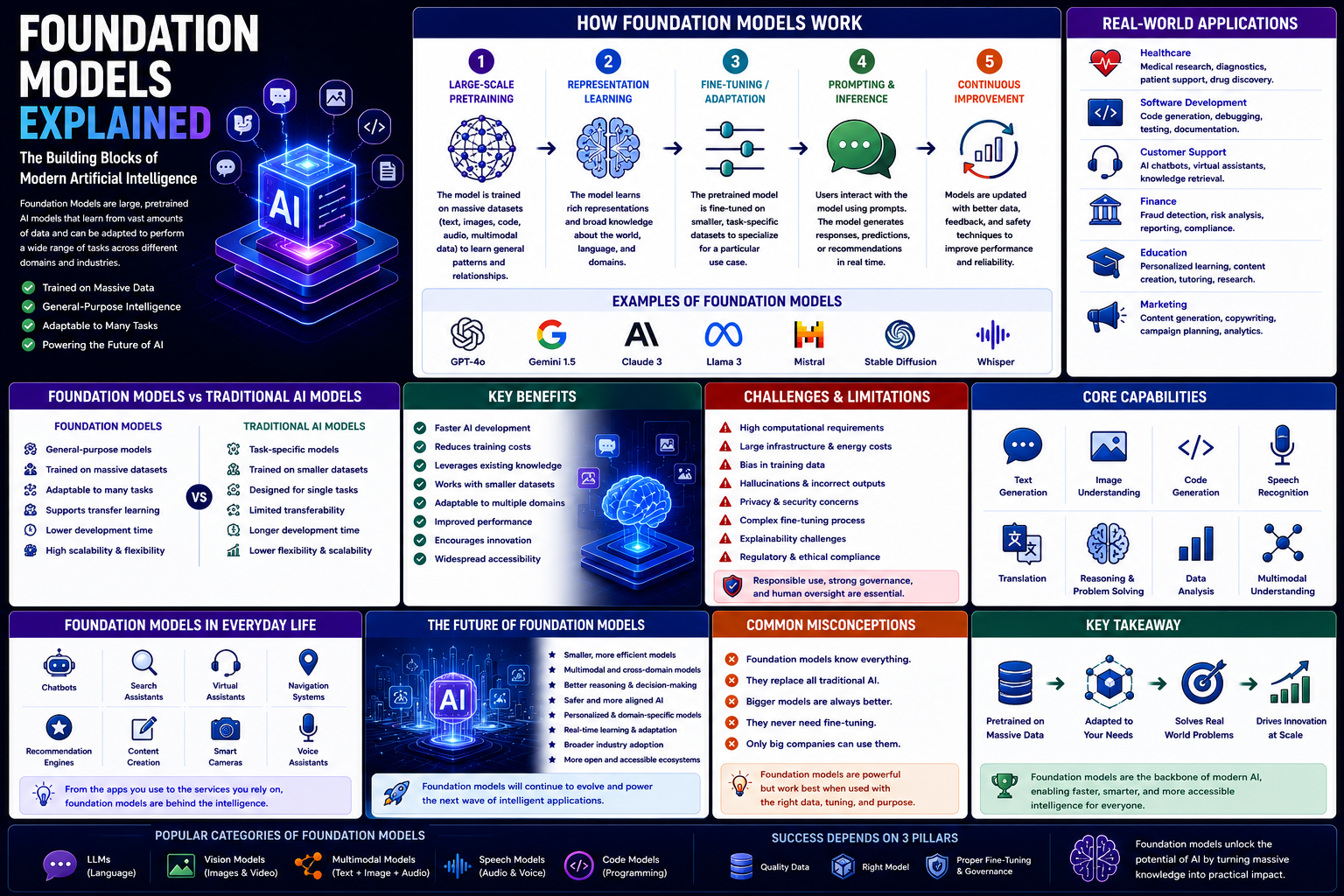
Foundation Models Explained: The Building Blocks of Modern Artificial Intelligence
Introduction
Artificial Intelligence has advanced dramatically with the emergence of Foundation Models—large, pretrained AI models capable of performing a wide variety of tasks across different domains. Instead of building separate models for every individual problem, organizations can now start with a powerful general-purpose model and adapt it to their specific needs.
Foundation Models are trained on enormous datasets containing text, images, code, audio, or multimodal content. After pretraining, they can be fine-tuned or prompted to perform specialized tasks such as writing articles, generating code, translating languages, analyzing images, answering questions, and powering AI assistants.
Today's most advanced AI systems—including many chatbots, copilots, and generative AI applications—are built on foundation models.
What Are Foundation Models?
A Foundation Model is a large pretrained AI model that learns general patterns from vast amounts of data and can be adapted to perform many downstream tasks.
Unlike traditional AI models built for a single purpose, foundation models provide a flexible base for numerous applications.
Examples include:
Large Language Models (LLMs)
Vision Foundation Models
Multimodal Models
Speech Models
Code Generation Models
They form the foundation for modern AI applications across industries.
Why Foundation Models Matter
Foundation Models have changed how AI is developed.
They help organizations:
Reduce development time
Reuse pretrained knowledge
Lower AI training costs
Support multiple tasks
Improve scalability
Enable transfer learning
Accelerate innovation
Increase accessibility to advanced AI
Organizations no longer need to train every AI model from scratch.
How Foundation Models Work
Most Foundation Models follow a multi-stage lifecycle.
1. Large-Scale Pretraining
The model learns patterns from massive datasets consisting of text, images, audio, video, code, or multimodal data.
2. Representation Learning
The model develops generalized knowledge about language, vision, reasoning, or other domains.
3. Fine-Tuning
Organizations adapt the pretrained model for domain-specific tasks using smaller datasets.
4. Prompting and Inference
Users interact with the model through prompts, allowing it to generate responses, predictions, or recommendations.
5. Continuous Improvement
Models may be updated with improved training data, reinforcement learning, or safety enhancements.
Core Components of Foundation Models
Foundation Models combine several advanced technologies.
Transformer Architecture
Processes relationships within large datasets efficiently.
Self-Supervised Learning
Learns patterns without requiring extensive manual labeling.
Massive Training Data
Builds broad general knowledge.
Transfer Learning
Allows reuse of pretrained knowledge across tasks.
Fine-Tuning
Specializes models for specific industries and applications.
Inference Engine
Generates outputs based on user inputs and learned knowledge.
Foundation Models vs Traditional AI Models
Foundation Models
Traditional AI Models
General-purpose
Task-specific
Massive pretraining
Built for individual tasks
Adaptable to many domains
Limited flexibility
Supports transfer learning
Often requires retraining
Powers multiple AI applications
Designed for a single use case
Foundation Models provide significantly greater flexibility and scalability.
Real-World Applications
Foundation Models are transforming numerous industries.
Healthcare
Medical research
Clinical documentation
Drug discovery
Software Development
Code generation
Debugging
Documentation
Customer Support
AI chatbots
Virtual assistants
Knowledge retrieval
Finance
Fraud detection
Financial reporting
Risk analysis
Education
Personalized tutoring
Content generation
Language learning
Marketing
Copywriting
Campaign planning
Content optimization
Benefits of Foundation Models
Foundation Models offer many advantages.
Benefits include:
Faster AI development
Broad knowledge
High scalability
Lower training costs
Flexible deployment
Support for multiple tasks
Improved productivity
Strong ecosystem support
They enable organizations to build sophisticated AI solutions quickly.
Challenges and Limitations
Despite their capabilities, Foundation Models have limitations.
These include:
High computational requirements
Hallucinations
Large infrastructure costs
Bias in training data
Privacy concerns
Explainability challenges
Energy consumption
Regulatory compliance
Responsible deployment remains essential.
Foundation Models in Everyday Life
Many AI-powered services rely on Foundation Models.
Examples include:
AI chatbots
Search assistants
Writing assistants
Translation tools
Coding assistants
Image generation
Voice assistants
Enterprise copilots
Millions of users interact with Foundation Models every day.
Future of Foundation Models
Future developments include:
Smaller efficient models
Multimodal intelligence
Domain-specific foundation models
Better reasoning capabilities
Improved AI safety
Personalized AI assistants
Autonomous AI systems
Enterprise-scale AI platforms
Foundation Models will remain central to future AI innovation.
Common Misconceptions
Several myths surround Foundation Models.
Common misconceptions include:
Foundation Models know everything.
They replace all traditional AI.
Bigger models are always better.
They never require fine-tuning.
Foundation Models are only for large technology companies.
In reality, organizations of all sizes increasingly use Foundation Models through cloud platforms and open-source ecosystems.
Final Thoughts
Foundation Models have fundamentally changed how Artificial Intelligence is developed by providing powerful pretrained systems that can be adapted to countless applications. They enable organizations to build advanced AI solutions faster, reduce development costs, and accelerate innovation across industries.
As AI continues to evolve, Foundation Models will remain the backbone of next-generation technologies, powering intelligent assistants, autonomous systems, enterprise applications, and future breakthroughs in Artificial Intelligence.
Frequently Asked Questions
What is a Foundation Model?
A Foundation Model is a large pretrained AI model that learns general knowledge from massive datasets and can be adapted for many different tasks.
Why are Foundation Models important?
They reduce development time, improve scalability, support transfer learning, and enable organizations to build advanced AI applications more efficiently.
Are Large Language Models Foundation Models?
Yes. Many Large Language Models are a category of Foundation Models focused primarily on language understanding and generation.
Which industries use Foundation Models?
Healthcare, finance, manufacturing, education, retail, software development, media, logistics, and many other industries.
Do Foundation Models replace traditional AI?
No. They complement traditional AI by providing reusable pretrained capabilities while specialized models remain valuable for specific tasks.
Comments (0)