
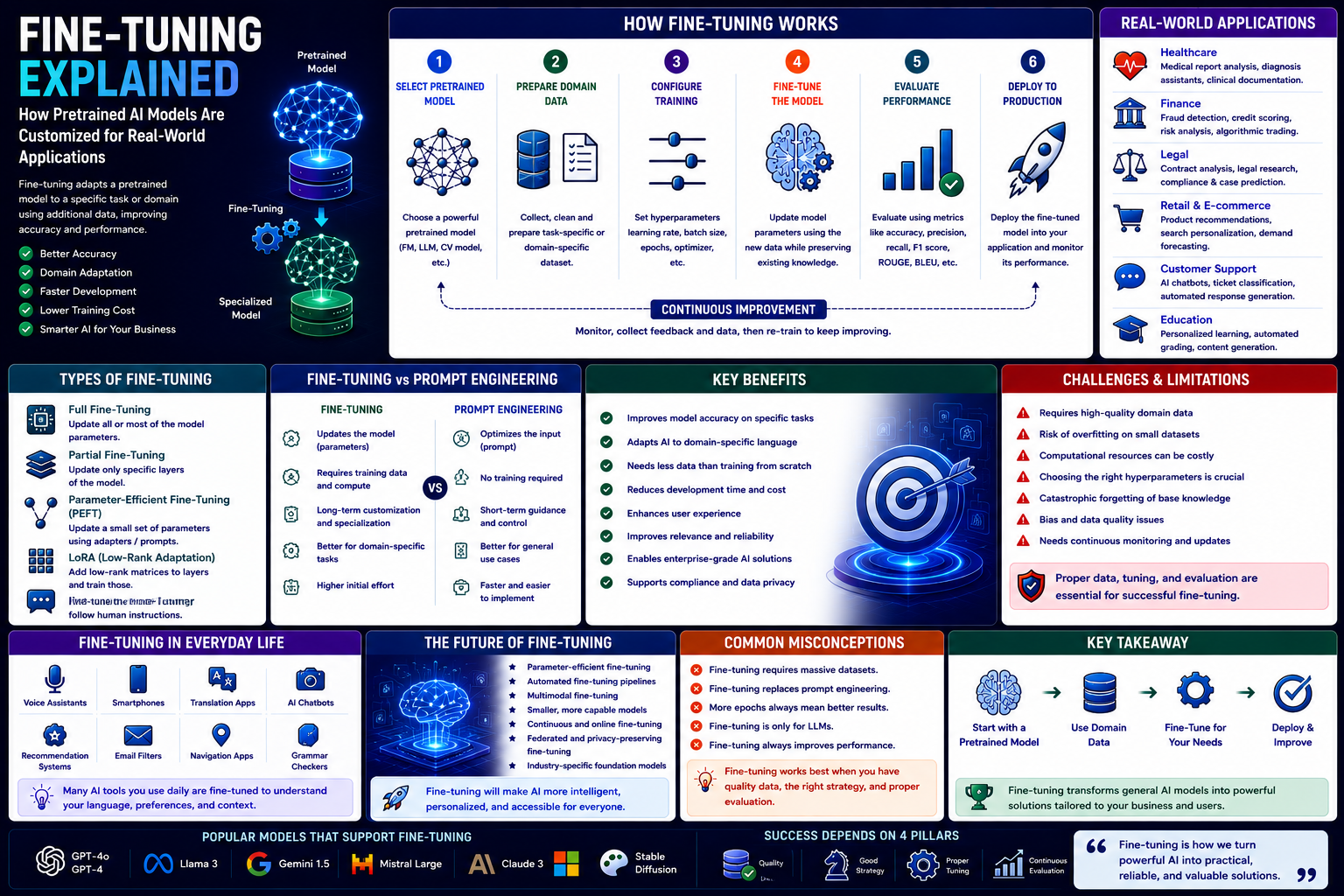
Fine-Tuning Explained: How Pretrained AI Models Are Customized for Real-World Applications
Introduction
Modern Artificial Intelligence has shifted from building every model from scratch to adapting powerful pretrained models for specialized business needs. Large Language Models (LLMs), computer vision models, speech recognition systems, and multimodal foundation models already possess broad knowledge acquired during pretraining.
However, organizations often require AI systems that understand industry terminology, internal workflows, compliance requirements, or company-specific data.
Fine-Tuning makes this possible.
Rather than retraining an entire model, Fine-Tuning updates selected model parameters using domain-specific datasets. This allows organizations to build highly accurate AI systems for healthcare, finance, legal services, manufacturing, education, customer support, and many other industries.
What Is Fine-Tuning?
Fine-Tuning is the process of taking a pretrained AI model and training it further using a smaller, task-specific dataset.
Instead of learning from scratch, the model builds upon existing knowledge while adapting to a new objective.
Examples include:
Medical diagnosis assistants
Legal document analysis
Financial fraud detection
Product recommendation systems
Customer support chatbots
AI coding assistants
Fine-Tuning enables specialized AI with significantly less data and computing resources than full model training.
Why Fine-Tuning Matters
Building large AI models requires enormous investments.
Fine-Tuning helps organizations:
Reduce development costs
Improve task accuracy
Use smaller datasets
Accelerate deployment
Customize enterprise AI
Improve domain expertise
Increase business value
Deliver better user experiences
It allows businesses to leverage powerful foundation models without creating new models from the ground up.
How Fine-Tuning Works
Most Fine-Tuning workflows follow these stages.
1. Select a Pretrained Model
Choose a suitable foundation model such as:
GPT-based models
BERT
Llama
Vision Transformers
Speech models
2. Prepare Domain Data
Collect and clean industry-specific datasets relevant to the intended application.
Examples include:
Medical records
Legal contracts
Product catalogs
Customer support tickets
Financial reports
3. Configure Training
Developers define:
Learning rate
Batch size
Epochs
Optimization algorithms
Validation metrics
4. Fine-Tune the Model
Selected model parameters are updated using the new dataset while preserving existing knowledge.
5. Evaluate and Deploy
The model is tested for:
Accuracy
Precision
Recall
Robustness
Bias
Performance
After validation, it is deployed into production.
Types of Fine-Tuning
Several approaches are commonly used.
Full Fine-Tuning
Updates nearly all model parameters.
Partial Fine-Tuning
Updates only selected layers.
Parameter-Efficient Fine-Tuning (PEFT)
Optimizes a small subset of parameters.
LoRA (Low-Rank Adaptation)
Adds lightweight trainable layers for efficient customization.
Instruction Fine-Tuning
Trains models to better follow human instructions.
Fine-Tuning vs Prompt Engineering
Fine-Tuning
Prompt Engineering
Modifies the model
Modifies the prompt
Requires training data
No additional training
Long-term customization
Short-term interaction
Better for specialized tasks
Better for general tasks
Higher implementation effort
Faster experimentation
Both techniques complement each other in modern AI development.
Real-World Applications
Fine-Tuning powers specialized AI across many industries.
Healthcare
Medical diagnosis
Clinical documentation
Drug discovery
Finance
Fraud detection
Credit analysis
Regulatory reporting
Legal
Contract analysis
Compliance review
Case research
Retail
Personalized recommendations
Product search
Customer support
Manufacturing
Predictive maintenance
Quality inspection
Process optimization
Education
Personalized tutoring
Automated grading
Learning assistants
Benefits of Fine-Tuning
Organizations gain many advantages.
Benefits include:
Higher accuracy
Domain expertise
Faster deployment
Lower training costs
Better personalization
Improved user experience
Enhanced productivity
Scalable AI solutions
Fine-Tuning allows organizations to build AI systems tailored to their unique business needs.
Challenges and Limitations
Despite its advantages, Fine-Tuning introduces challenges.
These include:
High-quality dataset requirements
Computational costs
Risk of overfitting
Bias in training data
Hyperparameter optimization
Model maintenance
Security considerations
Regulatory compliance
Careful planning and evaluation are essential for successful deployment.
Fine-Tuning in Everyday Life
Fine-Tuned AI models support many familiar technologies.
Examples include:
AI customer support
Medical assistants
Translation tools
Coding assistants
Recommendation engines
Voice assistants
Banking chatbots
Enterprise search
Users interact with Fine-Tuned AI systems every day.
Future of Fine-Tuning
Future developments include:
Parameter-efficient fine-tuning
Personalized enterprise AI
Domain-specific foundation models
Automated fine-tuning pipelines
Multimodal fine-tuning
Edge AI customization
Federated fine-tuning
Continuous learning systems
Fine-Tuning will remain one of the most important techniques for adapting powerful AI models to specialized applications.
Common Misconceptions
Several myths surround Fine-Tuning.
Common misconceptions include:
Fine-Tuning requires enormous datasets.
Every AI project needs Fine-Tuning.
Fine-Tuning replaces prompt engineering.
Fine-Tuning always improves performance.
Only Large Language Models can be Fine-Tuned.
In reality, Fine-Tuning works best when appropriate datasets, evaluation methods, and deployment strategies are carefully chosen.
Final Thoughts
Fine-Tuning has become one of the most valuable techniques in modern Artificial Intelligence, allowing organizations to transform powerful foundation models into highly specialized business solutions. By adapting pretrained models with targeted datasets, businesses can improve accuracy, reduce costs, accelerate deployment, and create AI systems tailored to their unique requirements.
As foundation models continue to evolve, Fine-Tuning will remain essential for delivering reliable, domain-specific, and enterprise-ready AI applications.
Frequently Asked Questions
What is Fine-Tuning?
Fine-Tuning is the process of adapting a pretrained AI model to perform a specialized task using additional domain-specific training data.
Why is Fine-Tuning important?
It improves accuracy, personalization, and performance while reducing development time and training costs.
Which industries use Fine-Tuning?
Healthcare, finance, legal, retail, manufacturing, education, customer service, telecommunications, and many more.
What is the difference between Fine-Tuning and Transfer Learning?
Transfer Learning is the broader concept of reusing pretrained knowledge, while Fine-Tuning is a specific method of adapting pretrained models.
Does Fine-Tuning replace Prompt Engineering?
No. Prompt Engineering improves model interaction without retraining, while Fine-Tuning changes the model itself.
Comments (0)