
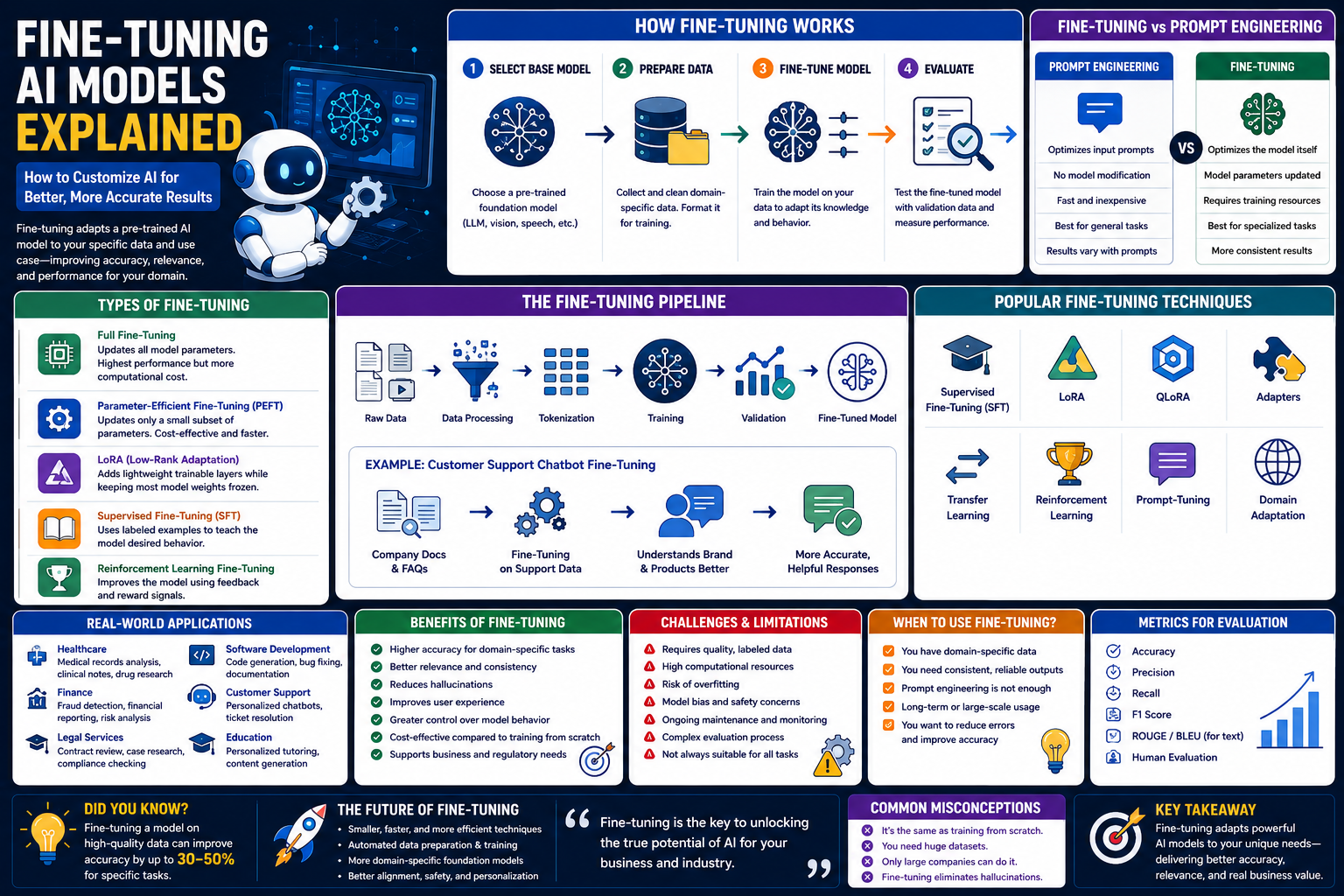
Fine-Tuning AI Models Explained: How to Customize Artificial Intelligence for Better Performance
Introduction
Modern Artificial Intelligence models are trained on massive datasets covering a wide range of topics. While these foundation models perform well across many general tasks, organizations often need AI systems that understand their specific business, industry, products, terminology, or workflows.
This is where Fine-Tuning becomes valuable.
Fine-tuning allows developers to adapt an existing AI model using additional domain-specific data, improving its performance for specialized tasks without training a completely new model from scratch.
From healthcare and finance to legal services, software development, education, and customer support, fine-tuned AI models deliver more accurate, relevant, and personalized results.
What Is AI Model Fine-Tuning?
Fine-tuning is the process of taking a pre-trained AI model and continuing its training using a smaller, specialized dataset.
Instead of building a model from the beginning, organizations customize an existing model so it performs better for a specific domain or application.
Fine-tuned models are commonly used for:
Customer support
Medical diagnosis assistance
Legal document analysis
Code generation
Financial reporting
Product recommendations
Enterprise search
Industry-specific chatbots
How Fine-Tuning Works
Most fine-tuning projects follow a structured workflow.
1. Select a Base Model
Organizations begin with a pre-trained foundation model.
Examples include:
Large Language Models
Vision models
Speech recognition models
Recommendation models
2. Prepare Training Data
Specialized datasets are collected and cleaned.
Examples include:
Company documentation
Medical records (with privacy safeguards)
Legal contracts
Product catalogs
Technical manuals
Customer conversations
High-quality data leads to better results.
3. Train the Model
The model learns patterns from the specialized dataset while retaining its existing knowledge.
Training adjusts selected parameters to improve task-specific performance.
4. Evaluate Performance
The model is tested using unseen examples.
Evaluation may include:
Accuracy
Precision
Recall
Response quality
Safety checks
Human review
5. Deployment
Once validated, the fine-tuned model is deployed into production and monitored for continuous improvement.
Types of Fine-Tuning
Several approaches are used depending on the task and available resources.
Full Fine-Tuning
Updates all model parameters.
Parameter-Efficient Fine-Tuning (PEFT)
Updates only selected parameters, reducing cost and training time.
LoRA (Low-Rank Adaptation)
A popular PEFT technique that adds lightweight trainable layers while keeping most of the original model unchanged.
Supervised Fine-Tuning (SFT)
Uses labeled examples to teach the model desired behaviors.
Reinforcement Learning
Improves model performance using feedback and reward-based optimization.
Fine-Tuning vs Prompt Engineering
Prompt Engineering
Fine-Tuning
Changes the input prompt
Changes the model itself
Fast and inexpensive
Requires training resources
No model modification
Updates model behavior
Best for temporary tasks
Best for long-term specialization
Works immediately
Requires preparation and evaluation
Many organizations use both techniques together for the best results.
Popular Fine-Tuning Techniques
Modern AI development includes several techniques.
Examples include:
Supervised Fine-Tuning (SFT)
LoRA
QLoRA
PEFT
Adapter Training
Transfer Learning
Reinforcement Learning
Domain Adaptation
Each technique balances cost, performance, and computational requirements.
Real-World Applications
Fine-tuning supports many industries.
Healthcare
Clinical documentation
Medical question answering
Diagnostic assistance
Finance
Fraud detection
Financial analysis
Regulatory compliance
Legal Services
Contract review
Case research
Legal assistants
Software Development
Code generation
API documentation
Bug detection
Customer Support
Brand-specific chatbots
Technical support
Knowledge assistants
Education
Personalized tutoring
Course recommendations
Assessment support
Benefits of Fine-Tuning
Fine-tuning offers many advantages.
Benefits include:
Higher accuracy
Industry-specific expertise
Better customer experiences
Personalized AI responses
Reduced hallucinations
Improved workflow automation
Greater business value
Better compliance with organizational requirements
Organizations use fine-tuning to create AI systems tailored to their unique needs.
Challenges and Limitations
Despite its benefits, fine-tuning also presents challenges.
These include:
High computational costs
Need for quality training data
Risk of overfitting
Ongoing maintenance
Privacy concerns
Bias in specialized datasets
Performance evaluation complexity
Infrastructure requirements
Careful planning helps overcome these challenges.
Fine-Tuning in Everyday AI
Many AI-powered services rely on fine-tuned models.
Examples include:
Customer support assistants
Medical AI tools
Banking assistants
Enterprise search systems
Coding assistants
Educational platforms
Recommendation engines
Translation services
Fine-tuning enables these systems to provide more relevant and reliable results.
Future of Fine-Tuning
The future of AI fine-tuning includes:
Smaller and faster adaptation techniques
More efficient parameter tuning
Automated fine-tuning pipelines
Industry-specific foundation models
Federated fine-tuning
Personalized AI assistants
Better safety alignment
Continuous learning systems
Fine-tuning will remain an essential method for creating specialized AI solutions.
Common Misconceptions
Several myths surround fine-tuning.
Common misconceptions include:
Fine-tuning means training an AI model from scratch.
Fine-tuning always requires massive datasets.
Prompt engineering and fine-tuning are the same.
Fine-tuned models never make mistakes.
Only large companies can fine-tune AI models.
In reality, modern techniques have made fine-tuning more accessible and efficient for organizations of different sizes.
Final Thoughts
Fine-tuning has become one of the most effective ways to adapt Artificial Intelligence for specialized business and industry needs. Rather than relying solely on general-purpose AI models, organizations can create systems that better understand their terminology, workflows, customers, and objectives.
As AI adoption continues to grow, fine-tuning will remain a key strategy for building accurate, reliable, and high-performing AI applications across every major industry.
Frequently Asked Questions
What is AI model fine-tuning?
Fine-tuning is the process of adapting a pre-trained AI model using specialized training data for a specific task or domain.
Why is fine-tuning important?
It improves model accuracy, relevance, and performance for industry-specific applications.
What is the difference between prompt engineering and fine-tuning?
Prompt engineering changes how you interact with the model, while fine-tuning changes the model itself.
What industries use fine-tuned AI?
Healthcare, finance, education, legal services, software development, customer support, manufacturing, retail, and many others.
Can small businesses use fine-tuning?
Yes. Modern parameter-efficient techniques have made fine-tuning more accessible and affordable.
Comments (0)