
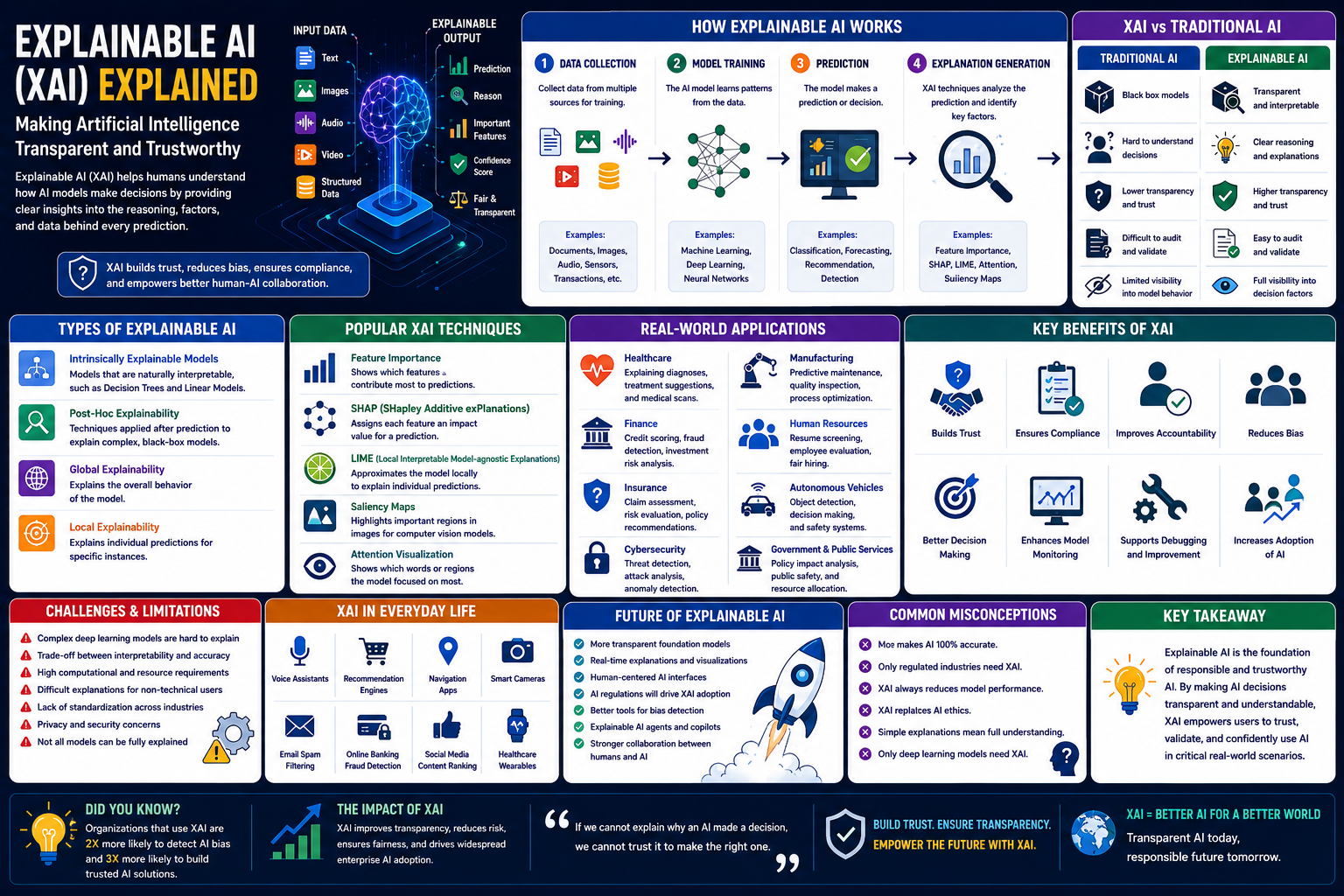
Explainable AI (XAI) Explained: Making Artificial Intelligence Transparent and Trustworthy
Introduction
Artificial Intelligence is transforming healthcare, finance, education, transportation, manufacturing, cybersecurity, and countless other industries. As AI systems make increasingly important decisions, a critical question has emerged:
How did the AI reach that decision?
Many modern AI models—especially deep learning systems—operate like "black boxes." They can produce highly accurate predictions, but the reasoning behind those predictions is often difficult for humans to understand.
Explainable AI (XAI) addresses this challenge by making AI systems more transparent, interpretable, and accountable. Rather than simply providing an answer, Explainable AI helps users understand the reasoning, evidence, and factors that influenced the model's decision.
As organizations deploy AI in high-stakes environments, Explainable AI has become essential for building trust, ensuring compliance, reducing bias, and supporting responsible AI adoption.
What Is Explainable AI?
Explainable AI (XAI) is a branch of Artificial Intelligence focused on making AI models understandable to humans.
Instead of treating AI as a mysterious black box, XAI provides insights into:
How predictions are made
Which features influenced the outcome
Confidence levels
Decision pathways
Model limitations
Potential sources of bias
The goal is to make AI decisions easier to interpret, validate, and trust.
Why Explainable AI Matters
Transparent AI systems are especially important when decisions affect people.
Examples include:
Loan approvals
Medical diagnoses
Hiring decisions
Insurance claims
Fraud detection
Criminal justice
Autonomous vehicles
Financial risk assessment
Understanding how an AI system reached its conclusion helps organizations improve fairness, safety, and accountability.
How Explainable AI Works
Most Explainable AI systems follow a structured workflow.
1. Data Collection
AI models receive structured or unstructured data.
Examples include:
Customer records
Medical images
Financial transactions
Text documents
Sensor data
2. Model Training
The AI model learns patterns using machine learning or deep learning techniques.
3. Prediction
The trained model generates predictions, classifications, or recommendations.
4. Explanation Generation
XAI methods analyze the prediction and identify:
Important features
Decision factors
Confidence scores
Alternative outcomes
Model reasoning
5. Human Review
Experts evaluate both the prediction and the explanation before making important decisions.
Types of Explainable AI
Different approaches provide different levels of interpretability.
Intrinsically Explainable Models
Models that are naturally easy to understand, such as decision trees and linear regression.
Post-Hoc Explainability
Techniques that explain complex models after predictions have been made.
Global Explainability
Explains how the overall model behaves.
Local Explainability
Explains why a specific prediction was made.
Popular Explainable AI Techniques
Several methods are commonly used.
Feature Importance
Measures how much each feature contributed to the prediction.
SHAP (SHapley Additive exPlanations)
Assigns contribution values to each input feature.
LIME (Local Interpretable Model-Agnostic Explanations)
Explains individual predictions using simplified local models.
Saliency Maps
Highlights image regions that influenced computer vision models.
Attention Visualization
Shows which words or image regions received the most focus.
Explainable AI vs Traditional AI
Traditional AI
Explainable AI
Often acts as a black box
Provides understandable explanations
Hard to interpret decisions
Transparent decision-making
Lower user trust
Higher confidence and accountability
Difficult to audit
Easier compliance and validation
Limited visibility into model behavior
Clear insight into predictions
Explainable AI improves confidence in AI-powered decision-making.
Real-World Applications
Explainable AI is widely used across industries.
Healthcare
Medical diagnosis support
Treatment recommendations
Clinical decision assistance
Finance
Credit scoring
Fraud detection
Investment analysis
Insurance
Claim evaluation
Risk assessment
Policy recommendations
Manufacturing
Predictive maintenance
Quality inspection
Process optimization
Cybersecurity
Threat detection
Malware analysis
Network monitoring
Government
Public services
Compliance
Risk management
Benefits of Explainable AI
Explainable AI offers numerous advantages.
Benefits include:
Greater transparency
Increased trust
Better regulatory compliance
Improved model debugging
Bias detection
Better decision support
Increased accountability
Safer AI deployment
Organizations increasingly rely on XAI for responsible AI implementation.
Challenges and Limitations
Despite its value, Explainable AI faces challenges.
These include:
Complex deep learning models
Trade-offs between accuracy and interpretability
Computational overhead
Difficult explanations for non-technical users
Standardization challenges
Regulatory differences
Privacy concerns
Limited explainability for some models
Research continues to improve XAI techniques and usability.
Explainable AI in Everyday Life
Many AI-powered services already use explainability.
Examples include:
Credit approval systems
Healthcare diagnostics
Recommendation engines
Fraud detection
Autonomous driving assistance
Enterprise AI dashboards
Predictive analytics
Customer support AI
Explainability helps users understand and trust AI-driven decisions.
Future of Explainable AI
Future developments include:
More transparent foundation models
Better visualization tools
Real-time AI explanations
Industry-specific XAI frameworks
Stronger regulatory compliance
Human-centered AI design
Explainable AI agents
Trustworthy autonomous systems
Explainable AI will remain essential as AI becomes more deeply integrated into society.
Common Misconceptions
Several myths surround Explainable AI.
Common misconceptions include:
Explainable AI makes AI perfect.
Only regulated industries need XAI.
Explainability always reduces model accuracy.
XAI replaces AI ethics.
Simple explanations always reflect complete model behavior.
In reality, Explainable AI improves transparency and trust but does not eliminate every limitation of Artificial Intelligence.
Final Thoughts
Explainable AI is becoming one of the most important pillars of responsible Artificial Intelligence. As AI systems influence more decisions across healthcare, finance, education, transportation, and business, transparency and accountability are no longer optional—they are essential.
By helping humans understand how AI reaches its conclusions, Explainable AI builds trust, supports better decision-making, and encourages the responsible adoption of intelligent technologies. As AI continues to evolve, XAI will play a vital role in ensuring that powerful models remain understandable, fair, and aligned with human values.
Frequently Asked Questions
What is Explainable AI?
Explainable AI (XAI) is a set of techniques that helps humans understand how AI models make decisions.
Why is Explainable AI important?
It increases trust, improves transparency, supports regulatory compliance, and helps detect bias.
What industries use Explainable AI?
Healthcare, finance, insurance, manufacturing, cybersecurity, government, education, and enterprise AI.
Is Explainable AI only for deep learning?
No. XAI techniques can be applied to many types of machine learning models.
Does Explainable AI improve trust?
Yes. Providing understandable explanations helps users evaluate and confidently use AI-generated recommendations.
Comments (0)