
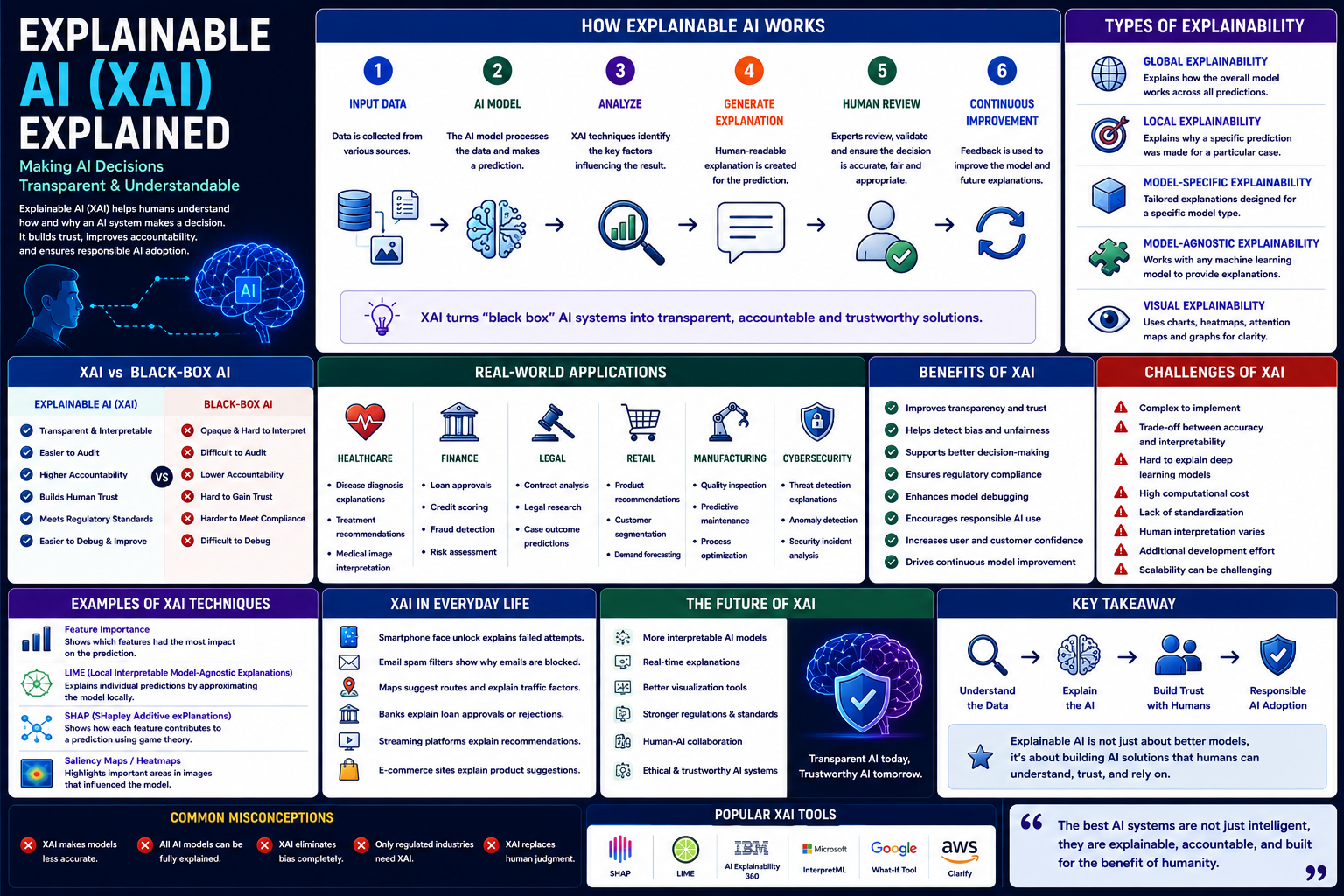
Explainable AI (XAI) Explained: How Artificial Intelligence Makes Decisions Transparent and Understandable
Introduction
Artificial Intelligence is making increasingly important decisions in healthcare, finance, transportation, education, manufacturing, and many other industries. While AI systems often achieve remarkable accuracy, they can also operate as black boxes, producing outputs without clearly explaining how those decisions were made.
This lack of transparency creates challenges for businesses, regulators, and users who need to trust AI systems.
Explainable AI (XAI) addresses this issue by making AI models more understandable. It provides insights into how AI reaches conclusions, identifies the factors influencing predictions, and helps humans validate whether those decisions are fair, reliable, and appropriate.
As AI becomes more deeply integrated into critical business processes, Explainable AI is becoming a cornerstone of responsible and trustworthy AI deployment.
What Is Explainable AI?
Explainable AI (XAI) is a set of techniques and methods that help humans understand how an AI system arrives at its predictions, recommendations, or decisions.
Instead of simply producing an answer, XAI provides meaningful explanations about the reasoning behind that answer.
Explainable AI helps users:
Understand model predictions
Identify influential features
Detect potential bias
Validate AI decisions
Improve trust
Support compliance
Debug AI models
Improve business confidence
Why Explainable AI Matters
Organizations increasingly rely on AI for high-impact decisions.
Explainable AI helps businesses:
Build trust in AI
Meet regulatory requirements
Detect unfair bias
Improve accountability
Support human oversight
Reduce operational risk
Improve customer confidence
Accelerate enterprise AI adoption
Without transparency, organizations may struggle to justify AI-driven decisions.
How Explainable AI Works
Most XAI systems follow a structured process.
1. Collect Data
AI receives structured or unstructured input data.
2. Generate Predictions
The trained model produces a prediction or recommendation.
3. Analyze Influencing Factors
XAI techniques identify which features had the greatest impact on the result.
4. Generate Explanations
The system provides human-readable explanations describing why the prediction was made.
5. Human Validation
Experts review explanations for accuracy, fairness, and compliance.
6. Continuous Improvement
Insights are used to improve models and decision-making processes.
Types of Explainability
Several approaches are commonly used.
Global Explainability
Explains how the overall AI model works.
Local Explainability
Explains why a specific prediction was made.
Model-Specific Explainability
Designed for particular machine learning models.
Model-Agnostic Explainability
Works across many different AI models.
Visual Explainability
Uses heatmaps, feature importance charts, or attention maps to explain AI decisions.
Explainable AI vs Black-Box AI
Explainable AI (XAI)
Black-Box AI
Transparent decisions
Limited visibility
Easier auditing
Difficult to audit
Supports compliance
Harder to justify decisions
Better human trust
Lower transparency
Easier debugging
More difficult troubleshooting
Many organizations balance high-performance AI with explainability requirements.
Real-World Applications
Explainable AI is used across many industries.
Healthcare
Medical diagnosis support
Treatment recommendations
Clinical decision assistance
Finance
Loan approvals
Fraud detection
Credit risk assessment
Legal
Compliance analysis
Contract review
Legal research
Manufacturing
Quality inspection
Predictive maintenance
Process optimization
Retail
Recommendation systems
Customer segmentation
Demand forecasting
Cybersecurity
Threat detection
Risk assessment
Security monitoring
Benefits of Explainable AI
Organizations gain many advantages.
Benefits include:
Improved trust
Better transparency
Easier regulatory compliance
Fairer AI decisions
Faster debugging
Improved governance
Better customer confidence
Enhanced model quality
Explainability helps organizations deploy AI responsibly.
Challenges and Limitations
Despite its benefits, Explainable AI introduces challenges.
These include:
Increased computational complexity
Trade-offs between accuracy and explainability
Difficulty explaining deep learning models
User interpretation challenges
Scalability issues
Additional development effort
Privacy concerns
Lack of standardized explanations
Choosing the appropriate level of explainability depends on the application and regulatory requirements.
Explainable AI in Everyday Life
Many familiar AI-powered services use explainability features.
Examples include:
Banking loan decisions
Medical diagnosis systems
Insurance claim assessments
Fraud alerts
Hiring recommendations
Personalized shopping
Credit scoring
AI-assisted customer support
Users increasingly expect AI systems to explain important decisions.
Future of Explainable AI
Future developments include:
More interpretable foundation models
Real-time explanation systems
AI governance platforms
Industry-specific XAI solutions
Visual explanation interfaces
Regulatory compliance automation
Human-AI collaboration
Standardized explainability frameworks
Explainable AI will become increasingly important as AI regulations and enterprise adoption continue to grow.
Common Misconceptions
Several myths surround Explainable AI.
Common misconceptions include:
Explainable AI makes models less accurate.
Every AI model can be fully explained.
Explainability eliminates bias.
Only regulated industries need XAI.
Explainable AI replaces human judgment.
In reality, Explainable AI improves transparency while working alongside human expertise and governance.
Final Thoughts
Explainable AI helps bridge the gap between powerful machine learning models and human understanding. By making AI decisions more transparent and interpretable, organizations can build greater trust, improve governance, meet regulatory requirements, and deploy AI responsibly.
As Artificial Intelligence becomes increasingly embedded in critical business processes, Explainable AI will play a central role in ensuring that intelligent systems remain accountable, ethical, and understandable.
Frequently Asked Questions
What is Explainable AI (XAI)?
Explainable AI is a set of methods that help humans understand how AI systems make predictions and decisions.
Why is Explainable AI important?
It improves transparency, trust, fairness, accountability, and regulatory compliance for AI-powered systems.
Which industries use Explainable AI?
Healthcare, finance, legal, manufacturing, retail, insurance, cybersecurity, education, and government all benefit from XAI.
Does Explainable AI reduce model accuracy?
Not necessarily. Some highly accurate models can also provide useful explanations, although there may be trade-offs depending on the approach.
Is Explainable AI required for every AI system?
Not always. Explainability is particularly important for high-risk or regulated applications where decisions significantly affect people.
Comments (0)