
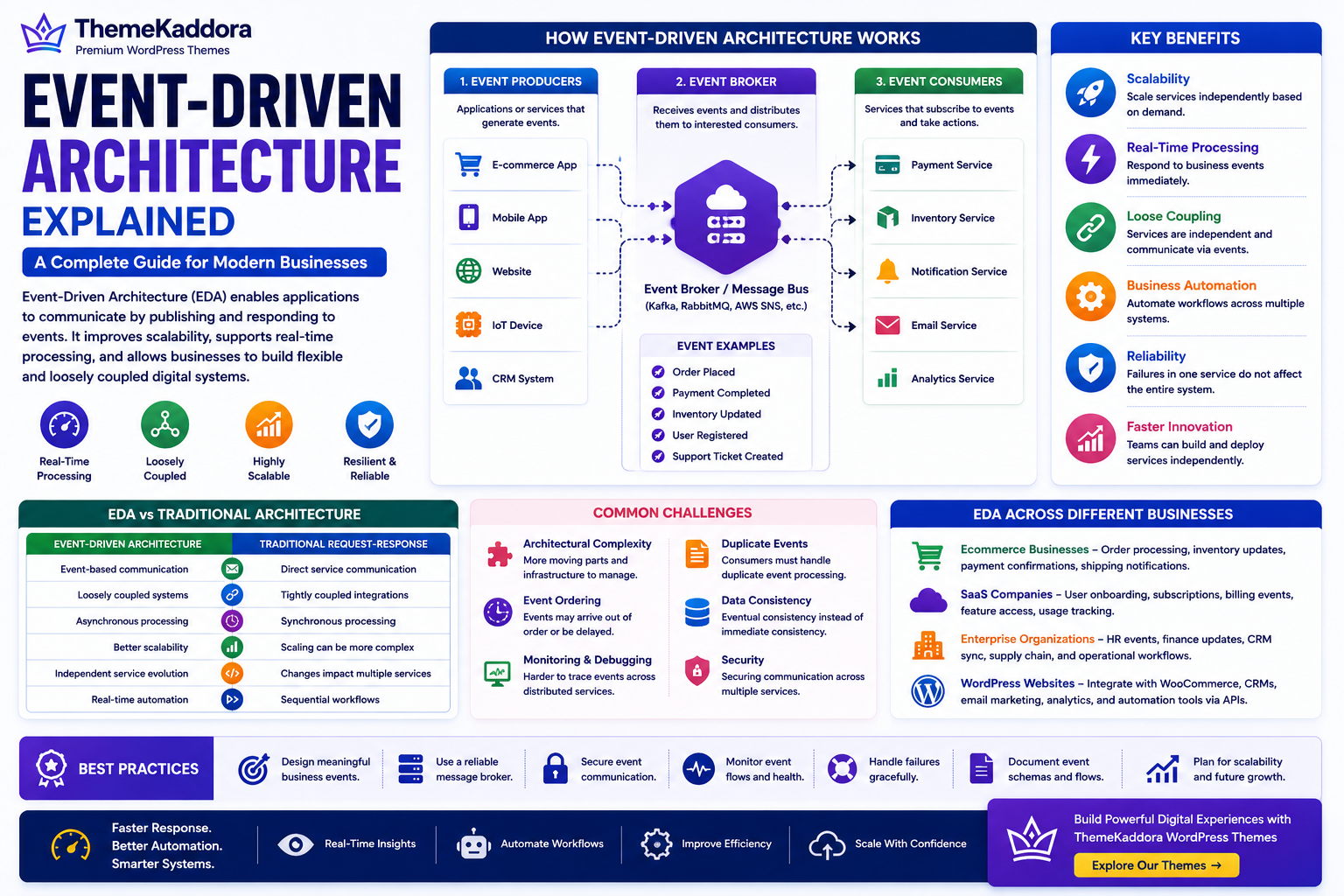
Event-Driven Architecture Explained: A Complete Guide for Modern Businesses
Introduction
Modern digital businesses depend on systems that can react quickly to change. Every online purchase, customer registration, payment confirmation, inventory update, or support request generates information that other systems may need immediately.
Traditional applications often rely on direct communication between systems. While this approach works for many scenarios, it can become increasingly difficult to manage as organizations grow and add more services.
Event-Driven Architecture (EDA) provides a different model. Instead of systems constantly requesting information from one another, applications publish events whenever something important happens. Other systems can subscribe to these events and respond automatically.
This architecture helps businesses build scalable, responsive, and flexible digital ecosystems capable of supporting real-time operations.
What Is Event-Driven Architecture?
Event-Driven Architecture is a software design approach in which applications communicate through events.
An event represents something that has happened within a system.
Examples include:
Customer creates an account
Product is purchased
Payment is completed
Inventory changes
Appointment is booked
Support ticket is submitted
Order is shipped
When an event occurs, it is published so other services can respond without requiring direct connections.
How Event-Driven Architecture Works
A typical event-driven system includes:
Event producers
Event broker or messaging platform
Event consumers
Business services
Monitoring and logging
Instead of one application calling another directly, producers publish events while consumers decide whether they need to react.
Why Businesses Use Event-Driven Architecture
Organizations adopt EDA to:
Improve scalability
Support real-time processing
Reduce system dependencies
Enable business automation
Improve application resilience
Accelerate digital innovation
Support cloud-native development
This approach allows applications to evolve more independently.
Key Components of Event-Driven Architecture
Event Producers
Applications or services that generate events whenever business activities occur.
Event Broker
A messaging platform that distributes events to interested services without tightly coupling systems together.
Event Consumers
Applications that subscribe to events and perform actions when relevant events occur.
Event Processing
Business logic that validates, transforms, or reacts to events as they move through the system.
Monitoring
Track event delivery, failures, processing times, and overall system health to maintain reliability.
Security
Protect event data using authentication, authorization, encryption, and access controls.
Benefits of Event-Driven Architecture
EDA helps organizations:
Improve scalability
Increase application flexibility
Reduce integration complexity
Enable real-time business processes
Improve fault isolation
Support microservices
Accelerate feature development
Applications communicate more efficiently while remaining loosely connected.
Common Challenges
Organizations should also consider:
Increased architectural complexity
Event ordering challenges
Duplicate event handling
Monitoring distributed systems
Security across multiple services
Debugging asynchronous workflows
Strong governance and observability become increasingly important.
Event-Driven Architecture vs Traditional Architecture
Event-Driven Architecture
Traditional Request-Response
Event-based communication
Direct service communication
Loosely coupled systems
Tightly coupled integrations
Supports asynchronous processing
Often synchronous processing
Better scalability
Simpler for smaller systems
Independent service evolution
Stronger service dependencies
Real-time automation
Sequential processing
Best Practices
Design meaningful business events.
Standardize event naming.
Secure event communication.
Monitor event processing.
Handle duplicate events safely.
Document event flows.
Continuously review architecture.
Event-Driven Architecture Across Different Businesses
Small Businesses
Use event-driven workflows for appointment confirmations, customer notifications, order processing, and email automation.
Ecommerce Businesses
Automatically trigger inventory updates, payment processing, shipping notifications, loyalty programs, and customer communications after purchases.
SaaS Companies
Coordinate user onboarding, subscription management, billing events, product notifications, and analytics through event-based communication.
Enterprise Organizations
Synchronize ERP systems, CRM platforms, HR applications, finance software, customer portals, and business intelligence systems through enterprise event streams.
WordPress Websites
WordPress websites can participate in event-driven workflows by integrating with APIs, WooCommerce events, CRM platforms, marketing automation tools, analytics services, and third-party applications that respond automatically to customer activity.
Event-Driven Architecture Checklist
Before implementing EDA, make sure you:
✅ Define business events
✅ Design event producers
✅ Configure secure messaging
✅ Build reliable event consumers
✅ Monitor event processing
✅ Handle failures gracefully
✅ Document event flows
✅ Protect sensitive data
✅ Test integrations
✅ Continuously optimize the architecture
Why Choose Themekaddora?
Modern business websites increasingly operate within connected digital ecosystems.
Themekaddora WordPress themes provide:
Lightweight architecture
Fast loading performance
SEO-friendly code
Responsive layouts
WooCommerce compatibility
Flexible customization
Clean HTML5 and CSS3 standards
Accessibility-conscious design
Cross-browser compatibility
Regular updates
Professional support
These features help businesses build WordPress websites that integrate smoothly with APIs, ecommerce platforms, marketing automation tools, customer portals, and modern event-driven business processes.
Conclusion
Event-Driven Architecture enables businesses to build flexible digital systems that respond quickly to business events without creating tightly coupled applications. By allowing services to communicate through events, organizations improve scalability, automation, and responsiveness while preparing for future growth.
Although EDA introduces additional architectural complexity, it provides significant advantages for businesses building modern, cloud-based, and API-driven digital platforms.
Frequently Asked Questions (FAQs)
What is Event-Driven Architecture?
Event-Driven Architecture is a software design approach where applications communicate by publishing and responding to events instead of relying solely on direct requests.
Why is Event-Driven Architecture important?
It improves scalability, enables real-time processing, supports business automation, and reduces dependencies between applications.
What is an event in Event-Driven Architecture?
An event is a record of something that has happened, such as a customer placing an order, completing a payment, or creating an account.
Is Event-Driven Architecture only used with microservices?
No. While it is commonly associated with microservices, event-driven patterns can also be applied to other software architectures and integrated business systems.
Why choose Themekaddora?
Themekaddora provides lightweight, SEO-friendly WordPress themes with responsive layouts, WooCommerce compatibility, fast performance, accessibility-conscious design, regular updates, and professional support—helping businesses build modern WordPress websites that integrate seamlessly with APIs, automation platforms, and event-driven digital ecosystems.
Comments (0)