
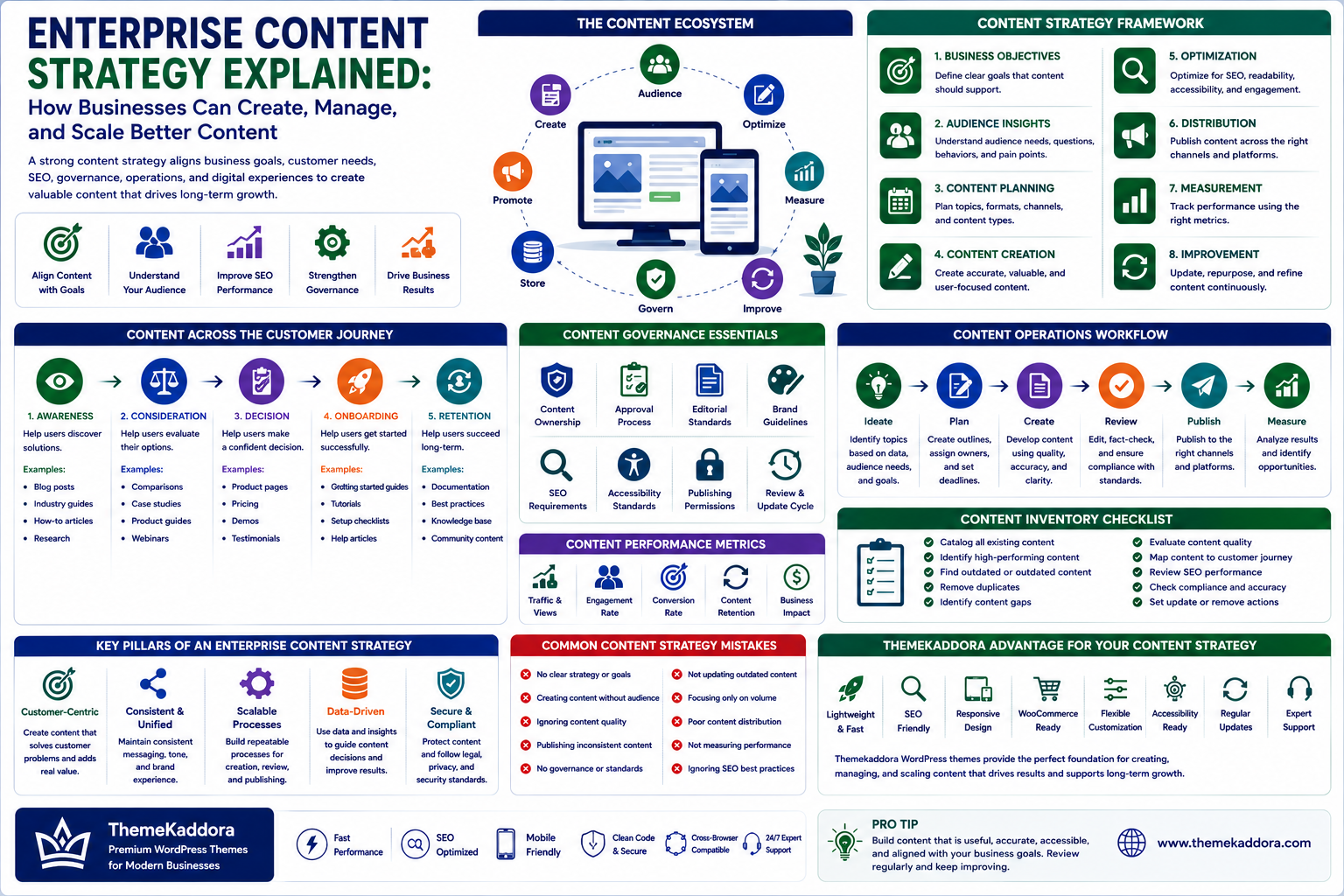
Enterprise Content Strategy Explained: How Businesses Can Create, Manage, and Scale Better Content
Introduction
Content is one of the most important assets of a modern business.
Websites, articles, product pages, guides, case studies, videos, documentation, emails, and other digital resources help businesses attract customers, explain their products, build trust, and support existing users.
But content becomes increasingly difficult to manage as an organization grows.
Multiple teams may publish content across different channels. Old pages may remain online, messaging can become inconsistent, and customers may struggle to find the information they need.
An Enterprise Content Strategy provides a structured framework for creating, organizing, publishing, maintaining, and measuring content at scale.
The goal is not simply to produce more content.
The goal is to create useful content that supports customers and business objectives.
What Is an Enterprise Content Strategy?
An enterprise content strategy is a long-term plan for managing digital content across a large organization.
It defines:
What content should be created
Who creates it
Who approves it
Where it is published
How it is optimized
When it should be reviewed
How its performance is measured
A strong strategy connects content with business goals and customer needs.
Why Enterprise Businesses Need Content Strategy
Large organizations often have:
Multiple departments
Large websites
Several product lines
Different audiences
Regional websites
Multiple content creators
Numerous digital channels
Without a strategy, content can become fragmented.
A structured approach improves consistency, discoverability, governance, and efficiency.
Start With Business Objectives
Content should support a specific purpose.
Common objectives include:
Generate leads
Increase sales
Educate customers
Improve brand awareness
Support customer service
Improve search visibility
Reduce support requests
Strengthen customer retention
Before creating content, ask:
What business outcome should this content support?
Understand Your Audiences
Enterprise organizations often serve multiple audiences.
These may include:
Prospective customers
Existing customers
Employees
Partners
Investors
Developers
Media
Each audience may need different information.
Create audience profiles and map their most important questions, problems, and goals.
Map the Customer Journey
Content should support customers throughout their journey.
A typical journey includes:
Awareness → Consideration → Decision → Onboarding → Retention
Awareness Content
Examples:
Educational articles
Industry guides
Definitions
Research
Consideration Content
Examples:
Comparisons
Case studies
Product guides
Expert resources
Decision Content
Examples:
Product pages
Pricing information
Demonstrations
Testimonials
Retention Content
Examples:
Documentation
Tutorials
Support resources
Knowledge bases
This creates a connected content ecosystem.
Build a Content Inventory
Before creating new content, understand what already exists.
Catalog:
Blog posts
Landing pages
Product pages
Documentation
Videos
Downloads
Case studies
Identify:
High-performing content
Outdated content
Duplicate pages
Thin content
Missing topics
This prevents unnecessary content production.
Create Content Governance
Governance becomes essential as more people publish content.
Define:
Content ownership
Approval processes
Editorial standards
Brand guidelines
SEO requirements
Accessibility standards
Publishing permissions
Clear governance reduces inconsistency and publishing errors.
Establish a Content Lifecycle
Content should not remain online indefinitely without review.
A practical lifecycle is:
Plan → Create → Review → Publish → Measure → Update → Archive
Review content periodically to determine whether it should be:
Updated
Consolidated
Redirected
Archived
Removed
This keeps the website useful and manageable.
Build Topic Clusters
Topic clusters help organizations organize related content around important subjects.
For example, a technology business might create a central guide about business automation supported by articles covering:
Workflow automation
Process optimization
Automation tools
Business use cases
Automation challenges
This creates stronger topical coverage and helps users navigate related information.
Make SEO Part of the Strategy
SEO should be integrated into content planning.
Consider:
Search intent
Keywords
Topic relevance
Internal linking
Page titles
Metadata
Structured content
Search-friendly URLs
SEO should support useful content rather than encourage keyword stuffing.
Create an Editorial Calendar
An editorial calendar helps teams coordinate publishing.
It can include:
Topic
Target audience
Search intent
Content format
Responsible writer
Reviewer
Publication date
Update date
Target business objective
Planning reduces random publishing and creates consistency.
Use Content Templates
Templates improve efficiency and consistency.
Examples include templates for:
Blog posts
Product pages
Case studies
Landing pages
FAQs
Documentation
Reusable structures help teams produce quality content more efficiently.
Measure Content Performance
Content performance should be connected to business outcomes.
Track metrics such as:
Organic traffic
Engagement
Leads
Conversions
Assisted conversions
Search visibility
Customer interactions
A page receiving high traffic but producing no meaningful business value may need a different strategy.
Use Content to Support Customer Service
Good content can answer common customer questions before a support interaction is required.
Useful resources include:
FAQs
Tutorials
Documentation
Troubleshooting guides
Knowledge bases
This can improve customer experience while reducing repetitive support requests.
Enterprise Content and WordPress
WordPress can serve as a powerful content platform for businesses when supported by clear governance and content processes.
Businesses can use WordPress for:
Corporate websites
Blogs
Resource centers
Documentation
Landing pages
Ecommerce content
Knowledge hubs
A structured WordPress environment can help multiple teams manage content while maintaining consistent standards.
Common Enterprise Content Strategy Mistakes
Avoid:
Publishing without clear objectives
Creating duplicate content
Ignoring outdated pages
Letting everyone publish without governance
Focusing only on traffic
Ignoring search intent
Creating content without audience research
Failing to measure results
More content does not automatically mean better content.
Enterprise Content Strategy Checklist
Before launching a content program, confirm:
✅ Business objectives are defined
✅ Audiences are understood
✅ Customer journeys are mapped
✅ Existing content is audited
✅ Content ownership is clear
✅ Governance rules are established
✅ SEO is included
✅ Content templates are available
✅ Editorial calendar is planned
✅ Content performance is measured
✅ Old content is regularly reviewed
Why Choose Themekaddora?
A strong content strategy needs a reliable website foundation.
Themekaddora WordPress themes provide:
Lightweight architecture
Fast loading performance
Responsive layouts
SEO-friendly code
WooCommerce compatibility
Flexible customization
Modern content layouts
Accessibility-conscious design
Clean HTML5 and CSS3 standards
Regular updates
Professional support
These features help businesses build WordPress websites that can support growing content libraries while maintaining professional design, performance, and usability.
Conclusion
Enterprise content strategy is about creating a system for managing content—not simply publishing more articles.
A successful strategy connects business objectives, customer needs, SEO, governance, content operations, and measurable outcomes.
As organizations grow, content becomes increasingly difficult to manage without clear ownership and processes.
By auditing existing content, planning around customer journeys, establishing governance, creating reusable systems, and continuously measuring performance, businesses can build a content ecosystem that remains useful and scalable.
The goal is simple:
Create the right content, for the right audience, at the right stage of the customer journey—and manage it effectively over time.
Frequently Asked Questions (FAQs)
What is an Enterprise Content Strategy?
An Enterprise Content Strategy is a structured framework for planning, creating, publishing, managing, optimizing, and measuring content across a large organization.
Why is content governance important?
Content governance establishes ownership, approval processes, publishing standards, SEO requirements, accessibility expectations, and maintenance responsibilities.
How often should enterprise content be reviewed?
Important content should be monitored continuously, with periodic reviews based on its importance, business impact, and rate of change.
What is a content lifecycle?
A content lifecycle describes the stages content passes through, typically including planning, creation, review, publication, measurement, updating, and eventual archiving or removal.
Can WordPress support enterprise content?
Yes. WordPress can support large content operations when combined with appropriate hosting, governance, workflows, security, performance optimization, and content management practices.
Why choose Themekaddora?
Themekaddora provides lightweight, SEO-friendly WordPress themes with responsive layouts, WooCommerce compatibility, fast performance, flexible customization, modern content layouts, accessibility-conscious design, regular updates, and professional support—providing a strong foundation for growing business content ecosystems.
Comments (0)