
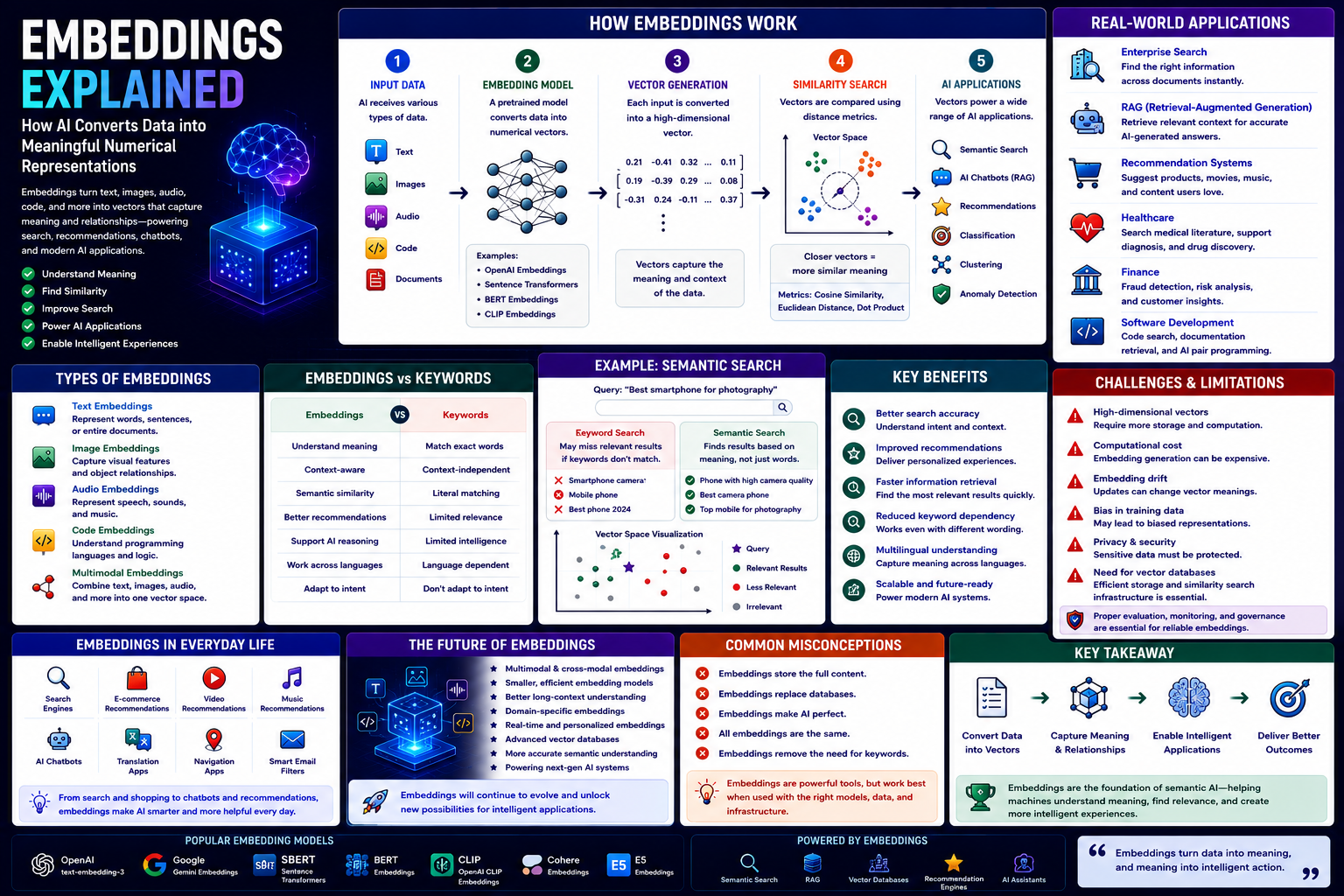
Embeddings Explained: How AI Converts Data into Meaningful Numerical Representations
Introduction
Modern Artificial Intelligence systems do much more than match keywords. They understand context, meaning, relationships, and intent. This capability is made possible through Embeddings, one of the most important technologies behind Large Language Models (LLMs), semantic search, recommendation engines, Retrieval-Augmented Generation (RAG), and vector databases.
Embeddings transform text, images, audio, code, or other types of information into numerical vectors that capture semantic meaning. Instead of treating words or images as isolated items, embeddings place similar concepts close together in a mathematical space, allowing AI systems to recognize relationships and retrieve relevant information efficiently.
From AI-powered search engines to recommendation systems and intelligent chatbots, embeddings are at the core of many modern AI applications.
What Are Embeddings?
Embeddings are numerical vector representations of data that capture semantic meaning and relationships.
Instead of storing only raw text or images, AI converts them into vectors containing hundreds or thousands of numerical values.
Items with similar meanings produce vectors that are close together in vector space.
For example:
"Car" and "Automobile" generate similar embeddings.
"Doctor" and "Hospital" are closely related.
"Apple" (fruit) and "Apple" (technology company) receive different embeddings based on context.
Embeddings help AI understand meaning rather than simply matching words.
Why Embeddings Matter
Traditional keyword search has limitations.
Embeddings help AI systems:
Understand context
Improve semantic search
Recommend relevant content
Reduce keyword dependency
Power Retrieval-Augmented Generation
Improve personalization
Detect similarity
Enable multilingual understanding
They provide a much richer representation of information than simple text matching.
How Embeddings Work
Most embedding systems follow a structured workflow.
1. Input Data
The AI receives:
Text
Images
Audio
Video
Source code
Documents
2. Embedding Model
A pretrained neural network converts the input into a numerical vector.
Examples include:
OpenAI embedding models
Sentence Transformers
BERT embeddings
CLIP embeddings
3. Vector Generation
Each piece of content becomes a high-dimensional vector representing its meaning.
4. Similarity Search
Vectors are compared using mathematical distance metrics such as:
Cosine similarity
Euclidean distance
Dot product
Closer vectors indicate greater semantic similarity.
5. AI Applications
Embedding vectors are used for:
Semantic search
Recommendations
Question answering
Document retrieval
Clustering
Classification
Types of Embeddings
Different AI systems use different embeddings.
Text Embeddings
Represent words, sentences, or documents.
Image Embeddings
Capture visual characteristics and object relationships.
Audio Embeddings
Represent speech, sounds, and music.
Code Embeddings
Understand software structure and programming logic.
Multimodal Embeddings
Combine multiple data types such as text and images into a shared vector space.
Embeddings vs Keywords
Embeddings
Keywords
Understand meaning
Match exact words
Context-aware
Context-independent
Semantic similarity
Literal matching
Better recommendations
Limited search quality
Supports AI reasoning
Limited intelligence
Embeddings provide a deeper understanding of information than keyword-based systems.
Real-World Applications
Embeddings power many AI solutions.
Semantic Search
Enterprise search
Website search
Document retrieval
Retrieval-Augmented Generation (RAG)
AI chatbots
Knowledge assistants
Customer support
Recommendation Systems
Movies
Products
Music
Articles
Healthcare
Medical literature search
Clinical documentation
Drug discovery
Finance
Fraud detection
Risk analysis
Customer insights
Software Development
Code search
Documentation retrieval
AI coding assistants
Benefits of Embeddings
Organizations gain numerous advantages.
Benefits include:
Better search accuracy
Improved recommendations
Faster retrieval
Context-aware AI
Better multilingual support
Enhanced personalization
Efficient information retrieval
Scalable AI systems
Embeddings significantly improve how AI understands and retrieves information.
Challenges and Limitations
Despite their strengths, embeddings present challenges.
These include:
High-dimensional vector storage
Computational costs
Embedding drift
Bias in training data
Privacy concerns
Vector database management
Model updates
Domain adaptation
Proper evaluation and governance remain essential.
Embeddings in Everyday Life
Many everyday AI applications rely on embeddings.
Examples include:
AI chatbots
Search engines
Voice assistants
Music recommendations
Video recommendations
Online shopping
Translation services
Enterprise knowledge search
Users interact with embedding-powered AI every day.
Future of Embeddings
Future developments include:
Multimodal embeddings
Better multilingual understanding
Smaller embedding models
Domain-specific embeddings
Real-time vector updates
Improved semantic reasoning
Personalized embeddings
Enterprise AI knowledge systems
Embeddings will remain one of the most important technologies behind modern AI.
Common Misconceptions
Several myths surround embeddings.
Common misconceptions include:
Embeddings store complete documents.
Embeddings replace databases.
Keywords are no longer useful.
Every AI model uses the same embeddings.
Embeddings understand meaning perfectly.
In reality, embeddings provide mathematical representations of meaning and work alongside other AI technologies.
Final Thoughts
Embeddings are one of the foundational technologies powering modern Artificial Intelligence. By converting text, images, audio, and other data into meaningful numerical representations, embeddings enable AI systems to understand context, retrieve relevant information, and deliver more intelligent user experiences.
As semantic search, Retrieval-Augmented Generation, recommendation systems, and enterprise AI continue to grow, embeddings will remain essential for building scalable, accurate, and context-aware AI applications.
Frequently Asked Questions
What are AI embeddings?
AI embeddings are numerical vector representations of data that capture semantic meaning and relationships.
Why are embeddings important?
They enable semantic search, recommendations, Retrieval-Augmented Generation, clustering, and many other AI applications.
Which industries use embeddings?
Healthcare, finance, retail, education, manufacturing, cybersecurity, software development, media, and telecommunications.
Are embeddings used in Large Language Models?
Yes. LLMs rely heavily on embeddings to represent text and understand relationships between concepts.
Do embeddings replace keyword search?
No. They enhance search by understanding meaning rather than relying only on exact keyword matches.
Comments (0)