
Edge Computing for Business Websites: A Complete Guide
Introduction
Website visitors expect fast, responsive digital experiences regardless of where they are located. Whether someone is browsing an online store, reading a knowledge base, or using a customer portal, delays of even a few seconds can affect user experience and business outcomes.
Traditionally, websites process requests in centralized data centers. As audiences become more global and applications become more interactive, this model can introduce additional network latency.
Edge Computing addresses this challenge by moving certain computing tasks closer to users instead of relying entirely on centralized infrastructure.
For business websites, edge computing can improve performance, support global audiences, strengthen reliability, and enable faster digital experiences without changing how visitors interact with the website.
What Is Edge Computing?
Edge computing is a distributed computing approach that processes data closer to where users or devices are located.
Instead of sending every request to a single central server, some processing occurs at edge locations positioned geographically closer to users.
This reduces the distance that data must travel, helping improve responsiveness.
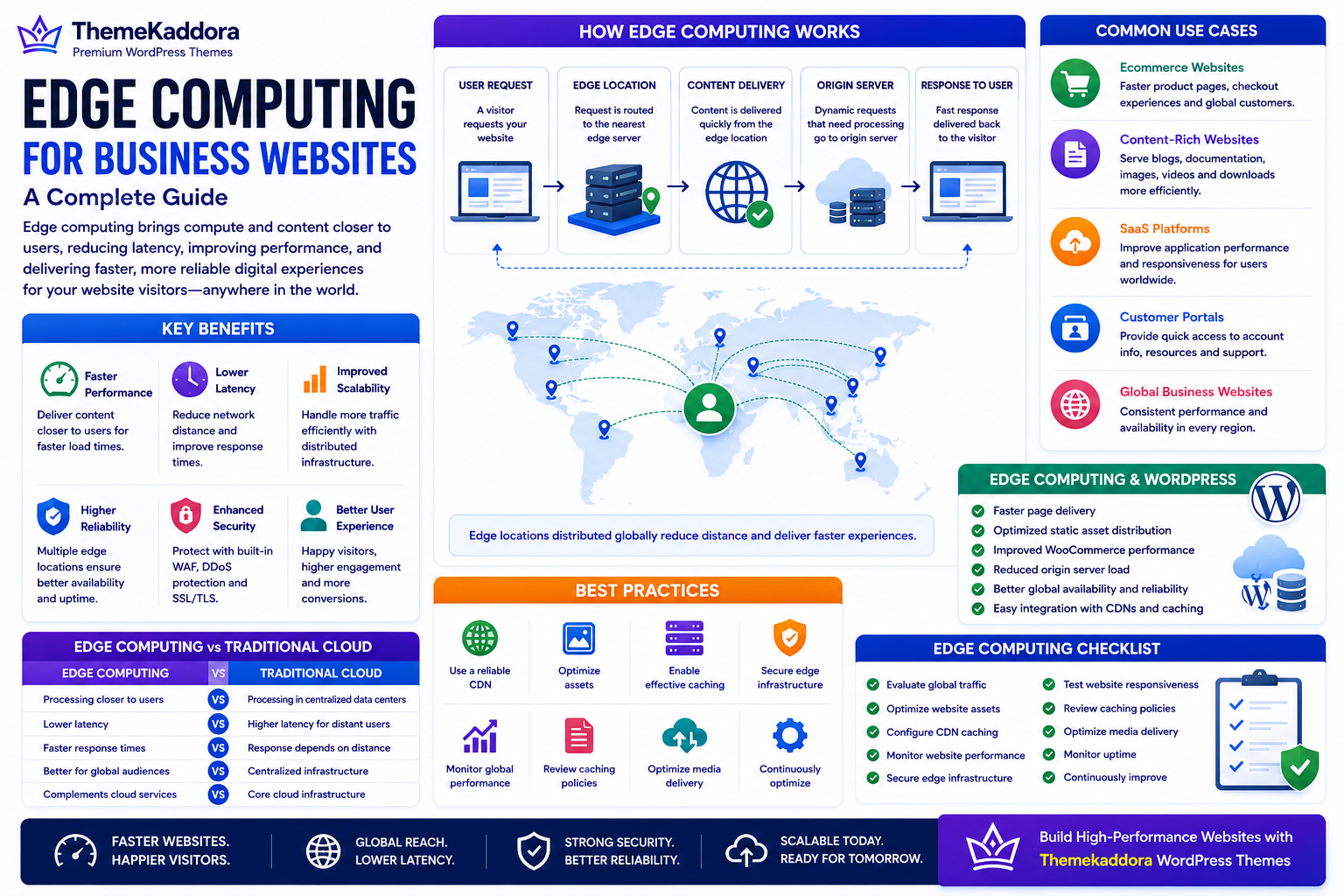
How Edge Computing Works
A typical edge computing environment includes:
User devices
Edge locations
Content Delivery Network (CDN)
Cloud infrastructure
Origin servers
Security services
Frequently requested resources can be delivered from nearby edge locations, while more complex processing continues to occur in centralized infrastructure.
Why Businesses Use Edge Computing
Organizations adopt edge computing to:
Reduce latency
Improve website performance
Support global users
Increase reliability
Improve availability
Strengthen security
Optimize digital experiences
The result is faster and more consistent access to digital services.
Edge Computing vs Traditional Cloud Computing
Edge Computing:
Processing occurs closer to users
Lower latency
Faster response times
Better support for global audiences
Complements cloud services
Traditional Cloud Computing:
Processing mainly occurs in centralized data centers
Higher latency for distant users
Response depends on network distance
Centralized infrastructure
Core cloud infrastructure
Edge computing does not replace cloud computing—it extends it.
Key Benefits of Edge Computing
Faster Website Performance
Serving content closer to visitors reduces loading delays and improves perceived speed.
Lower Latency
Shorter network paths help websites respond more quickly to user requests.
Improved Scalability
Distributed infrastructure helps businesses handle growing traffic more efficiently.
Better Reliability
Multiple edge locations improve resilience if individual infrastructure components experience issues.
Enhanced Security
Many edge platforms include security services such as DDoS protection, web application firewalls, and traffic filtering.
Improved User Experience
Faster interactions often contribute to better engagement and customer satisfaction.
Common Business Use Cases
Ecommerce Websites
Deliver product pages, images, and checkout experiences more efficiently to customers worldwide.
Content-Rich Websites
Serve blogs, documentation, media libraries, and knowledge bases from locations closer to visitors.
SaaS Platforms
Improve dashboard responsiveness and application performance for distributed users.
Customer Portals
Provide faster access to account information, downloads, and support resources.
Global Business Websites
Improve consistency for visitors accessing the website from different regions.
Edge Computing and WordPress
Many WordPress websites benefit from edge computing through:
Faster page delivery
Optimized image distribution
Static asset caching
Improved WooCommerce performance
Reduced server workload
Better global availability
Combined with caching and performance optimization, edge computing can significantly improve the user experience.
Common Challenges
Organizations should also consider:
Additional infrastructure planning
Distributed monitoring
Cache management
Regional compliance requirements
Integration complexity
Increased architectural planning
The benefits generally increase as websites grow in scale and geographic reach.
Best Practices
Use a reliable CDN.
Optimize static assets.
Enable effective caching.
Monitor global performance.
Secure edge infrastructure.
Review performance metrics regularly.
Continuously optimize website delivery.
Edge Computing Checklist
Before implementing edge computing, make sure you:
✅ Evaluate global traffic
✅ Optimize website assets
✅ Configure CDN caching
✅ Monitor website performance
✅ Secure edge infrastructure
✅ Test website responsiveness
✅ Review caching policies
✅ Optimize media delivery
✅ Monitor uptime
✅ Continuously improve performance
Why Choose Themekaddora?
Performance is one of the foundations of an excellent business website.
Themekaddora WordPress themes provide:
Lightweight architecture
Fast loading performance
SEO-friendly code
Responsive layouts
WooCommerce compatibility
Flexible customization
Accessibility-conscious design
Clean HTML5 and CSS3 standards
Cross-browser compatibility
Regular updates
Professional support
Combined with modern hosting, caching, and edge computing technologies, Themekaddora themes help businesses build WordPress websites that deliver fast, reliable, and scalable digital experiences.
Conclusion
Edge computing helps businesses deliver faster and more responsive digital experiences by processing and serving content closer to users. Rather than replacing cloud infrastructure, it complements traditional hosting by reducing latency, improving scalability, and enhancing reliability.
For organizations serving regional, national, or global audiences, edge computing can play an important role in improving website performance and supporting long-term digital growth.
Frequently Asked Questions (FAQs)
What is edge computing?
Edge computing is a distributed computing model that processes data closer to users instead of relying entirely on centralized data centers.
How does edge computing improve website performance?
By reducing the distance data travels, edge computing lowers latency, speeds up content delivery, and improves the user experience.
Is edge computing the same as a CDN?
No. A CDN focuses primarily on delivering cached content, while edge computing can also perform processing and application logic closer to users. Many modern edge platforms combine both capabilities.
Can WordPress websites benefit from edge computing?
Yes. WordPress websites can improve speed, reliability, global performance, caching efficiency, and WooCommerce experiences through edge-enabled infrastructure.
Why choose Themekaddora?
Themekaddora provides lightweight, SEO-friendly WordPress themes with responsive layouts, WooCommerce compatibility, fast performance, accessibility-conscious design, regular updates, and professional support—helping businesses build WordPress websites that fully leverage modern hosting, caching, and edge computing technologies.
Comments (0)