
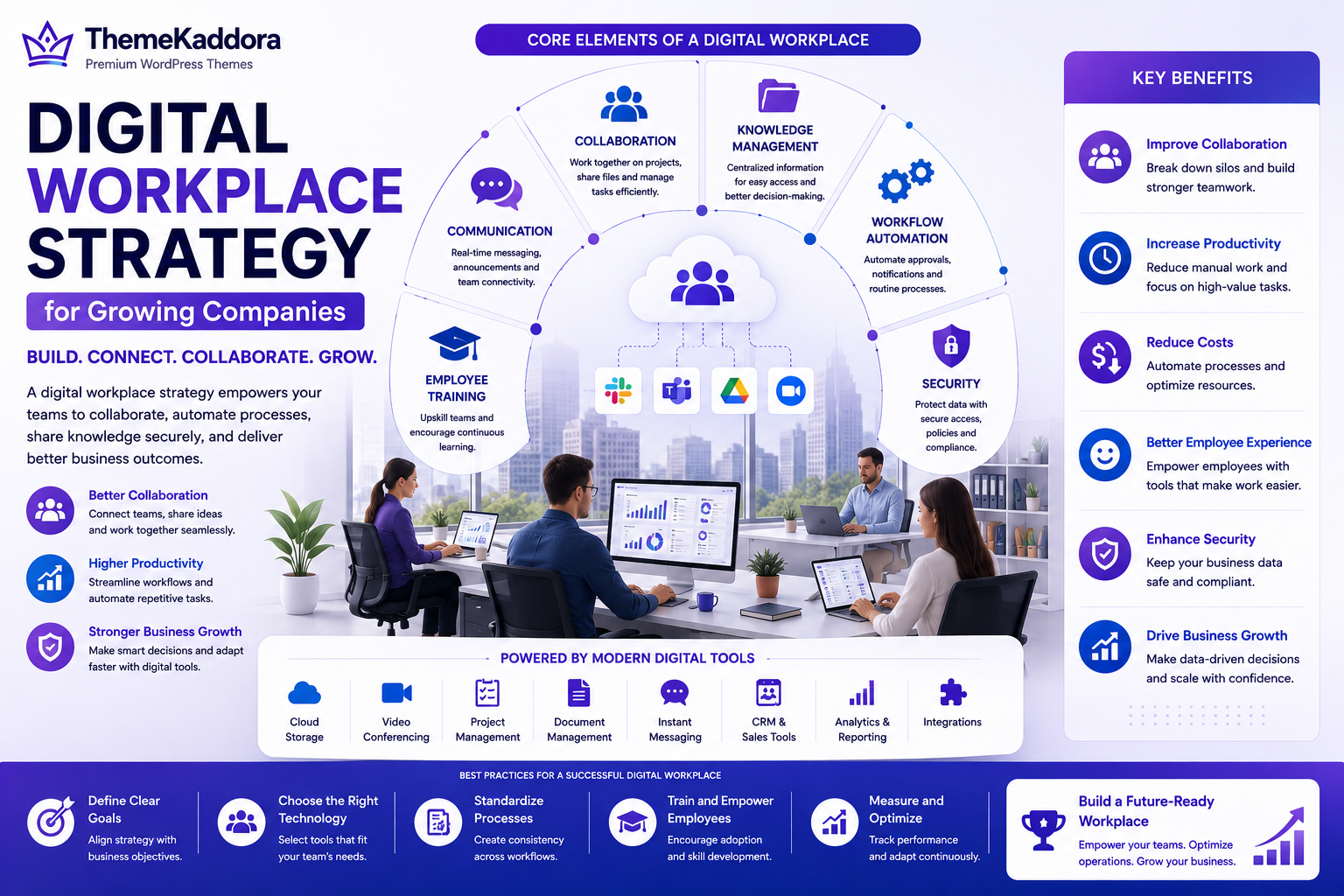
Digital Workplace Strategy for Growing Companies: A Complete Guide
Introduction
The modern workplace has changed dramatically. Employees now collaborate across different locations, use cloud-based applications, attend virtual meetings, and access business systems from multiple devices.
As organizations grow, managing communication, projects, documents, and workflows becomes increasingly complex. Without a clear strategy, teams may experience duplicated work, communication gaps, inconsistent processes, and reduced productivity.
A Digital Workplace Strategy helps businesses create a connected work environment where employees can collaborate effectively, access the right information, and complete work efficiently.
Whether your business operates from a single office, follows a hybrid model, or supports remote teams worldwide, a well-planned digital workplace improves employee experiences while supporting long-term business growth.
What Is a Digital Workplace Strategy?
A Digital Workplace Strategy is a plan for using digital technologies, processes, and collaboration tools to improve how employees work together.
A successful strategy typically includes:
Communication platforms
Document management
Collaboration tools
Project management
Workflow automation
Knowledge sharing
Security policies
Employee training
The objective is to create a productive, connected, and secure work environment.
Why a Digital Workplace Strategy Matters
Organizations adopt digital workplace strategies to:
Improve collaboration
Increase employee productivity
Support remote and hybrid work
Reduce operational inefficiencies
Improve knowledge sharing
Strengthen business agility
Enhance employee satisfaction
An effective workplace strategy helps teams spend less time searching for information and more time creating value.
Core Elements of a Digital Workplace
Communication
Provide reliable channels for team discussions, announcements, and real-time collaboration while reducing unnecessary communication barriers.
Collaboration
Enable employees to work together through shared documents, project workspaces, task management, and collaborative planning.
Knowledge Management
Create centralized documentation, policies, training materials, and internal resources that employees can access easily.
Workflow Automation
Automate repetitive administrative tasks such as approvals, notifications, onboarding, reporting, and routine requests.
Security
Protect business information with secure authentication, role-based permissions, data protection policies, and regular security reviews.
Employee Training
Help employees adopt new technologies through continuous learning and digital skills development.
Common Challenges
Growing companies often encounter:
Disconnected communication tools
Information silos
Manual workflows
Inconsistent documentation
Employee resistance to change
Security concerns
A structured strategy helps organizations address these challenges while improving operational efficiency.
Best Practices
Define clear workplace objectives.
Standardize communication processes.
Centralize business knowledge.
Automate repetitive tasks.
Encourage collaboration across departments.
Invest in employee training.
Review and improve workplace processes regularly.
Digital Workplace Strategy Across Different Businesses
Small Businesses
Use affordable cloud-based collaboration, document sharing, scheduling, and communication tools to improve productivity.
Ecommerce Businesses
Coordinate customer service, inventory management, marketing, and fulfillment teams through integrated digital workflows.
Marketing Agencies
Improve campaign planning, client communication, creative collaboration, approvals, and reporting using shared workspaces.
Enterprise Organizations
Implement enterprise collaboration platforms, digital governance, secure document management, and standardized workflows across departments.
WordPress Businesses
Businesses using WordPress can support digital workplace initiatives by integrating collaboration tools, project management platforms, customer portals, documentation systems, WooCommerce workflows, and automated content publishing.
Digital Workplace Strategy Checklist
Before implementing a digital workplace strategy, make sure you:
✅ Define workplace objectives
✅ Improve communication
✅ Centralize documentation
✅ Standardize workflows
✅ Automate repetitive tasks
✅ Protect business information
✅ Train employees
✅ Measure productivity
✅ Collect employee feedback
✅ Continuously improve workplace processes
Why Choose Themekaddora?
A successful digital workplace depends on a reliable digital foundation.
Themekaddora WordPress themes provide:
Lightweight architecture
Fast loading performance
SEO-friendly code
Responsive layouts
WooCommerce compatibility
Flexible customization
Accessibility-conscious design
Clean HTML5 and CSS3 standards
Cross-browser compatibility
Regular updates
Professional support
These features help businesses build secure, scalable, and high-performing WordPress websites that support collaboration, knowledge sharing, customer engagement, and long-term digital growth.
Conclusion
A Digital Workplace Strategy helps growing companies create connected, productive, and flexible work environments. By improving communication, collaboration, workflow automation, and knowledge management, businesses can enhance employee experiences while supporting operational efficiency.
Whether your teams work in the office, remotely, or in a hybrid environment, investing in a digital workplace strategy prepares your organization for future growth and continuous innovation.
Frequently Asked Questions (FAQs)
What is a Digital Workplace Strategy?
A Digital Workplace Strategy is a plan for improving how employees communicate, collaborate, manage information, and complete work using digital technologies.
Why is a Digital Workplace Strategy important?
It increases productivity, supports remote and hybrid work, improves collaboration, strengthens knowledge sharing, and enhances employee experience.
What technologies are commonly used in a digital workplace?
Organizations commonly use communication platforms, project management software, document management systems, workflow automation tools, cloud storage, and collaboration applications.
Can small businesses benefit from a Digital Workplace Strategy?
Yes. Small businesses can improve efficiency by adopting affordable digital tools for communication, collaboration, scheduling, document sharing, and workflow management.
Why choose Themekaddora?
Themekaddora provides lightweight, SEO-friendly WordPress themes with responsive layouts, WooCommerce compatibility, fast performance, accessibility-conscious design, regular updates, and professional support—helping businesses create modern websites that support productive digital workplaces and sustainable business growth.
Comments (0)