
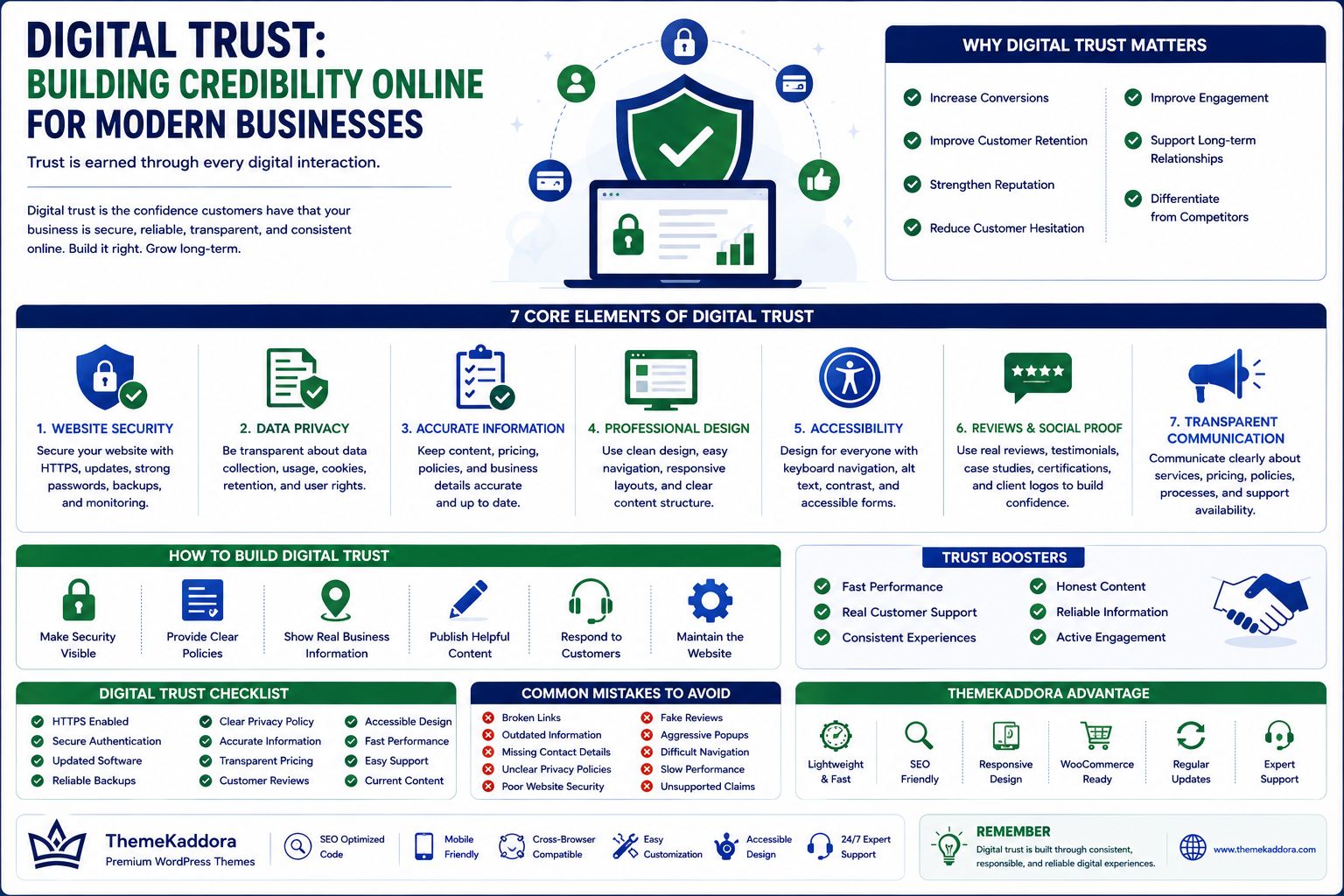
Digital Trust: Building Credibility Online for Modern Businesses
Introduction
Customers make decisions based on what they see and experience online.
Before contacting a business, purchasing a product, sharing personal information, or signing up for a service, visitors often ask themselves a simple question:
Can I trust this business?
A professional logo and attractive website are no longer enough to establish credibility.
Digital trust is built through many connected factors, including security, privacy, transparency, accessibility, reliable information, consistent experiences, and responsive customer support.
For modern businesses, a trustworthy digital presence can influence whether visitors become customers—or leave for a competitor.
This guide explains what digital trust means, why it matters, and how businesses can build stronger credibility online.
What Is Digital Trust?
Digital trust is the confidence customers have that a business will provide a secure, reliable, transparent, and consistent digital experience.
It can influence whether users feel comfortable:
Visiting a website
Creating an account
Sharing information
Making a payment
Downloading resources
Contacting support
Purchasing products or services
Digital trust is created through repeated positive interactions.
Why Digital Trust Matters
Strong digital trust can help businesses:
Increase conversions
Improve customer retention
Strengthen reputation
Reduce customer hesitation
Improve engagement
Support long-term relationships
Differentiate from competitors
A trustworthy digital experience reduces uncertainty.
The Core Elements of Digital Trust
1. Website Security
Security is one of the foundations of digital trust.
Businesses should prioritize:
HTTPS
Secure authentication
Regular software updates
Strong passwords
Access controls
Reliable backups
Security monitoring
Security should be treated as an ongoing process.
2. Data Privacy
Customers want to understand how their information is collected and used.
Businesses should provide clear information about:
Data collection
Cookies
Personalization
Marketing communications
Data retention
User rights
Transparency helps customers make informed decisions.
3. Accurate Information
Outdated information can damage credibility.
Regularly review:
Contact details
Pricing
Product information
Service descriptions
Company information
Policies
Documentation
Accuracy demonstrates professionalism.
4. Professional Website Design
A professional website creates an important first impression.
Focus on:
Consistent branding
Clear navigation
Readable typography
Responsive design
High-quality content
Logical page structure
Design should support credibility rather than distract from it.
5. Accessibility
An accessible website demonstrates that the business values inclusive experiences.
Consider:
Keyboard navigation
Alternative text
Color contrast
Accessible forms
Clear headings
Captions where appropriate
Accessibility can strengthen both usability and trust.
6. Customer Reviews and Testimonials
Social proof can reduce uncertainty.
Useful trust signals include:
Customer reviews
Testimonials
Case studies
Client logos
Industry certifications
Awards
Authenticity is essential.
7. Transparent Communication
Customers should be able to easily understand:
What you offer
What something costs
How services work
How to contact you
What happens after purchase
Clear communication reduces confusion.
Digital Trust and Website Performance
Website performance can also influence credibility.
Slow websites may create the impression that a business is:
Outdated
Unreliable
Difficult to work with
Poorly maintained
A fast, responsive website communicates attention to quality.
Digital Trust and Content
Content is another major trust signal.
High-quality content should be:
Accurate
Useful
Original
Easy to understand
Regularly maintained
Avoid exaggerated claims that cannot be supported.
Trust grows when businesses communicate honestly.
Common Digital Trust Mistakes
Avoid:
Broken links
Outdated information
Missing contact details
Unclear privacy policies
Poor website security
Fake reviews
Aggressive popups
Difficult navigation
Slow performance
Unsupported claims
Small credibility issues can influence customer decisions.
How to Build Digital Trust
Make Security Visible
Use HTTPS and communicate security practices where appropriate.
Provide Clear Policies
Make privacy, terms, returns, shipping, and other important policies easy to find.
Show Real Business Information
Provide accurate contact information and relevant business details.
Publish Helpful Content
Demonstrate expertise through useful guides, resources, and educational content.
Respond to Customers
Accessible customer support shows that a real organization stands behind its products or services.
Maintain the Website
Regularly review content, links, plugins, themes, forms, and security.
Digital Trust Across Different Businesses
Small Businesses
Build trust through accurate contact information, customer reviews, professional websites, transparent pricing, and responsive communication.
Ecommerce Businesses
Focus on secure checkout, clear product information, transparent shipping and returns, customer reviews, and reliable order communication.
SaaS Companies
Build trust through secure authentication, transparent pricing, reliable documentation, privacy practices, uptime communication, and responsive support.
Enterprise Organizations
Maintain consistent security, governance, privacy, accessibility, content standards, and customer experiences across digital properties.
WordPress Websites
WordPress businesses can strengthen trust by using reputable themes and plugins, maintaining updates, implementing security practices, optimizing performance, providing accurate content, and creating accessible user experiences.
Digital Trust Checklist
Review your website regularly:
✅ HTTPS enabled
✅ Secure authentication
✅ Updated software
✅ Reliable backups
✅ Clear privacy information
✅ Accurate contact details
✅ Transparent pricing
✅ Current content
✅ Customer reviews or proof
✅ Accessible design
✅ Fast performance
✅ Easy customer support
Why Choose Themekaddora?
Digital trust starts with a professional and reliable website foundation.
Themekaddora WordPress themes provide:
Lightweight architecture
Fast loading performance
SEO-friendly code
Responsive layouts
WooCommerce compatibility
Flexible customization
Accessibility-conscious design
Clean HTML5 and CSS3 standards
Cross-browser compatibility
Regular updates
Professional support
These features help businesses create professional WordPress websites that support credibility, usability, performance, and long-term customer trust.
Conclusion
Digital trust is built through every interaction a customer has with your business.
Security, privacy, accurate content, accessibility, performance, transparency, and customer service all contribute to whether visitors feel confident engaging with your brand.
A trustworthy website is not created through one badge or design element.
It is created through consistent, reliable, and responsible digital experiences.
Businesses that prioritize digital trust can build stronger customer relationships and create a digital presence that supports sustainable growth.
Frequently Asked Questions (FAQs)
What is digital trust?
Digital trust is the confidence customers have that a business will provide secure, reliable, transparent, and consistent digital experiences.
Why is digital trust important for businesses?
Digital trust reduces customer hesitation, improves credibility, supports conversions, strengthens relationships, and helps businesses build long-term reputations.
How can a website build trust?
Businesses can build trust through website security, accurate information, transparent policies, professional design, accessibility, customer reviews, reliable support, and fast performance.
Does website security affect digital trust?
Yes. Secure connections, reliable authentication, software updates, access controls, and responsible data practices help customers feel more confident interacting with a website.
Why choose Themekaddora?
Themekaddora provides lightweight, SEO-friendly WordPress themes with responsive layouts, WooCommerce compatibility, fast performance, accessibility-conscious design, flexible customization, regular updates, and professional support—helping businesses build credible and trustworthy digital experiences.
Comments (0)