
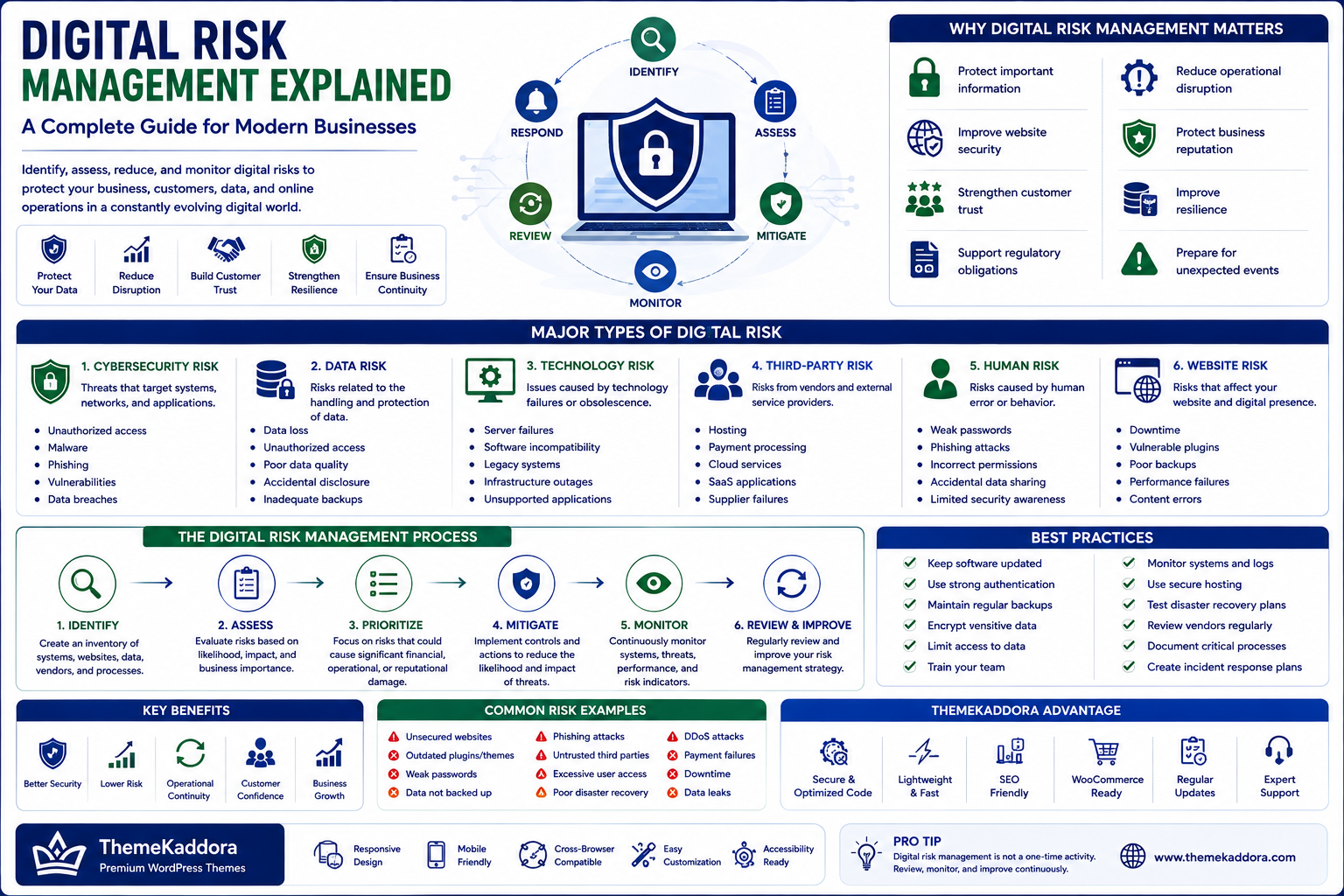
Digital Risk Management Explained: A Complete Guide for Modern Businesses
Introduction
Businesses increasingly depend on digital systems to operate, communicate with customers, process transactions, store information, and deliver services.
This dependence creates opportunities—but it also creates risk.
A website can go offline. Customer information can be exposed. A third-party service can fail. An outdated plugin can introduce vulnerabilities. An employee can accidentally share sensitive information. A technology provider can experience an unexpected outage.
Digital risk management helps businesses identify, evaluate, reduce, and monitor these risks before they become costly problems.
It is not limited to cybersecurity. Effective digital risk management covers technology, data, people, suppliers, websites, applications, processes, and business continuity.
What Is Digital Risk Management?
Digital risk management is the structured process of identifying and managing risks associated with digital technologies, systems, data, and online operations.
It helps organizations answer four important questions:
What could go wrong?
How likely is it to happen?
What would the impact be?
What can we do to reduce the risk?
The goal is not to eliminate every possible risk.
The goal is to understand risk and manage it intelligently.
Why Digital Risk Management Matters
A strong digital risk strategy can help businesses:
Protect important information
Reduce operational disruption
Improve website security
Strengthen customer trust
Protect business reputation
Improve resilience
Support regulatory obligations
Prepare for unexpected events
As digital dependency increases, risk management becomes a core business responsibility.
Major Types of Digital Risk
Cybersecurity Risk
Cybersecurity threats can affect websites, applications, networks, and business systems.
Potential risks include:
Unauthorized access
Malware
Phishing
Credential theft
Vulnerabilities
Data breaches
Security controls should be reviewed continuously.
Data Risk
Businesses collect and store significant amounts of information.
Data risks may involve:
Loss
Unauthorized access
Poor data quality
Accidental disclosure
Improper retention
Inadequate backups
Good data governance reduces these risks.
Technology Risk
Technology can fail or become outdated.
Examples include:
Server failures
Software incompatibility
Legacy systems
Infrastructure outages
Unsupported applications
Technology should be reviewed throughout its lifecycle.
Third-Party Risk
Modern businesses depend on external providers for:
Hosting
Payment processing
Analytics
Cloud infrastructure
Marketing
SaaS applications
A failure at a critical supplier can affect your own business.
Human Risk
Employees and contractors can unintentionally create security or operational problems.
Common causes include:
Weak passwords
Accidental data sharing
Phishing attacks
Incorrect permissions
Poor security awareness
Training and clear processes can reduce human-related risks.
Website Risk
Business websites can face:
Downtime
Broken functionality
Vulnerable plugins
Poor backups
Performance failures
Content errors
Regular website maintenance helps reduce exposure.
The Digital Risk Management Process
1. Identify Risks
Create an inventory of important systems, websites, applications, data, vendors, and processes.
2. Assess Risks
Evaluate each risk based on:
Likelihood
Potential impact
Business importance
Not every risk deserves the same level of attention.
3. Prioritize
Focus first on risks that could cause significant financial, operational, legal, or reputational damage.
4. Mitigate
Possible controls include:
Strong authentication
Backups
Security updates
Access controls
Monitoring
Employee training
Vendor assessments
Disaster recovery planning
5. Monitor
Digital risk changes over time.
Regularly review:
New vulnerabilities
Technology changes
Vendor relationships
Security incidents
Business processes
Risk management should be continuous.
Digital Risk Management Best Practices
Maintain Software
Keep operating systems, applications, themes, plugins, and dependencies updated.
Use Strong Authentication
Protect important accounts with strong authentication methods and appropriate access controls.
Create Reliable Backups
Backups should be maintained and tested so they can actually be restored when needed.
Limit Access
Give employees access only to the systems and information they need.
Monitor Critical Systems
Monitor important websites, applications, infrastructure, and security events.
Train Employees
Teach employees how to recognize phishing, protect credentials, handle data, and report incidents.
Assess Vendors
Review important third-party providers and understand their role in your risk environment.
Digital Risk Management for WordPress Websites
WordPress websites require regular attention because they often rely on multiple components.
Businesses should review:
WordPress core updates
Theme updates
Plugin updates
User permissions
Security configurations
Backups
Hosting
SSL/TLS configuration
Forms
Third-party integrations
Avoid installing unnecessary plugins and remove components that are no longer required.
Business Continuity and Disaster Recovery
Digital risk management should also prepare businesses for disruption.
A business continuity plan should consider:
Website outages
Infrastructure failures
Data loss
Cybersecurity incidents
Supplier failures
Communication problems
Document who is responsible for responding and what actions should happen first.
A backup is useful only if the organization knows how to restore it.
Common Digital Risk Mistakes
Avoid:
Treating security as a one-time project
Ignoring third-party risks
Keeping outdated software
Giving excessive user permissions
Failing to test backups
Ignoring employees
Having no incident response plan
Focusing only on cybersecurity
Digital risk is broader than security alone.
Digital Risk Checklist
Review your organization regularly:
✅ Identify critical digital systems
✅ Maintain software updates
✅ Protect important accounts
✅ Limit user permissions
✅ Maintain tested backups
✅ Monitor important systems
✅ Assess third-party providers
✅ Train employees
✅ Document incident procedures
✅ Review business continuity plans
Why Choose Themekaddora?
A reliable website foundation can reduce unnecessary technical risk.
Themekaddora WordPress themes provide:
Lightweight architecture
Responsive layouts
SEO-friendly code
Fast loading performance
WooCommerce compatibility
Flexible customization
Clean HTML5 and CSS3 standards
Cross-browser compatibility
Regular updates
Professional support
Using a well-maintained theme alongside proper WordPress security, hosting, backups, and update practices can help businesses maintain a more reliable digital presence.
Conclusion
Digital risk management is no longer an optional technology exercise. Businesses depend on digital systems for everyday operations, making resilience and risk awareness essential.
By identifying important risks, prioritizing potential impacts, implementing appropriate controls, and reviewing systems regularly, organizations can reduce disruption and build stronger digital operations.
The goal is not to eliminate every risk.
The goal is to understand, prepare for, and manage digital risk before it becomes a serious business problem.
Frequently Asked Questions (FAQs)
What is digital risk management?
Digital risk management is the process of identifying, assessing, prioritizing, mitigating, and monitoring risks associated with digital systems, technology, data, and online operations.
What are the main types of digital risk?
Major categories include cybersecurity risk, data risk, technology risk, third-party risk, human risk, and website or operational risk.
Why is digital risk management important?
It helps businesses protect information, reduce disruption, maintain customer trust, strengthen resilience, and prepare for unexpected digital incidents.
How can businesses reduce digital risk?
Businesses can reduce risk through software updates, strong authentication, access controls, tested backups, employee training, vendor assessments, monitoring, and business continuity planning.
How can WordPress businesses manage digital risk?
WordPress businesses should regularly update WordPress, themes, and plugins; limit user permissions; maintain reliable backups; use secure hosting; monitor websites; and remove unnecessary components.
Why choose Themekaddora?
Themekaddora provides lightweight, SEO-friendly WordPress themes with responsive layouts, WooCommerce compatibility, fast performance, flexible customization, regular updates, and professional support—helping businesses establish a reliable website foundation as part of a broader digital risk management strategy.
Comments (0)