
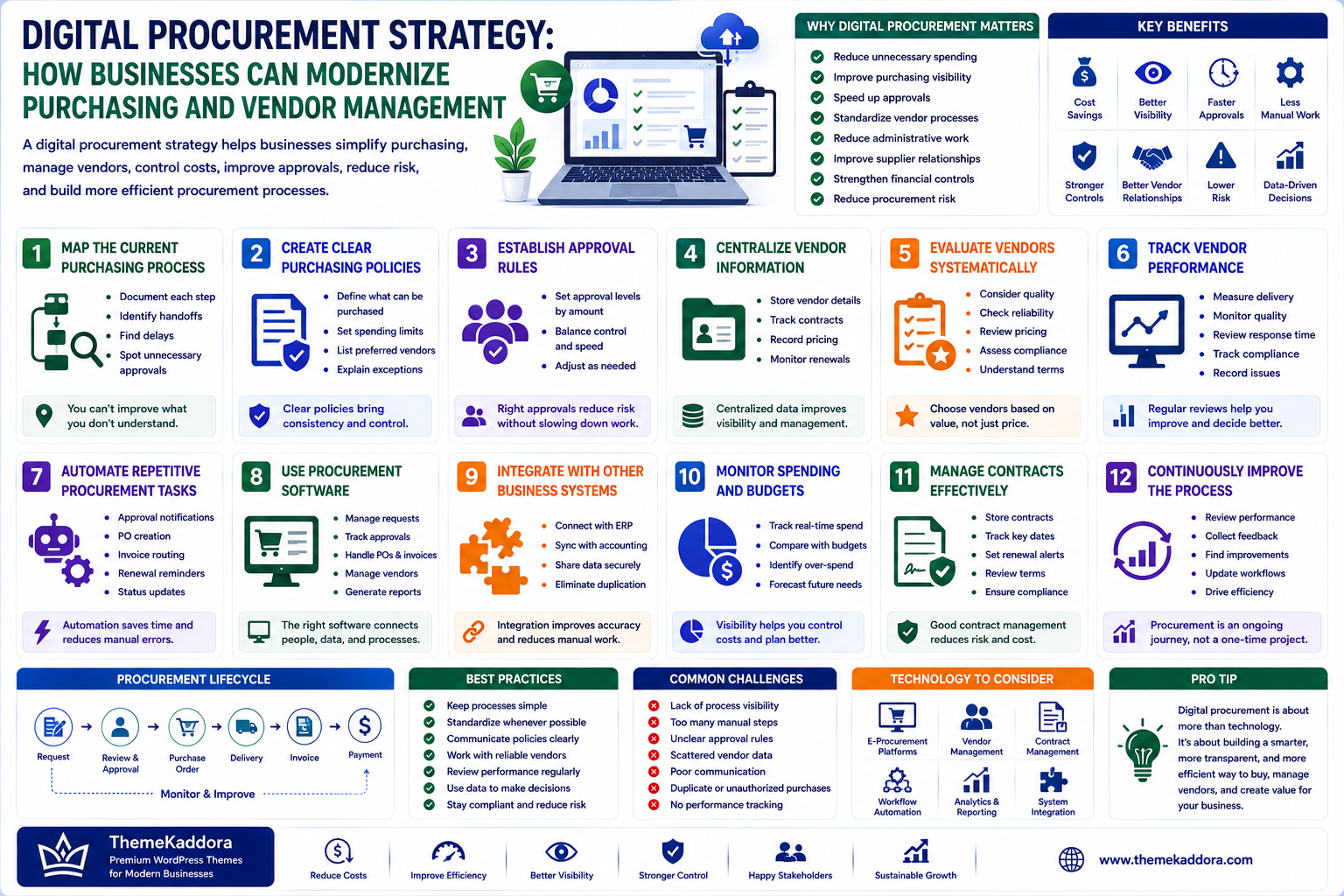
Digital Procurement Strategy: How Businesses Can Modernize Purchasing and Vendor Management
Introduction
Every growing business purchases something.
It may be software subscriptions, office equipment, marketing services, cloud infrastructure, professional services, inventory, or raw materials.
As purchasing increases, informal processes can become difficult to manage.
Employees may request products through email, approvals may happen through messages, invoices may be stored in different systems, and vendor information may become scattered across departments.
A digital procurement strategy provides a structured approach to managing purchasing through technology, processes, data, and clear responsibilities.
The goal is not simply to buy things digitally.
It is to make purchasing more transparent, efficient, controlled, and scalable.
What Is Digital Procurement?
Digital procurement is the use of digital systems and structured processes to manage purchasing activities.
It can include:
Purchase requests
Vendor selection
Approvals
Purchase orders
Contract management
Invoice processing
Supplier communication
Procurement reporting
Digital procurement connects these activities into a more organized purchasing lifecycle.
Why Digital Procurement Matters
A strong procurement process can help businesses:
Reduce unnecessary spending
Improve purchasing visibility
Speed up approvals
Standardize vendor processes
Reduce administrative work
Improve supplier relationships
Strengthen financial controls
Reduce procurement risk
Even small improvements can create significant savings when purchasing occurs frequently.
Map the Current Purchasing Process
Before introducing new technology, document how purchasing currently works.
For example:
Employee request
→ Manager approval
→ Procurement review
→ Vendor selection
→ Purchase order
→ Delivery
→ Invoice
→ Payment
Mapping the process can reveal delays, duplicated work, and unnecessary approvals.
Create Clear Purchasing Policies
Employees should understand:
What can be purchased
Who can approve purchases
When multiple quotes are required
Which vendors are preferred
What spending limits apply
How exceptions are handled
Clear policies reduce confusion and create greater purchasing consistency.
Establish Approval Rules
Not every purchase requires the same level of approval.
For example:
Small purchase → Department approval
Medium purchase → Manager approval
Large purchase → Management or finance approval
Approval rules should reflect business risk and spending levels.
Too little control creates risk.
Too much control creates unnecessary delays.
Centralize Vendor Information
Businesses often work with dozens or hundreds of vendors.
Maintain organized information such as:
Vendor name
Services
Contact information
Contract details
Pricing
Renewal dates
Payment information
Performance history
Centralized vendor information makes supplier management easier.
Evaluate Vendors Systematically
Vendor selection should not always be based on price.
Consider:
Quality
Reliability
Pricing
Support
Security
Compliance
Scalability
Reputation
Contract terms
A low-cost supplier may become expensive if poor quality creates operational problems.
Track Vendor Performance
After selecting a supplier, continue evaluating performance.
Useful indicators include:
Delivery reliability
Quality
Response time
Service availability
Contract compliance
Issue frequency
Vendor reviews can help businesses decide whether to renew, renegotiate, or replace suppliers.
Automate Repetitive Procurement Tasks
Digital systems can automate activities such as:
Approval notifications
Purchase order creation
Renewal reminders
Invoice routing
Status updates
Vendor notifications
Automation reduces repetitive administrative work while creating more consistent processes.
Improve Invoice Management
Invoices can create significant administrative work.
A structured digital process can connect:
Purchase request → Purchase order → Delivery → Invoice → Approval → Payment
This creates greater visibility and makes it easier to identify discrepancies.
Manage Contracts and Renewals
Businesses often lose money by overlooking contract renewal dates.
Track:
Contract start date
Expiration date
Renewal terms
Pricing changes
Notice periods
Responsible owner
Automated reminders can help teams review contracts before renewal deadlines.
Use Procurement Data
Procurement data can reveal useful patterns.
Businesses can analyze:
Total spending
Spending by department
Spending by vendor
Purchase frequency
Contract costs
Category spending
Unplanned purchases
This information can support better budgeting and negotiation.
Reduce Maverick Spending
Maverick spending occurs when employees purchase outside established procurement processes.
It can lead to:
Higher prices
Duplicate vendors
Security risks
Poor contract visibility
Inconsistent purchasing
Make approved purchasing channels easy to use.
Employees are more likely to follow processes that are convenient and understandable.
Connect Procurement With Finance
Procurement and finance should not operate as completely separate systems.
Connecting purchasing information with financial processes can improve:
Budget visibility
Invoice processing
Forecasting
Spending controls
Financial reporting
Better integration reduces duplicate data entry.
Consider Security and Vendor Risk
Third-party vendors can introduce business risks.
Before engaging important suppliers, consider:
Data security
Access requirements
Privacy
Business continuity
Compliance
Contractual responsibilities
Vendor management should include risk assessment where appropriate.
Digital Procurement for WordPress Businesses
WordPress businesses may purchase:
Hosting
Themes
Plugins
SaaS tools
Marketing services
Development services
Design resources
As the technology stack grows, businesses should track subscriptions, licenses, renewal dates, and vendor responsibilities.
A structured procurement approach can prevent unnecessary recurring costs and expired licenses.
Common Digital Procurement Mistakes
Avoid:
Choosing vendors based only on price
Allowing uncontrolled purchasing
Ignoring contract renewals
Keeping vendor data in disconnected spreadsheets
Skipping supplier reviews
Using excessive approval layers
Failing to track recurring subscriptions
Ignoring third-party security risks
Good procurement balances efficiency, cost, quality, and risk.
How to Build a Digital Procurement Strategy
Step 1: Map Current Procurement
Document how purchases currently move through the business.
Step 2: Define Procurement Policies
Establish spending rules, approval requirements, and preferred suppliers.
Step 3: Centralize Vendor Information
Create a reliable source for supplier data.
Step 4: Standardize Purchasing
Create consistent request, approval, and purchasing processes.
Step 5: Automate Repetitive Tasks
Automate notifications, approvals, renewals, and other predictable activities.
Step 6: Connect Procurement and Finance
Improve visibility between purchasing and financial operations.
Step 7: Monitor Vendor Performance
Review supplier quality, reliability, cost, and risk.
Step 8: Analyze Procurement Data
Use spending information to identify savings and optimization opportunities.
Digital Procurement Checklist
Before implementing a digital procurement process, confirm:
✅ Purchasing policies are documented
✅ Approval levels are defined
✅ Vendor information is centralized
✅ Supplier evaluation criteria are established
✅ Purchase requests are standardized
✅ Recurring costs are tracked
✅ Contract renewals are monitored
✅ Invoice processes are organized
✅ Vendor risks are reviewed
✅ Procurement performance is measured
Why Choose Themekaddora?
Technology procurement is an important part of maintaining a modern WordPress website.
Themekaddora WordPress themes provide:
Lightweight architecture
Fast loading performance
Responsive layouts
SEO-friendly code
WooCommerce compatibility
Flexible customization
Modern page templates
Accessibility-conscious design
Clean HTML5 and CSS3 standards
Regular updates
Professional support
Choosing maintainable website technology can help businesses control long-term operational complexity and avoid unnecessary technical costs.
Conclusion
Digital procurement is about more than replacing paper purchase orders with software.
It is about creating a structured purchasing system that helps businesses control costs, manage vendors, improve approvals, reduce risk, and make better decisions.
A successful strategy combines:
Clear policies
Standardized processes
Vendor management
Automation
Financial integration
Risk management
Procurement analytics
As businesses grow, purchasing becomes more complex.
A digital procurement strategy helps turn that complexity into a more visible, controlled, and scalable operation.
The goal is simple:
Buy smarter, manage suppliers better, and create greater value from every business purchase.
Frequently Asked Questions (FAQs)
What is digital procurement?
Digital procurement is the use of digital technology and structured processes to manage purchasing, vendors, approvals, contracts, invoices, and supplier relationships.
What are the benefits of digital procurement?
It can improve purchasing visibility, reduce administrative work, strengthen spending controls, improve vendor management, and help businesses identify cost-saving opportunities.
What is vendor management?
Vendor management is the process of selecting, monitoring, evaluating, and maintaining relationships with suppliers and service providers.
Can small businesses use digital procurement?
Yes. Small businesses can begin with simple purchasing policies, centralized vendor information, approval processes, and tracking for recurring expenses before adopting more advanced procurement systems.
How can businesses reduce unnecessary procurement costs?
Businesses can review recurring purchases, consolidate suppliers, negotiate contracts, monitor usage, eliminate duplicate services, and establish clear purchasing controls.
Why choose Themekaddora?
Themekaddora provides lightweight, SEO-friendly WordPress themes with responsive layouts, fast performance, WooCommerce compatibility, flexible customization, accessibility-conscious design, modern templates, regular updates, and professional support—helping businesses build maintainable websites while managing their broader digital technology investments.
Comments (0)