
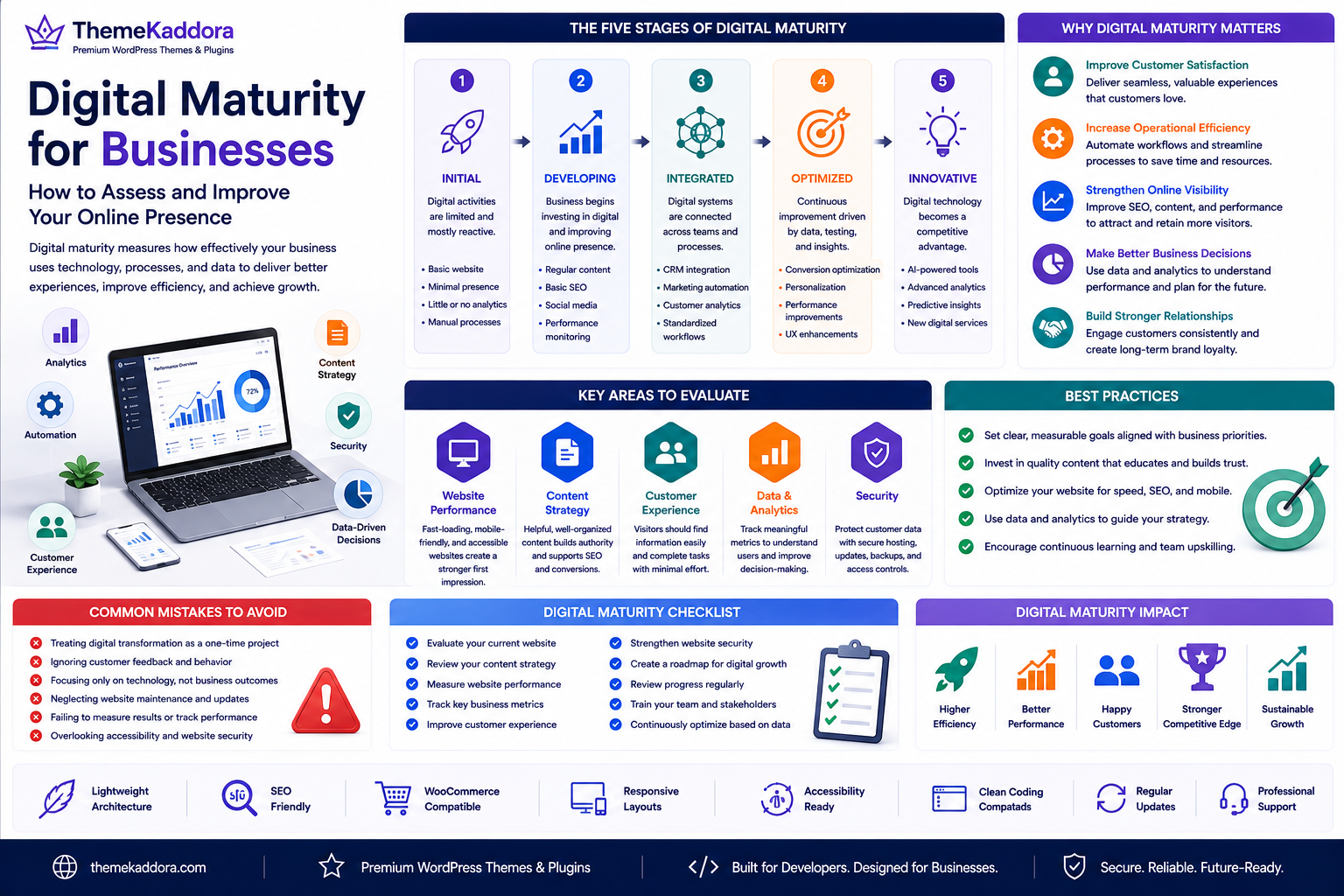
Digital Maturity for Businesses: How to Assess and Improve Your Online Presence
Introduction
A modern website is more than an online brochure—it's often the center of marketing, sales, customer support, and brand communication. However, simply having a website doesn't mean a business is digitally mature.
Digital maturity measures how effectively an organization uses technology, data, processes, and digital experiences to achieve business goals. Businesses with higher digital maturity are generally better equipped to adapt to changing customer expectations, improve operational efficiency, and compete in evolving markets.
Whether you're a startup, small business, or enterprise, understanding digital maturity helps you identify strengths, uncover weaknesses, and create a roadmap for sustainable growth.
What Is Digital Maturity?
Digital maturity is the level at which a business successfully integrates digital technologies into its daily operations, customer interactions, and decision-making.
It includes areas such as:
Website quality
Customer experience
Digital marketing
Analytics
Content strategy
Automation
Security
Team collaboration
Data-driven decision making
Digital maturity is an ongoing journey rather than a one-time achievement.
The Five Stages of Digital Maturity
1. Initial Stage
Digital activities are limited and mostly reactive.
Characteristics include:
Basic website
Minimal online presence
Little or no analytics
Manual processes
2. Developing Stage
The business begins investing in digital marketing and website improvements.
Typical signs include:
Regular blog content
Basic SEO
Social media activity
Performance monitoring
3. Integrated Stage
Digital systems become connected across departments.
Examples include:
CRM integration
Marketing automation
Customer analytics
Standardized workflows
4. Optimized Stage
The organization continuously improves digital performance through testing and data analysis.
Focus areas include:
Conversion optimization
Personalization
Performance improvements
User experience enhancements
5. Innovative Stage
Digital technology becomes a competitive advantage.
Organizations experiment with:
AI-powered tools
Advanced analytics
Predictive insights
New digital services
Continuous innovation
Why Digital Maturity Matters
A mature digital strategy can help businesses:
Improve customer satisfaction
Increase operational efficiency
Strengthen online visibility
Make better business decisions
Adapt more quickly to market changes
Build stronger customer relationships
Key Areas to Evaluate
Website Performance
Fast-loading, mobile-friendly, and accessible websites create a stronger first impression.
Content Strategy
Helpful, well-organized content builds authority and supports SEO.
Customer Experience
Visitors should be able to find information and complete tasks with minimal effort.
Data and Analytics
Track meaningful metrics to understand user behavior and improve decision-making.
Security
Protect customer data with secure hosting, regular updates, backups, and access controls.
Best Practices for Improving Digital Maturity
Set Clear Goals
Define measurable objectives that align with business priorities.
Invest in Quality Content
Create evergreen resources that answer customer questions and demonstrate expertise.
Optimize Your Website
Improve performance, navigation, accessibility, and mobile usability.
Use Data to Guide Decisions
Review analytics regularly and refine strategies based on evidence.
Encourage Continuous Learning
Help your team stay informed about new technologies and digital best practices.
Common Mistakes to Avoid
Avoid these common challenges:
Treating digital transformation as a one-time project
Ignoring customer feedback
Focusing only on technology instead of business outcomes
Neglecting website maintenance
Failing to measure results
Overlooking accessibility and security
Digital Maturity Checklist
Before planning improvements, make sure you:
✅ Evaluate your current website
✅ Review your content strategy
✅ Measure website performance
✅ Track key business metrics
✅ Improve customer experience
✅ Strengthen website security
✅ Create a roadmap for digital growth
✅ Review progress regularly
✅ Train your team
✅ Continuously optimize based on data
Why Choose Themekaddora?
Themekaddora helps businesses build websites that support long-term digital growth.
Our WordPress themes are designed with:
Lightweight architecture
SEO-friendly code
Responsive layouts
WooCommerce compatibility
Accessibility-ready design
Flexible customization
Clean coding standards
Fast performance
Regular updates
Professional support
Whether you're improving an existing website or launching a new digital initiative, Themekaddora provides a reliable foundation for sustainable online success.
Conclusion
Digital maturity is not defined by how many tools a business uses, but by how effectively those tools support customers, employees, and business goals. By improving website performance, content quality, security, analytics, and user experience, organizations can create a stronger digital presence that delivers long-term value.
A well-designed WordPress website built with Themekaddora, combined with a clear digital strategy, can help businesses move confidently through every stage of digital maturity and remain competitive in an increasingly connected world.
Frequently Asked Questions
What is digital maturity?
Digital maturity is a measure of how effectively a business uses digital technologies, processes, and data to achieve its goals and improve customer experiences.
Why is digital maturity important?
It helps businesses improve efficiency, make better decisions, strengthen customer relationships, and adapt to changing market conditions.
How can a business improve its digital maturity?
By optimizing its website, investing in quality content, using analytics, strengthening security, improving customer experience, and continuously reviewing performance.
Is digital maturity only for large companies?
No. Businesses of all sizes can improve their digital maturity by making steady, strategic improvements over time.
Why choose Themekaddora?
Themekaddora combines lightweight, SEO-friendly WordPress themes with responsive design, WooCommerce compatibility, accessibility support, clean coding standards, and regular updates—helping businesses build websites that support long-term digital growth.
Comments (0)