
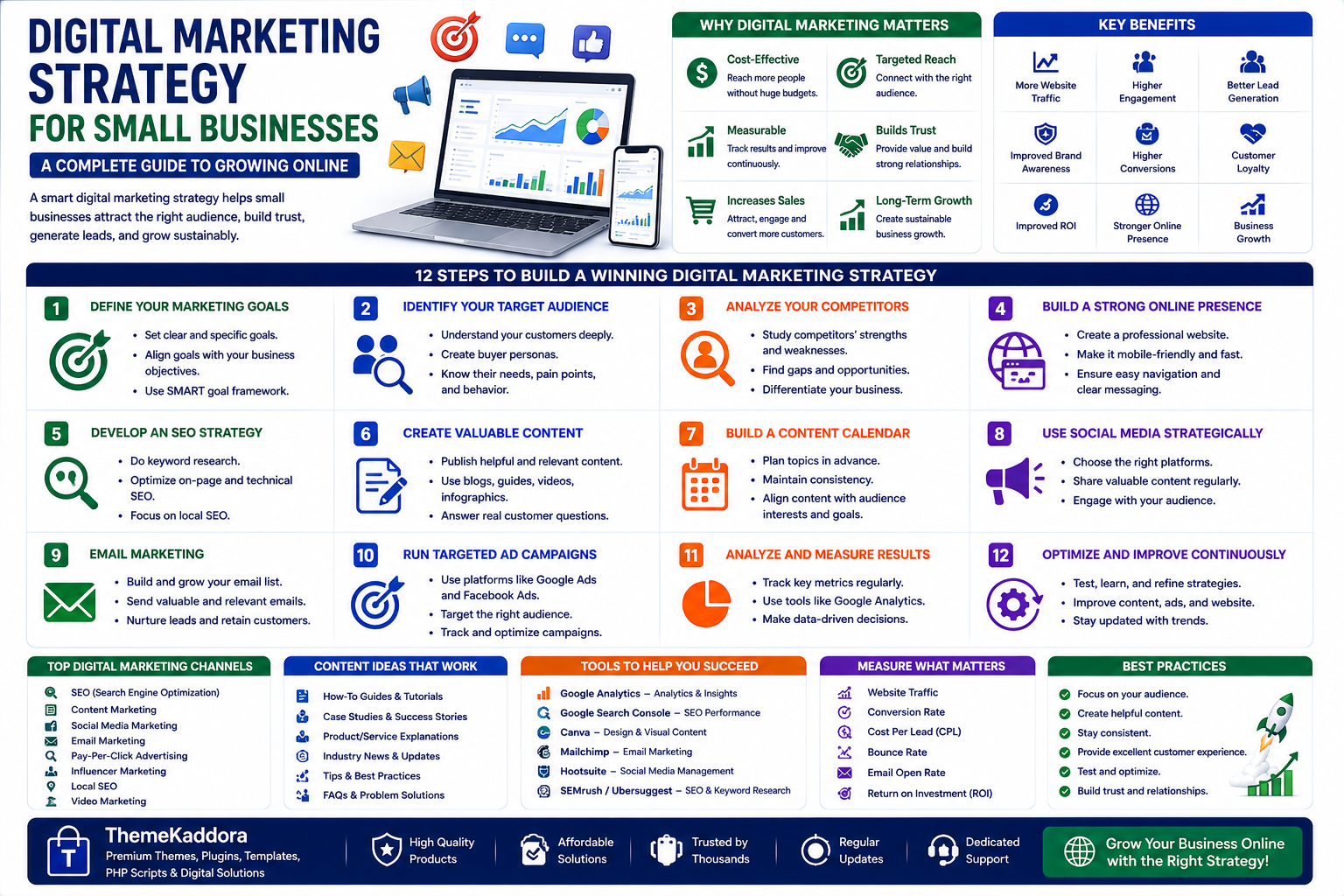
Digital Marketing Strategy for Small Businesses: A Complete Guide to Growing Online
Introduction
Building a successful business today requires more than having a good product or service.
Customers need to discover your business, understand what you offer, trust your brand, and have an easy way to take the next step.
This is where digital marketing becomes important.
Digital marketing allows businesses to reach potential customers through search engines, websites, social media, email, online advertising, content, and other digital channels.
For small businesses, digital marketing can be especially valuable because it provides opportunities to reach specific audiences without requiring the enormous budgets traditionally associated with large-scale advertising.
However, simply creating social media accounts or publishing occasional blog posts isn't a complete marketing strategy.
A successful digital marketing strategy requires clear goals, audience research, consistent content, measurable campaigns, and continuous optimization.
In this guide, you'll learn how to create a practical digital marketing strategy that can help your small business increase visibility, attract customers, generate leads, and build long-term growth.
1. Define Your Marketing Goals
Before choosing marketing channels, determine what you want to achieve.
Common goals include:
Increase website traffic
Generate leads
Increase sales
Build brand awareness
Improve customer retention
Grow an email list
Increase online bookings
Launch a new product
Make goals specific whenever possible.
Instead of:
"Get more customers."
define a measurable objective such as:
"Increase qualified website leads over the next quarter."
Clear goals make marketing performance easier to evaluate.
2. Identify Your Target Audience
Effective marketing starts with understanding who you want to reach.
Research:
Customer demographics
Industry
Location
Problems
Goals
Buying behavior
Budget
Preferred communication channels
Create customer profiles based on real information rather than assumptions.
The more clearly you understand your audience, the easier it becomes to create relevant marketing messages.
3. Analyze Your Competitors
Competitor research can reveal opportunities.
Study:
Their websites
Content
Search visibility
Social media activity
Offers
Customer reviews
Pricing
Advertising messages
Don't simply copy competitors.
Look for gaps.
Ask:
What questions aren't they answering?
Which customers are they ignoring?
What can we explain better?
Competitive research should help you differentiate your business.
4. Build a Strong Online Presence
Your website is often the central destination for your digital marketing efforts.
Make sure it clearly communicates:
What you offer
Who you serve
Why customers should choose you
How customers can contact you
What action visitors should take next
Your website should also be:
Mobile-friendly
Fast
Secure
Easy to navigate
Accessible
Search-engine friendly
Every marketing channel should ultimately support a clear customer journey.
5. Develop an SEO Strategy
Search engine optimization can help customers discover your business when they search for relevant information or products.
An SEO strategy may include:
Keyword research
Search intent analysis
Helpful content
On-page optimization
Internal linking
Technical SEO
Image optimization
Local SEO
Structured data where appropriate
Focus on creating useful resources rather than simply inserting keywords into pages.
Search visibility is generally a long-term investment.
6. Create Valuable Content
Content marketing helps businesses attract and educate potential customers.
Useful content formats include:
Blog articles
Tutorials
Guides
Case studies
Videos
Infographics
Checklists
Webinars
Industry reports
Frequently asked questions
Good content should answer real customer questions.
For example, instead of writing an article that only promotes your service, create a guide that helps potential customers solve a problem related to your industry.
Useful content can build trust before a customer is ready to buy.
7. Build a Content Calendar
Consistency is easier when content is planned in advance.
A content calendar can include:
Topic
Target audience
Keyword
Content format
Publishing date
Distribution channels
Responsible team member
Plan content around customer questions, seasonal demand, product launches, and business priorities.
8. Use Social Media Strategically
Social media can help businesses build awareness, engage customers, and distribute content.
Choose platforms based on your target audience.
Don't feel obligated to maintain every social network.
Focus on platforms where your customers actually spend time.
Social media content can include:
Educational posts
Short videos
Product demonstrations
Customer stories
Industry insights
Behind-the-scenes content
Questions and polls
Announcements
The objective should be meaningful engagement rather than simply collecting followers.
9. Build an Email Marketing Strategy
Email provides a direct way to communicate with interested customers.
Build an email list through legitimate opt-in methods.
Campaigns can include:
Welcome emails
Educational newsletters
Product announcements
Special offers
Customer stories
Product recommendations
Re-engagement campaigns
Segment your audience where appropriate so subscribers receive relevant information.
10. Use Paid Advertising Carefully
Paid advertising can generate traffic and leads faster than many organic channels.
Potential channels include:
Search advertising
Social media advertising
Display advertising
Video advertising
Retargeting
Before increasing your advertising budget, understand:
Cost per click
Cost per lead
Conversion rate
Customer acquisition cost
Revenue generated
Return on advertising spend
Paid advertising should be measured against business outcomes rather than clicks alone.
11. Optimize Landing Pages
When advertising or promoting a specific offer, send visitors to a relevant landing page whenever possible.
A good landing page should include:
Clear headline
Strong value proposition
Relevant benefits
Supporting information
Trust signals
Clear CTA
Simple conversion process
The landing page should match the message used in the advertisement or marketing campaign.
12. Use Local Marketing
Local businesses can benefit significantly from location-based digital marketing.
Strategies include:
Optimizing business listings
Collecting genuine customer reviews
Creating location-specific content
Maintaining accurate contact information
Publishing local offers
Participating in community events
Consistent business information across online platforms can help customers find and trust local businesses.
13. Build Social Proof
Customers often look for evidence before making purchasing decisions.
Useful forms of social proof include:
Customer reviews
Testimonials
Case studies
Ratings
Client logos
User-generated content
Success stories
Use genuine evidence.
Never create fake reviews or misleading customer claims.
14. Use Marketing Automation
Automation can reduce repetitive marketing work.
You can automate:
Welcome emails
Lead follow-ups
Appointment reminders
Customer segmentation
Reporting
Campaign notifications
Re-engagement campaigns
Automation should improve consistency while preserving useful human interaction.
15. Track Marketing Analytics
Marketing decisions should be based on data whenever possible.
Monitor:
Website traffic
Traffic sources
Leads
Sales
Conversion rate
Customer acquisition cost
Email performance
Social engagement
Search visibility
Revenue by channel
Don't measure every possible metric.
Focus on indicators connected to your business goals.
16. Understand Customer Acquisition Cost
Customer Acquisition Cost, or CAC, measures how much it costs to acquire a customer.
A simplified calculation is:
Total customer acquisition expenses ÷ Number of new customers
For example, if a business spends $2,000 on marketing and sales activities and acquires 40 new customers, the average acquisition cost is $50 per customer.
CAC should be evaluated alongside customer lifetime value and profit margins.
17. Focus on Customer Retention
Marketing doesn't stop after the first purchase.
Retaining existing customers can create significant long-term value.
Retention strategies include:
Helpful follow-up communication
Loyalty programs
Personalized recommendations
Customer support
Educational content
Exclusive offers
Reorder reminders
A strong retention strategy can reduce dependence on constantly acquiring new customers.
18. Repurpose Successful Content
You don't need to create everything from scratch.
A successful blog article can become:
Social posts
Short videos
Email content
Infographics
FAQs
Presentation slides
Downloadable guides
Content repurposing helps small teams get more value from existing work.
19. Test Your Marketing Strategy
Marketing strategies should evolve based on results.
Test:
Headlines
Offers
Landing pages
Email subject lines
CTAs
Content formats
Advertising messages
Document results and learn from unsuccessful experiments as well as successful ones.
Not every campaign will work.
The objective is continuous improvement.
20. Create an Integrated Marketing System
The strongest digital marketing strategies connect multiple channels.
For example:
SEO → Blog Content → Email List → Product Education → Conversion → Customer Retention
Social media can distribute content.
Email can nurture leads.
Paid advertising can accelerate reach.
Analytics can measure performance.
Each channel should support the larger customer journey rather than operating independently.
Common Digital Marketing Mistakes
Trying Every Marketing Channel
More channels don't automatically produce better results.
Focusing Only on Followers
Followers don't necessarily translate into customers.
Ignoring SEO
Paid advertising can produce traffic, but organic visibility can provide long-term value.
Publishing Without a Strategy
Content should solve customer problems or support a clear business objective.
Not Tracking Results
Without measurement, it's difficult to understand what works.
Giving Up Too Quickly
Some marketing channels require time before meaningful results appear.
Ignoring Existing Customers
Retention should be part of the overall marketing strategy.
Digital Marketing Checklist
Strategy
Marketing goals defined
Target audience identified
Competitors researched
Value proposition clarified
Website
Mobile-friendly
Fast
Secure
Clear CTAs
Conversion paths tested
Content
Content strategy created
Content calendar maintained
Customer questions addressed
Content repurposed
Marketing
SEO strategy
Social media strategy
Email marketing
Paid advertising where appropriate
Automation
Analytics
Website analytics
Conversion tracking
CAC monitoring
Campaign performance
Revenue attribution where practical
Why Choose ThemeKaddora?
ThemeKaddora is a digital marketplace focused on practical digital products and solutions for website owners, developers, freelancers, agencies, entrepreneurs, and online businesses.
Its ecosystem can include:
WordPress themes
WordPress plugins
WooCommerce solutions
SaaS products
AI-powered tools
Business automation solutions
Website templates
Digital assets
Conclusion
Digital marketing provides small businesses with powerful ways to reach customers, build trust, and grow online.
But successful marketing isn't about being everywhere.
It's about being useful in the right places.
Start by understanding your audience.
Define measurable goals.
Build a strong website.
Create useful content.
Invest in SEO.
Use social media strategically.
Build an email audience.
Experiment with paid advertising.
Track results.
Automate repetitive processes.
Most importantly, connect your marketing activities into a single customer journey.
The strongest digital marketing strategy is not necessarily the one with the largest budget.
It's the one that consistently creates value for the right audience and turns that value into measurable business results.
ThemeKaddora's ecosystem of WordPress themes, plugins, WooCommerce solutions, SaaS products, AI tools, templates, and business solutions can support businesses building and improving their digital presence.
Ultimately, digital marketing is not simply about generating clicks.
It's about creating meaningful connections that lead to trust, customers, and long-term business growth.
Frequently Asked Questions
1. What is a digital marketing strategy?
A digital marketing strategy is a structured plan for using online channels such as websites, search engines, social media, email, content, and advertising to achieve business goals.
2. Why is digital marketing important for small businesses?
Digital marketing can help small businesses reach targeted audiences, build awareness, generate leads, increase sales, and compete more effectively online.
3. Which digital marketing channel is best?
There is no single best channel for every business. The right mix depends on the target audience, industry, goals, budget, and customer journey.
4. How much should a small business spend on digital marketing?
There is no universal budget. Businesses should consider revenue, margins, growth goals, customer acquisition costs, and available resources.
5. How long does SEO take to work?
SEO results vary depending on competition, website quality, content, authority, search demand, and other factors. It generally requires consistent effort rather than a one-time campaign.
6. Is social media enough for digital marketing?
Usually, social media works best as part of a broader strategy that may include a website, SEO, content, email, analytics, and other channels.
7. Should small businesses use paid advertising?
Paid advertising can be useful when campaigns are properly targeted and measured. Businesses should monitor costs and conversion results carefully.
8. How can marketing automation help?
Marketing automation can handle repetitive tasks such as lead follow-ups, email sequences, segmentation, notifications, and reporting.
9. Why choose ThemeKaddora?
ThemeKaddora provides practical digital products and solutions across WordPress, WooCommerce, SaaS, AI, templates, automation, and other digital categories.
10. How can I measure digital marketing success?
Track metrics connected to your goals, such as qualified leads, sales, conversion rate, customer acquisition cost, revenue, retention, and channel performance.
Comments (0)