
Digital Experience Platforms (DXP) Explained: A Complete Guide for Businesses
Introduction
Customers interact with businesses through websites, mobile apps, email, customer portals, social media, and other digital channels. Managing these experiences separately often leads to inconsistent branding, fragmented customer journeys, and disconnected data.
A Digital Experience Platform (DXP) helps businesses bring these digital touchpoints together into a unified ecosystem. Rather than managing content and customer interactions independently, organizations can create consistent, personalized experiences across multiple channels.
As customer expectations continue to grow, DXPs have become an important part of digital transformation strategies for organizations that want to deliver engaging and connected online experiences.
Whether you're operating a WordPress website, ecommerce business, SaaS platform, or enterprise organization, understanding DXPs helps you prepare for the future of digital customer engagement.
What Is a Digital Experience Platform?
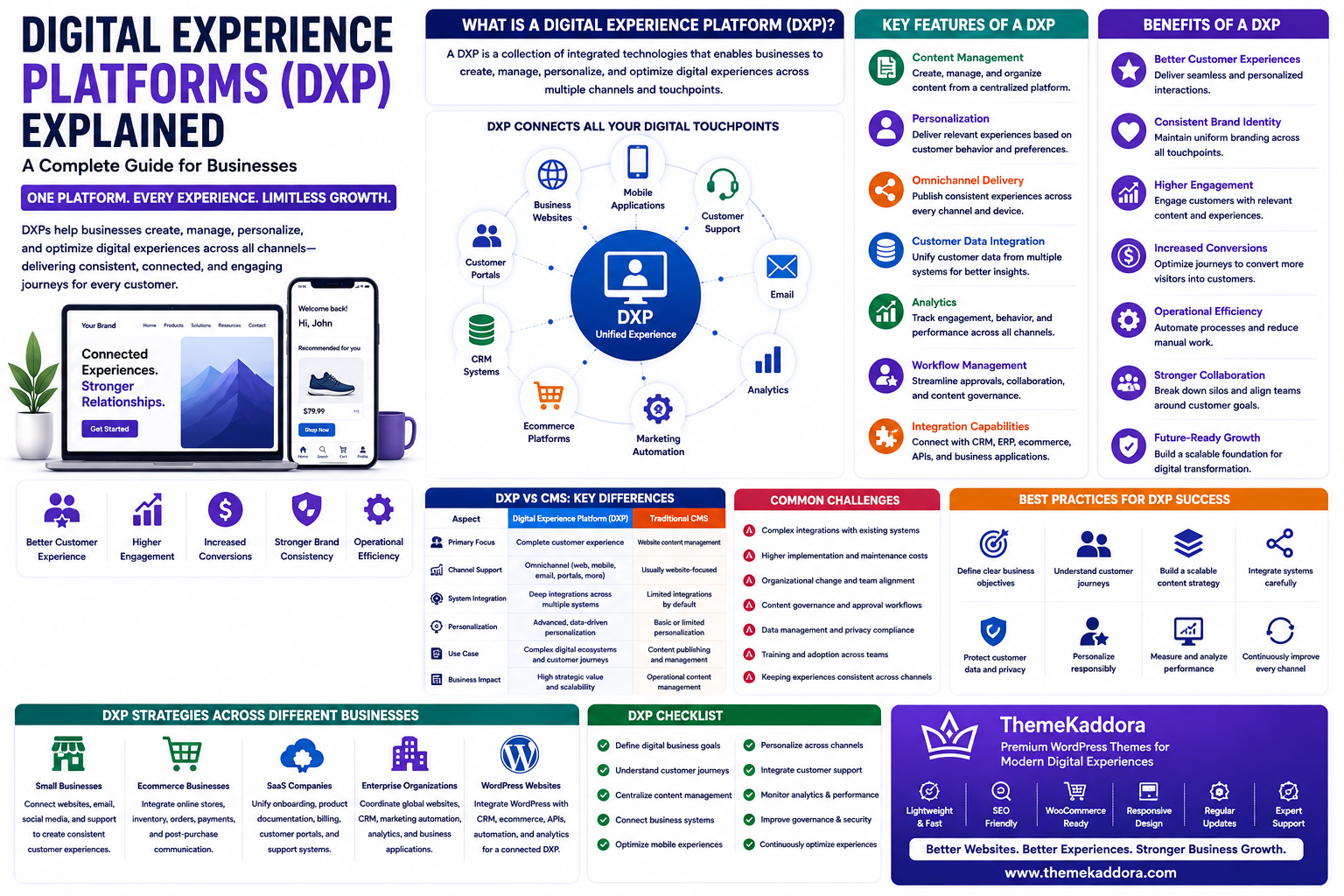
A Digital Experience Platform (DXP) is a collection of integrated technologies that enables businesses to create, manage, personalize, and optimize digital experiences across multiple channels.
Unlike a traditional content management system (CMS), a DXP focuses on the complete customer journey rather than simply publishing website content.
A DXP may connect:
Business websites
Mobile applications
Customer portals
Ecommerce platforms
Marketing automation
Analytics platforms
Customer support tools
The objective is to deliver consistent digital experiences regardless of where customers interact with the business.
Why Businesses Use DXPs
Organizations invest in Digital Experience Platforms to:
Improve customer experience
Personalize content
Deliver omnichannel experiences
Centralize digital operations
Improve collaboration
Increase customer engagement
Support long-term digital transformation
DXPs help businesses manage growing digital complexity.
Key Features of a DXP
Content Management
Create and manage digital content from a centralized platform.
Personalization
Deliver relevant content based on customer preferences, behavior, location, or previous interactions.
Omnichannel Delivery
Publish consistent experiences across websites, mobile apps, portals, and other digital channels.
Customer Data Integration
Connect customer information from multiple systems to improve personalization and decision-making.
Analytics
Monitor customer behavior, engagement, and business performance across digital channels.
Workflow Management
Support content approvals, collaboration, publishing processes, and governance.
Integration Capabilities
Connect with CRM platforms, ecommerce systems, APIs, marketing tools, and business applications.
Benefits of a DXP
Businesses gain:
Better customer experiences
Consistent branding
Higher engagement
Improved operational efficiency
Better personalization
Faster content management
Stronger collaboration
DXPs support organizations as their digital ecosystems continue to expand.
DXP vs CMS
Digital Experience Platform (DXP)
Traditional CMS
Focuses on the complete customer experience
Primarily manages website content
Supports omnichannel delivery
Usually website-focused
Integrates multiple business systems
Limited integrations by default
Offers advanced personalization
Basic personalization capabilities
Designed for complex digital ecosystems
Best suited for content publishing
A CMS is often one component within a broader Digital Experience Platform.
Common Challenges
Businesses implementing DXPs may face:
Complex integrations
Higher implementation costs
Organizational change
Content governance challenges
Data management complexity
Staff training requirements
Successful implementation requires planning, governance, and long-term commitment.
Best Practices
Define business objectives.
Understand customer journeys.
Build a scalable content strategy.
Integrate business systems carefully.
Protect customer data.
Measure digital performance.
Continuously optimize experiences.
DXPs Across Different Businesses
Small Businesses
Smaller organizations may begin with a CMS and gradually adopt DXP capabilities through integrations and marketing platforms.
Ecommerce Businesses
Deliver personalized shopping experiences, unified customer accounts, omnichannel purchasing, and connected support services.
SaaS Companies
Integrate websites, customer portals, onboarding systems, documentation, billing, and customer success platforms.
Enterprise Organizations
Coordinate global websites, regional content, CRM systems, marketing automation, customer portals, analytics, and business applications through centralized governance.
WordPress Websites
WordPress can support DXP strategies by integrating with CRM platforms, marketing automation tools, ecommerce solutions, APIs, analytics services, multilingual platforms, and customer portals, allowing businesses to create connected digital experiences without abandoning their existing CMS.
Digital Experience Platform Checklist
Before adopting a DXP strategy, make sure you:
✅ Define digital business goals
✅ Understand customer journeys
✅ Centralize content management
✅ Connect business systems
✅ Personalize responsibly
✅ Optimize omnichannel delivery
✅ Monitor analytics
✅ Protect customer data
✅ Improve governance
✅ Continuously optimize experiences
Why Choose Themekaddora?
Modern digital experiences require a strong website foundation.
Themekaddora WordPress themes provide:
Lightweight architecture
Fast loading performance
SEO-friendly code
Responsive layouts
WooCommerce compatibility
Flexible customization
Accessibility-conscious design
Clean HTML5 and CSS3 standards
Cross-browser compatibility
Regular updates
Professional support
These features help businesses build WordPress websites that integrate effectively with Digital Experience Platforms while remaining fast, scalable, and easy to manage.
Conclusion
Digital Experience Platforms help businesses move beyond traditional websites by connecting content, customer data, personalization, and digital services into one unified ecosystem. As customer expectations continue to evolve, organizations that deliver seamless and consistent experiences across every digital channel are better positioned for long-term success.
Whether you're using WordPress, running an ecommerce store, or managing an enterprise digital ecosystem, understanding DXPs provides valuable insight into the future of digital experience management.
Frequently Asked Questions (FAQs)
What is a Digital Experience Platform (DXP)?
A Digital Experience Platform (DXP) is an integrated set of technologies used to create, manage, personalize, and optimize digital experiences across multiple customer channels.
How is a DXP different from a CMS?
A CMS focuses mainly on managing website content, while a DXP manages the broader customer experience by integrating multiple systems, channels, and personalization capabilities.
Do small businesses need a DXP?
Not always. Many small businesses begin with a CMS such as WordPress and gradually adopt DXP features as their digital operations become more complex.
Can WordPress be part of a DXP?
Yes. WordPress can integrate with CRM systems, marketing automation platforms, ecommerce solutions, customer portals, analytics tools, and APIs, making it an effective component within a broader DXP strategy.
Why choose Themekaddora?
Themekaddora provides lightweight, SEO-friendly WordPress themes with responsive layouts, WooCommerce compatibility, fast performance, accessibility-conscious design, regular updates, and professional support—helping businesses build WordPress websites that integrate seamlessly into modern Digital Experience Platform strategies.
Comments (0)