
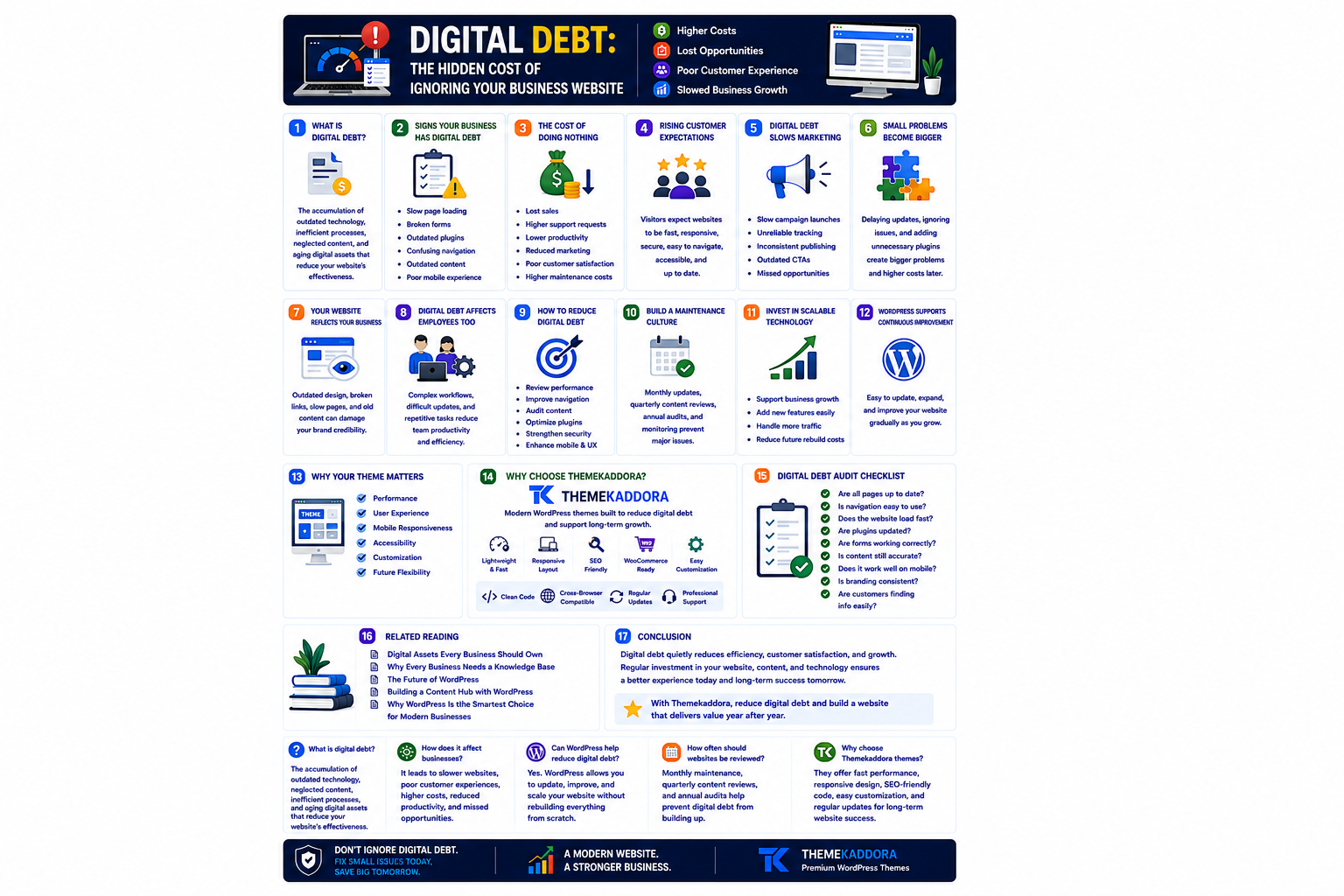
Digital Debt: The Hidden Cost of Ignoring Your Business Website
Introduction
Every business understands financial debt.
If you borrow money today, you eventually repay it with interest.
But many organizations overlook another type of debt that quietly grows in the background—digital debt.
Digital debt isn't recorded on a balance sheet, yet it affects customer experience, employee productivity, marketing performance, and business growth.
It builds slowly.
An outdated website.
Old plugins.
Broken forms.
Slow page loading.
Confusing navigation.
Inconsistent branding.
Each small issue may seem harmless on its own, but together they create friction that costs businesses time, money, and opportunities.
For companies using WordPress, understanding and managing digital debt is essential for building a website that continues to support growth rather than becoming a barrier to it.
What Is Digital Debt?
Digital debt is the accumulation of outdated technology, inefficient processes, neglected content, and aging digital assets that reduce the effectiveness of your online presence.
Unlike a sudden technical failure, digital debt develops gradually.
Businesses often postpone improvements because everything appears to be "working."
However, working isn't always the same as performing well.
Signs Your Business Has Digital Debt
Many organizations recognize these warning signs:
Pages load slowly.
Contact forms no longer function correctly.
Plugins haven't been updated for months.
Employees avoid updating the website because it's too complicated.
Customers struggle to find information.
Content contains outdated screenshots.
Navigation has become confusing.
Mobile usability has declined.
These problems reduce confidence and efficiency.
The Cost of Doing Nothing
Digital debt affects more than technology.
It influences nearly every part of the business.
Examples include:
Lost sales opportunities
Higher customer support requests
Lower employee productivity
Reduced marketing effectiveness
Poor customer satisfaction
Increased maintenance costs
Ignoring small problems often makes future improvements more expensive.
Customer Expectations Continue to Rise
Visitors compare your website with every excellent digital experience they have elsewhere.
They expect websites to be:
Fast
Responsive
Easy to navigate
Secure
Accessible
Up to date
A website that felt modern five years ago may no longer meet today's expectations.
Digital Debt Slows Marketing
Marketing teams rely on websites to publish campaigns, collect leads, and measure performance.
When the website becomes difficult to manage, marketing slows.
Examples include:
Landing pages take too long to build.
Campaign tracking becomes unreliable.
Content publishing is inconsistent.
Calls to action become outdated.
Technology should accelerate marketing—not create obstacles.
Small Problems Become Bigger Problems
Digital debt rarely appears all at once.
It grows through small decisions such as:
Delaying software updates
Ignoring broken links
Adding unnecessary plugins
Publishing duplicate content
Leaving outdated promotions online
Over time, maintenance becomes increasingly difficult.
Your Website Reflects Your Business
Customers often judge a company's professionalism by its website.
Consider the impression created by:
Old copyright dates
Broken images
Slow pages
Confusing menus
Outdated branding
Even excellent products can lose credibility when presented through an outdated digital experience.
Digital Debt Affects Employees Too
Internal teams also experience the impact.
Employees may struggle with:
Complex publishing workflows
Difficult content updates
Inconsistent documentation
Repetitive manual tasks
Modern tools improve both customer and employee experiences.
How to Reduce Digital Debt
Digital debt doesn't disappear overnight.
Start with manageable improvements.
Review:
Website performance
Navigation
Content quality
Plugin usage
Security
Accessibility
Mobile experience
Small improvements accumulate over time.
Build a Maintenance Culture
Instead of redesigning your website every few years, adopt continuous improvement.
Examples include:
Monthly updates
Quarterly content reviews
Annual UX audits
Performance monitoring
Security reviews
Consistent maintenance prevents major problems.
Invest in Scalable Technology
Businesses grow.
Your website should grow with you.
Choose technologies that support:
New products
Additional services
Content expansion
Customer portals
Online stores
Marketing automation
Scalability reduces future rebuilding costs.
WordPress Supports Continuous Improvement
One reason businesses choose WordPress is its flexibility.
It allows organizations to:
Update content easily
Expand functionality
Improve design
Add integrations
Scale over time
Rather than replacing the entire platform, businesses can improve it gradually.
Why Your Theme Matters
Your WordPress theme influences:
Performance
User experience
Mobile responsiveness
Accessibility
Customization
Future flexibility
A lightweight, well-maintained theme makes ongoing improvements easier.
Why Choose Themekaddora?
Themekaddora WordPress themes help businesses reduce digital debt by providing a modern foundation built for long-term growth.
Key features include:
Lightweight architecture
Responsive layouts
SEO-friendly code
WooCommerce compatibility
Fast loading performance
Flexible customization
Clean HTML5 and CSS3 standards
Cross-browser compatibility
Regular updates
Professional support
Whether you're refreshing an existing website or planning a complete redesign, Themekaddora themes make it easier to maintain a professional digital presence.
Digital Debt Audit Checklist
Review your website and ask:
✅ Are all pages up to date?
✅ Is navigation easy to understand?
✅ Does the website load quickly?
✅ Are plugins actively maintained?
✅ Are forms working correctly?
✅ Is content still accurate?
✅ Does the website work well on mobile devices?
✅ Is branding consistent?
✅ Are customers finding information easily?
Related Reading
Continue with these guides:
Digital Assets Every Business Should Own
Why Every Business Needs a Knowledge Base
The Future of WordPress
Building a Content Hub with WordPress
Why WordPress Is Still the Smartest Choice for Modern Businesses
These articles help businesses build a modern, sustainable digital strategy.
Conclusion
Digital debt rarely appears as a crisis.
Instead, it quietly reduces efficiency, customer satisfaction, and business growth through hundreds of small issues that accumulate over time.
Organizations that regularly invest in their websites, content, and technology create stronger customer experiences and remain more adaptable in a rapidly changing digital landscape.
A WordPress website built on a modern, well-maintained theme provides the flexibility needed to evolve without constantly starting over.
With Themekaddora, businesses gain a reliable foundation for reducing digital debt and building a website that continues delivering value year after year.
Frequently Asked Questions (FAQs)
What is digital debt?
Digital debt is the accumulation of outdated technology, neglected content, inefficient processes, and aging digital assets that reduce the effectiveness of a business's online presence.
How does digital debt affect businesses?
It can lead to slower websites, poor customer experiences, higher maintenance costs, reduced productivity, and missed business opportunities.
Can WordPress help reduce digital debt?
Yes. WordPress allows businesses to update content, improve functionality, enhance design, and scale their websites over time without rebuilding everything from scratch.
How often should businesses review their websites?
A combination of monthly maintenance, quarterly content reviews, and annual performance audits helps prevent digital debt from accumulating.
Why choose Themekaddora WordPress themes?
Themekaddora themes provide lightweight performance, responsive layouts, SEO-friendly code, flexible customization, and regular updates to help businesses build modern WordPress websites that remain effective as they grow.
Comments (0)