
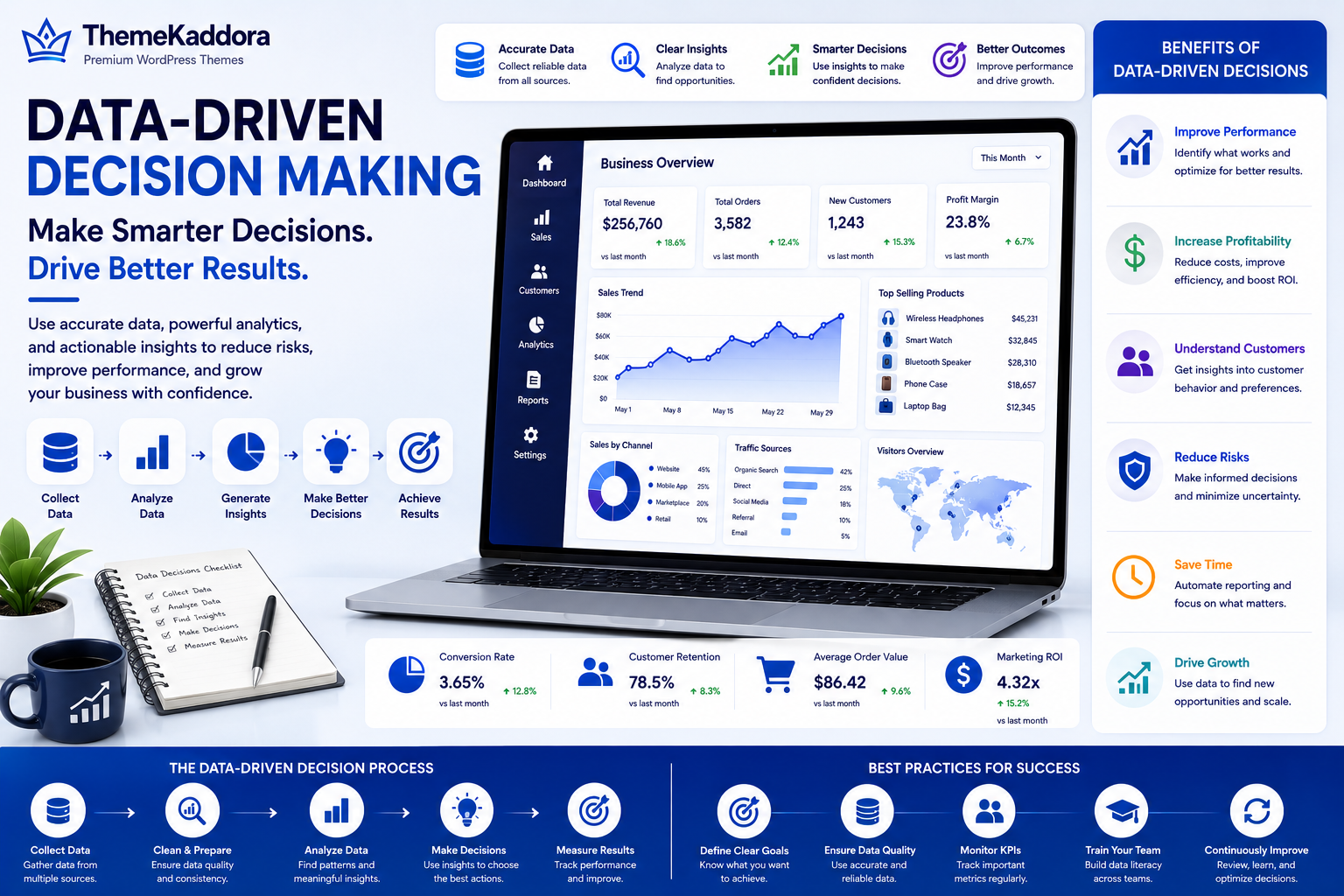
Data-Driven Decision Making Explained: A Complete Guide for Modern Businesses
Introduction
Every business makes decisions every day. Some involve hiring employees, launching products, planning marketing campaigns, or investing in new technologies. While experience and intuition remain valuable, relying only on assumptions can increase business risks.
Modern organizations have access to large amounts of information from websites, customer interactions, sales systems, marketing campaigns, financial reports, and operational processes.
Data-Driven Decision Making (DDDM) enables businesses to use this information to make informed, objective, and measurable decisions. Instead of guessing what might work, organizations analyze reliable data to identify opportunities, solve problems, and improve performance.
Whether you operate a startup, an ecommerce business, a marketing agency, or a WordPress-powered website, adopting a data-driven culture helps create more consistent and sustainable business growth.
What Is Data-Driven Decision Making?
Data-Driven Decision Making is the practice of using accurate data, analytics, and measurable insights to guide business decisions.
Rather than depending solely on opinions or assumptions, organizations evaluate evidence before taking action.
A successful DDDM strategy typically includes:
Data collection
Data quality management
Business analytics
Performance reporting
Dashboard monitoring
Goal measurement
Continuous improvement
The objective is to improve decision quality while reducing uncertainty.
Why Data-Driven Decision Making Matters
Organizations adopt data-driven practices to:
Improve business performance
Reduce operational risks
Increase efficiency
Identify growth opportunities
Improve customer experiences
Measure business success
Support strategic planning
Reliable information leads to more confident decisions.
Key Components of Data-Driven Decision Making
Data Collection
Gather information from reliable sources such as websites, CRM systems, ecommerce platforms, financial software, customer feedback, and operational systems.
Data Quality
Accurate decisions require complete, consistent, and trustworthy data. Regularly review information for errors, duplication, and outdated records.
Business Analytics
Analyze business data to understand customer behavior, operational performance, sales trends, and marketing effectiveness.
Performance Metrics
Track Key Performance Indicators (KPIs) that align with business objectives, such as revenue growth, customer retention, conversion rates, and operational efficiency.
Visualization
Use dashboards and reports to present complex information in a way that is easy to understand and act upon.
Continuous Improvement
Review business outcomes regularly and refine strategies based on measurable results.
Common Challenges
Businesses often face:
Poor-quality data
Disconnected systems
Inconsistent reporting
Information overload
Limited analytical skills
Delayed reporting
Building a strong data culture helps organizations overcome these challenges.
Best Practices
Define measurable business objectives.
Collect reliable and relevant data.
Standardize reporting processes.
Monitor KPIs regularly.
Encourage data literacy across teams.
Combine data with human expertise.
Continuously improve business decisions.
Data-Driven Decision Making Across Different Businesses
Small Businesses
Track sales, expenses, customer acquisition, and marketing performance to make informed decisions without requiring complex analytics platforms.
Ecommerce Businesses
Analyze product performance, customer behavior, inventory trends, abandoned carts, and conversion rates to improve profitability.
Marketing Agencies
Measure campaign performance, lead generation, client engagement, advertising ROI, and content effectiveness to optimize marketing strategies.
Enterprise Organizations
Use enterprise-wide analytics to support financial planning, operations, supply chain management, customer experience, human resources, and strategic planning.
WordPress Websites
WordPress businesses can use analytics to monitor website traffic, SEO performance, WooCommerce sales, user engagement, page performance, and customer journeys, enabling smarter content and marketing decisions.
Data-Driven Decision Making Checklist
Before implementing a data-driven strategy, make sure you:
✅ Define business objectives
✅ Identify important KPIs
✅ Collect reliable data
✅ Improve data quality
✅ Standardize reporting
✅ Build performance dashboards
✅ Train employees
✅ Review insights regularly
✅ Protect sensitive information
✅ Continuously improve decision-making
Why Choose Themekaddora?
Reliable business insights begin with reliable digital platforms.
Themekaddora WordPress themes provide:
Lightweight architecture
Fast loading performance
SEO-friendly code
Responsive layouts
WooCommerce compatibility
Flexible customization
Accessibility-conscious design
Clean HTML5 and CSS3 standards
Cross-browser compatibility
Regular updates
Professional support
These features help businesses build high-performing WordPress websites that generate accurate analytics, improve reporting, and support data-driven business decisions.
Conclusion
Data-Driven Decision Making helps organizations replace assumptions with evidence. By collecting reliable information, monitoring meaningful metrics, and continuously evaluating business performance, companies can reduce risks, improve efficiency, and make better strategic decisions.
Whether you're managing a growing startup, an ecommerce platform, or an enterprise organization, building a data-driven culture provides a strong foundation for innovation, operational excellence, and long-term success.
Frequently Asked Questions (FAQs)
What is Data-Driven Decision Making?
Data-Driven Decision Making is the process of using reliable data, analytics, and measurable insights to guide business decisions instead of relying solely on intuition.
Why is Data-Driven Decision Making important?
It improves decision quality, reduces risks, increases operational efficiency, supports strategic planning, and helps businesses identify growth opportunities.
What types of data should businesses use?
Businesses should use data from sales, customer feedback, websites, financial systems, marketing campaigns, operational processes, and other trusted business sources.
Can small businesses benefit from data-driven decision making?
Yes. Even basic sales reports, website analytics, customer feedback, and marketing metrics can help small businesses make better decisions and improve performance.
Why choose Themekaddora?
Themekaddora provides lightweight, SEO-friendly WordPress themes with responsive layouts, WooCommerce compatibility, fast performance, accessibility-conscious design, regular updates, and professional support—helping businesses build websites that support accurate analytics, informed decision-making, and sustainable digital growth.
Comments (0)