
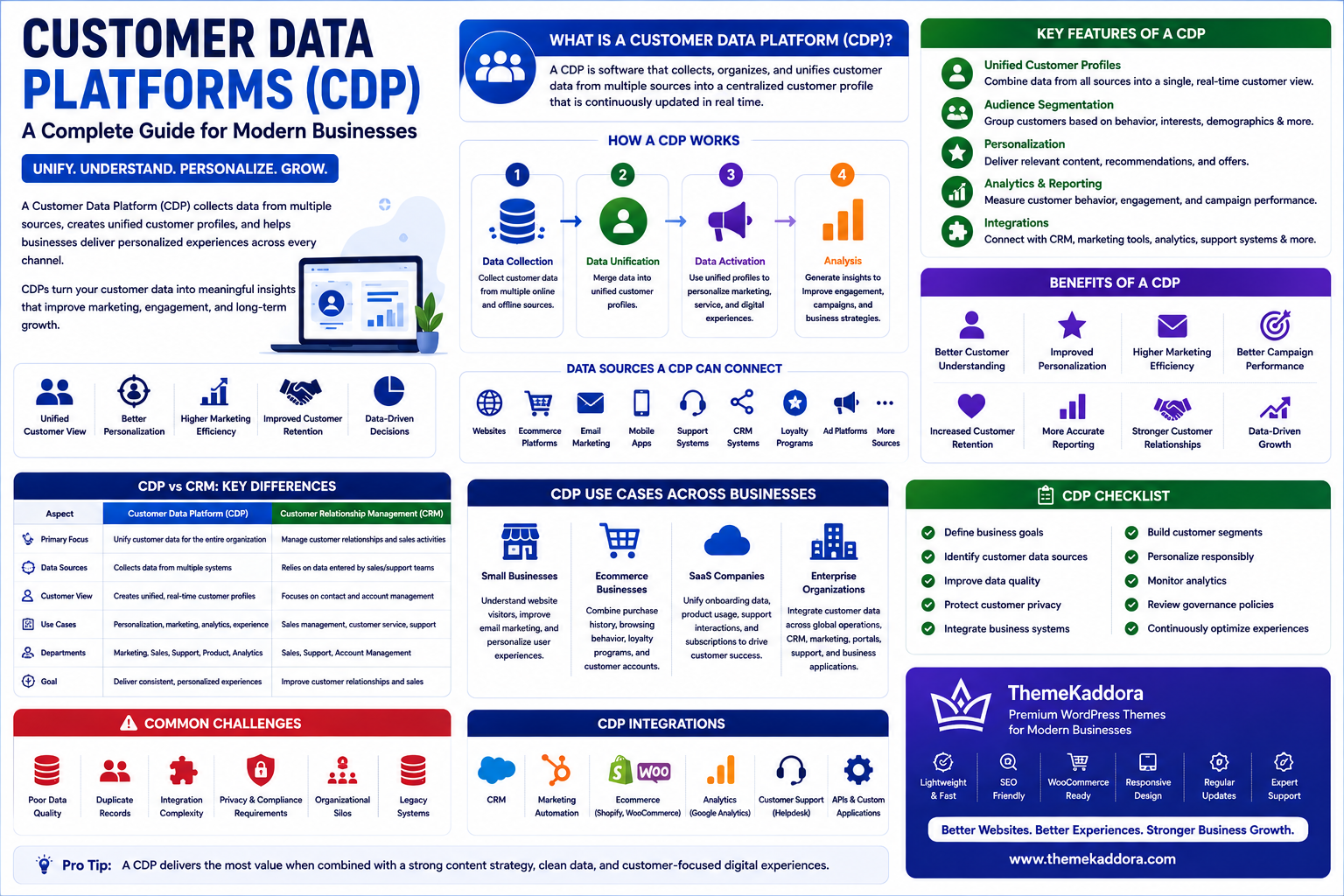
Customer Data Platforms (CDP): A Complete Guide for Modern Businesses
Introduction
Businesses collect customer data from many different sources. Website analytics, online stores, email campaigns, CRM systems, customer support platforms, mobile apps, and social media all generate valuable information.
However, when this information remains scattered across multiple systems, it becomes difficult to understand the complete customer journey.
A Customer Data Platform (CDP) helps businesses bring customer information together into a unified profile, making it easier to deliver personalized experiences, improve marketing performance, and support better business decisions.
As privacy expectations evolve and organizations rely more on first-party data, CDPs are becoming an important part of modern digital strategies.
Whether you operate a WordPress website, ecommerce store, SaaS platform, or enterprise business, understanding CDPs can help you create more connected and customer-focused digital experiences.
What Is a Customer Data Platform?
A Customer Data Platform (CDP) is software that collects, organizes, and unifies customer data from multiple sources into a centralized customer profile.
Unlike isolated databases, a CDP continuously updates customer information as new interactions occur.
A CDP may collect information from:
Business websites
Ecommerce platforms
CRM systems
Email marketing tools
Mobile applications
Customer support systems
Marketing automation platforms
Loyalty programs
The result is a more complete understanding of every customer.
Why Businesses Use CDPs
Organizations adopt Customer Data Platforms to:
Unify customer information
Improve personalization
Better understand customer behavior
Improve marketing efficiency
Support better decision-making
Increase customer retention
Create consistent customer experiences
A unified view of the customer enables more relevant interactions.
How a CDP Works
A Customer Data Platform generally follows four stages:
Data Collection
Collect customer information from multiple online and offline sources.
Data Unification
Merge customer records into unified customer profiles.
Data Activation
Use customer profiles to personalize marketing, customer service, websites, and digital experiences.
Analysis
Generate insights that help improve business strategies and customer engagement.
Key Features
Most Customer Data Platforms include:
Unified Customer Profiles
Combine data from multiple systems into a single customer record.
Audience Segmentation
Group customers based on interests, demographics, behavior, purchase history, or engagement.
Personalization
Deliver relevant website content, product recommendations, and marketing messages.
Analytics and Reporting
Measure customer engagement, campaign performance, and business outcomes.
System Integrations
Connect with CRM software, ecommerce platforms, marketing automation, analytics tools, and customer support systems.
Benefits of a Customer Data Platform
Businesses benefit from:
Better customer understanding
Improved personalization
Higher marketing efficiency
Better customer retention
Improved campaign performance
More accurate reporting
Stronger customer relationships
Customer data becomes more useful when it is organized and accessible.
CDP vs CRM
Customer Data Platform (CDP)
Customer Relationship Management (CRM)
Collects data from multiple systems
Primarily manages customer relationships and sales activities
Creates unified customer profiles
Focuses on sales and customer interactions
Supports personalization
Supports customer relationship management
Integrates multiple data sources
Often relies on manually entered customer information
Used across marketing, service, and analytics
Commonly used by sales and support teams
Many organizations use both systems together.
Best Practices
Define clear business objectives.
Collect only necessary customer data.
Maintain strong data quality.
Respect customer privacy.
Integrate business systems carefully.
Monitor customer insights.
Continuously improve personalization.
Common Challenges
Businesses may encounter:
Poor data quality
Duplicate customer records
Integration complexity
Privacy compliance requirements
Organizational silos
Legacy systems
Planning and governance help reduce these challenges.
Customer Data Platforms Across Different Businesses
Small Businesses
Use customer data to better understand visitors, improve email marketing, and personalize website experiences.
Ecommerce Businesses
Combine purchase history, browsing behavior, loyalty programs, and customer accounts to improve shopping experiences.
SaaS Companies
Unify onboarding data, subscription activity, customer support interactions, and product usage to improve customer success.
Enterprise Organizations
Integrate customer information across departments, regional operations, websites, CRM platforms, marketing systems, and support teams.
WordPress Websites
WordPress websites can participate in CDP strategies through integrations with CRM platforms, WooCommerce, analytics tools, marketing automation software, customer portals, and APIs that connect customer information across business systems.
Customer Data Platform Checklist
Before adopting a CDP strategy, make sure you:
✅ Define business goals
✅ Identify customer data sources
✅ Improve data quality
✅ Protect customer privacy
✅ Integrate business systems
✅ Build customer segments
✅ Personalize responsibly
✅ Monitor analytics
✅ Review governance policies
✅ Continuously optimize customer experiences
Why Choose Themekaddora?
Modern customer experiences begin with a high-performance website.
Themekaddora WordPress themes provide:
Lightweight architecture
Fast loading performance
SEO-friendly code
Responsive layouts
WooCommerce compatibility
Flexible customization
Accessibility-conscious design
Clean HTML5 and CSS3 standards
Cross-browser compatibility
Regular updates
Professional support
These features help businesses build WordPress websites that integrate effectively with Customer Data Platforms while delivering fast, scalable, and customer-focused digital experiences.
Conclusion
Customer Data Platforms help businesses transform scattered customer information into meaningful insights. By creating unified customer profiles and connecting multiple business systems, organizations can deliver better personalization, improve marketing performance, strengthen customer relationships, and make more informed decisions.
As digital ecosystems become increasingly connected, CDPs will continue to play an important role in creating seamless customer experiences across every interaction.
Frequently Asked Questions (FAQs)
What is a Customer Data Platform (CDP)?
A Customer Data Platform (CDP) is software that collects and unifies customer information from multiple systems to create comprehensive customer profiles.
Why is a CDP important?
A CDP helps businesses improve personalization, marketing performance, customer understanding, and decision-making by centralizing customer data.
How is a CDP different from a CRM?
A CDP combines customer data from many systems for organization-wide use, while a CRM primarily focuses on managing sales activities and customer relationships.
Can WordPress integrate with a CDP?
Yes. WordPress can integrate with CRM systems, WooCommerce, analytics tools, marketing automation platforms, customer portals, and APIs, making it a valuable component of a Customer Data Platform strategy.
Why choose Themekaddora?
Themekaddora provides lightweight, SEO-friendly WordPress themes with responsive layouts, WooCommerce compatibility, fast performance, accessibility-conscious design, regular updates, and professional support—helping businesses build WordPress websites that integrate seamlessly with Customer Data Platforms and support long-term digital growth.
Comments (0)