
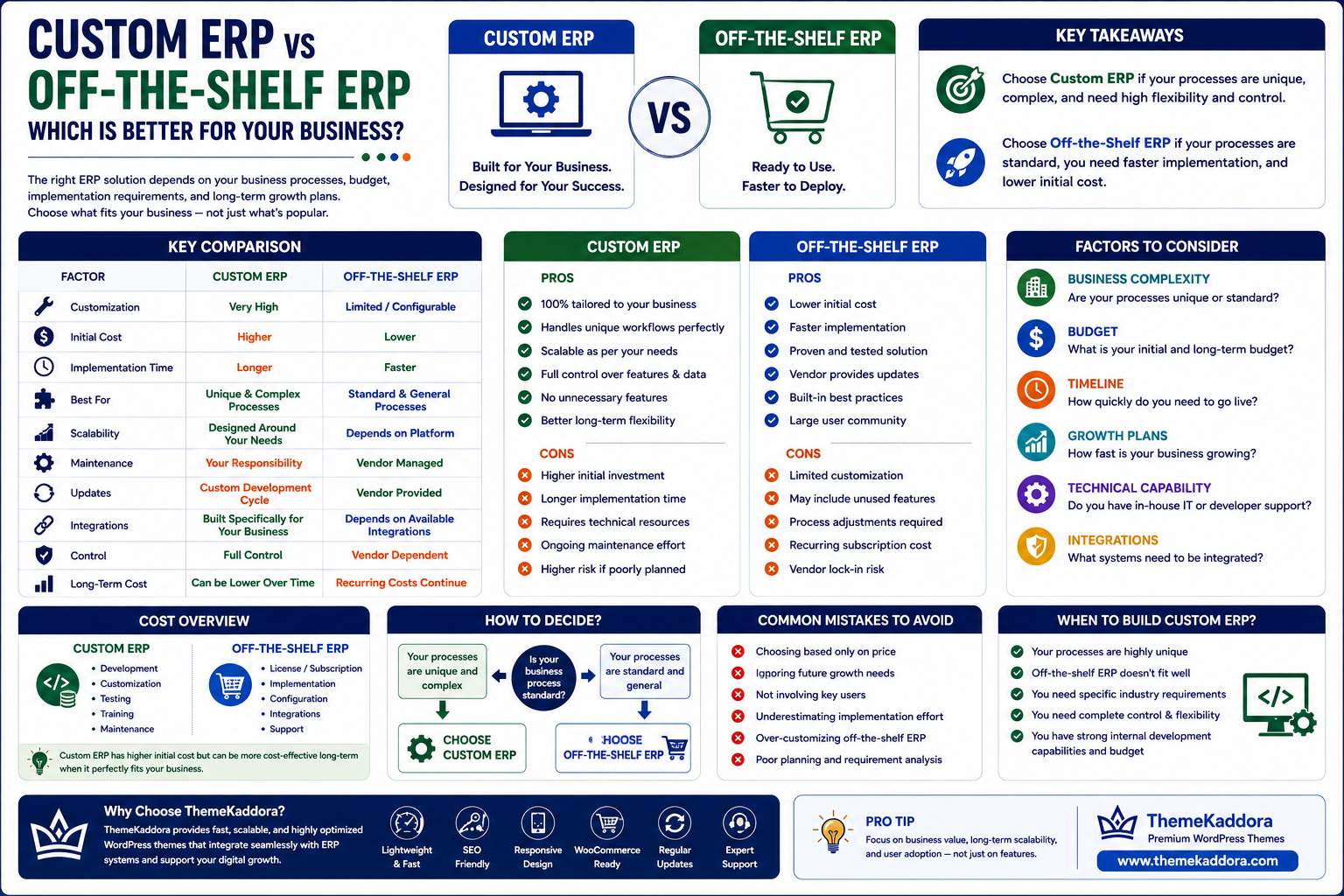
Custom ERP vs Off-the-Shelf ERP: Which Is Better for Your Business?
Introduction
Choosing an Enterprise Resource Planning (ERP) system is a major decision for any growing organization.
ERP software can connect finance, inventory, procurement, sales, human resources, operations, reporting, and other important business processes through a centralized platform.
However, one important question appears before implementation:
Should your business buy an existing ERP system or build a custom ERP solution?
This decision can have a significant impact on cost, implementation time, flexibility, scalability, integrations, maintenance, and long-term business operations.
An off-the-shelf ERP provides pre-built functionality developed for a broad range of businesses. A custom ERP, on the other hand, is designed specifically around the requirements and workflows of an individual organization.
Neither approach is automatically better.
A business with relatively standard processes may benefit from an existing ERP platform that can be configured and deployed quickly. A company with highly specialized workflows may find that a custom ERP provides greater flexibility and control.
The right decision depends on the complexity of your business, available budget, implementation requirements, growth plans, technical capabilities, and the degree to which your processes differ from standard industry workflows.
In this guide, we'll compare custom ERP and off-the-shelf ERP software and explain how
1. What Is Off-the-Shelf ERP?
An off-the-shelf ERP is a pre-built enterprise resource planning platform designed to serve many organizations.
Instead of developing the entire system from scratch, businesses purchase or subscribe to an existing ERP platform and configure it according to their requirements.
Typical off-the-shelf ERP platforms may provide modules for:
Finance
Accounting
Inventory
Procurement
Human resources
Sales
Manufacturing
Projects
Reporting
The biggest advantage is that the core software already exists.
Businesses can therefore focus on configuration, data migration, integrations, and employee training instead of building every feature themselves.
Off-the-shelf ERP can be particularly attractive when a company's processes are relatively standard and closely match the functionality provided by the software.
2. What Is Custom ERP?
A custom ERP is software developed specifically for the requirements of a particular organization.
Instead of adapting business processes to an existing platform, developers build the system around the organization's workflows.
Custom ERP development may include:
Custom dashboards
Industry-specific workflows
Custom approval systems
Specialized inventory processes
Unique financial workflows
Custom HR functionality
Business-specific reports
Specialized integrations
AI-powered automation
For example, a company with a highly specialized manufacturing or distribution workflow may require processes that standard ERP software cannot handle efficiently.
A custom ERP allows developers to create those workflows directly into the platform.
The major advantage is control and flexibility.
However, custom ERP also requires more planning, development, testing, maintenance, and long-term technical management.
3. Custom ERP vs Off-the-Shelf ERP: Key Differences
The fundamental difference is simple:
Off-the-shelf ERP adapts existing software to your business.
Custom ERP adapts the software to your business processes.
Factor
Custom ERP
Off-the-Shelf ERP
Customization
Very high
Usually limited/configurable
Initial development
Higher
Usually lower
Implementation
Potentially longer
Usually faster
Business-specific workflows
Excellent
Depends on platform
Scalability
Designed around requirements
Depends on vendor
Maintenance
Organization/vendor dependent
Usually vendor managed
Updates
Custom development cycle
Vendor provided
Integrations
Can be built specifically
Depends on available integrations
Control
High
Vendor dependent
Best for
Unique processes
Standardized processes
This comparison shows why businesses should not make the decision based only on price.
The best ERP approach depends on how closely the software needs to match the organization's operational model.
4. Cost Comparison
Cost is one of the first factors businesses consider.
At first glance, off-the-shelf ERP often appears less expensive because the software has already been developed.
Businesses may pay for:
Subscription
User licenses
Implementation
Configuration
Integrations
Support
Custom ERP usually requires a larger initial investment because the software must be designed and developed.
Costs may include:
Business analysis
UI/UX design
Software development
Database architecture
Integrations
Testing
Deployment
Training
Maintenance
However, initial price should not be the only consideration.
Businesses should evaluate the Total Cost of Ownership (TCO).
For example, an inexpensive ERP may require significant customization, third-party integrations, additional licenses, or workarounds.
A custom ERP may have a higher initial development cost but could provide better long-term value when highly specialized processes are involved.
The right question is therefore not:
"Which option is cheaper?"
Instead ask:
"Which option provides the best long-term value for our business?"
5. Customization and Flexibility
Customization is one of the biggest differences between the two approaches.
Off-the-shelf ERP systems often provide configuration options such as:
Custom fields
User roles
Workflow settings
Reports
Dashboards
Approval rules
However, there may be limits to how much the platform can be changed.
If a business has unusual processes, employees may need to modify their workflows to fit the ERP.
Custom ERP provides much greater flexibility.
Developers can build features around specific business requirements, including:
Unique workflows
Custom approval chains
Specialized calculations
Industry-specific dashboards
Custom reports
Unique user roles
This can make custom ERP particularly useful for businesses whose processes are a competitive advantage.
However, customization should not be pursued simply because it is possible.
Every additional feature increases development and maintenance requirements.
6. Implementation Time
Implementation time is another major difference.
An off-the-shelf ERP already contains the core functionality, so implementation can focus on:
Configuration
Data migration
Integration
Testing
Training
This can make deployment faster.
Custom ERP requires additional stages such as:
Requirements analysis
Architecture
Design
Development
Testing
Deployment
Training
As a result, custom ERP generally requires a longer development cycle.
However, implementation time should also be evaluated in relation to business complexity.
A highly customized off-the-shelf ERP may require extensive modifications and integrations, reducing the time advantage.
A well-planned custom ERP project can also be implemented in phases, allowing the business to prioritize the most important modules first.
7. Scalability
Both approaches can scale, but they do so differently.
Off-the-shelf ERP scalability depends largely on the vendor's architecture and product roadmap.
Businesses should evaluate:
Maximum users
Transaction capacity
Number of locations
Available modules
Database capabilities
Integration limits
Custom ERP can be designed around the organization's expected growth.
Developers can plan the architecture for:
Additional users
New locations
Larger datasets
Additional modules
New integrations
Increased transaction volumes
However, custom scalability depends heavily on software architecture and development quality.
A poorly designed custom ERP can become difficult to scale just like any other application.
Therefore, scalability should be evaluated technically rather than assumed based on whether the system is custom or pre-built.
8. Security and Data Ownership
Security is an important consideration when choosing between custom and off-the-shelf ERP software.
An off-the-shelf ERP typically comes with security features developed and maintained by the vendor.
Depending on the platform, these may include:
Role-based access control
Data encryption
Multi-factor authentication
Security monitoring
Regular updates
Automated backups
Audit logs
The advantage is that businesses do not necessarily need to build every security mechanism themselves.
However, organizations should carefully review the vendor's security policies, data-storage practices, backup procedures, compliance requirements, and access controls.
With a custom ERP, the organization can have greater control over how the application is designed and how data is stored and accessed.
Custom development can support business-specific requirements such as:
Custom permissions
Specialized access rules
Internal approval systems
Organization-specific audit trails
Custom data retention policies
However, greater control also means greater responsibility.
A custom ERP requires ongoing security maintenance, vulnerability monitoring, updates, backups, and technical management.
Therefore, custom ERP does not automatically mean better security. Security depends on the quality of the architecture, development practices, infrastructure, and ongoing maintenance.
9. ERP Integrations
Modern businesses rarely operate using a single application.
An ERP may need to connect with:
CRM platforms
E-commerce websites
Payment gateways
Banking systems
Payroll software
Shipping platforms
Marketing tools
Communication applications
Business intelligence platforms
Off-the-shelf ERP systems may provide ready-made integrations and APIs.
This can reduce development time when the required integrations are already supported.
However, businesses may face limitations when they need to connect with less common or highly specialized systems.
Custom ERP can be designed specifically around the organization's integration requirements.
Developers can build APIs, webhooks, data synchronization processes, and custom connectors for systems that are unique to the business.
The important question is not simply whether an ERP supports integrations.
Ask:
Can it integrate with the systems your business actually uses?
10. Maintenance and Updates
Maintenance is another major difference between the two approaches.
With an off-the-shelf ERP, the vendor generally manages the core product.
Depending on the platform, this may include:
Software updates
Security patches
Bug fixes
Infrastructure maintenance
New features
Performance improvements
This can reduce the internal technical workload.
However, businesses also depend on the vendor's product roadmap.
A vendor may discontinue a feature, change pricing, modify functionality, or eventually discontinue the product.
With a custom ERP, the organization has greater control over its development roadmap.
Features can be added according to business priorities rather than a vendor's schedule.
However, the organization must also plan for:
Security updates
Bug fixes
Server maintenance
Database optimization
Performance monitoring
Feature development
Technical support
Custom ERP therefore requires a long-term maintenance strategy.
11. Which Businesses Should Choose Off-the-Shelf ERP?
Off-the-shelf ERP can be a strong option when a business has relatively standard operational processes.
It may be suitable for organizations that:
Want faster implementation
Have predictable business workflows
Need established ERP functionality
Have limited internal development resources
Prefer vendor-managed updates
Want access to existing integrations
Prefer predictable software subscriptions
Do not require extensive customization
For example, a growing business that primarily needs accounting, inventory, purchasing, sales, and HR functionality may not need to build an ERP from scratch.
An existing ERP could provide the required functionality more efficiently.
The key is to determine whether the organization's processes can be handled effectively through configuration rather than extensive development.
12. Which Businesses Should Choose Custom ERP?
Custom ERP can be more appropriate when standard software cannot adequately support critical business processes.
It may be suitable for businesses that:
Have highly specialized workflows
Operate in a niche industry
Require unique calculations or processes
Need extensive customization
Require specialized integrations
Want complete control over the platform
Have strong technical requirements
Consider their internal processes a competitive advantage
For example, a company with a unique supply-chain process may find that forcing its operations into a standard ERP creates unnecessary manual work.
A custom solution can be designed around the actual workflow instead.
However, custom ERP should be considered a long-term technology investment rather than simply a software purchase.
13. Can You Combine Both Approaches?
Businesses do not always have to choose completely custom or completely off-the-shelf ERP.
A hybrid approach can sometimes provide the best balance.
For example, a business might use an established ERP for:
Accounting
Inventory
Procurement
HR
while developing custom applications or modules for:
Industry-specific workflows
Specialized customer portals
Custom dashboards
Unique approval systems
Business-specific automation
This approach can reduce development requirements while still providing flexibility where it matters most.
Another option is to select a highly configurable ERP platform and customize only the processes that provide significant business value.
The goal should be to avoid unnecessary development while ensuring that important business requirements are properly supported.
14. Common ERP Selection Mistakes
Choosing between custom and off-the-shelf ERP requires careful planning.
Avoid these common mistakes.
Choosing Only Based on Initial Cost
A lower initial price does not always mean lower long-term costs.
Consider implementation, customization, licensing, maintenance, integrations, training, and support.
Assuming Custom ERP Is Always Better
More customization does not automatically produce better software.
Custom development makes sense when it solves meaningful business problems.
Choosing an ERP Because It Has More Features
A long feature list does not guarantee a good business fit.
Focus on the features your organization actually needs.
Ignoring Existing Workflows
Before selecting a system, document how your business currently operates.
This makes it easier to determine whether standard ERP functionality is sufficient.
Underestimating Maintenance
Custom ERP requires ongoing technical support.
Make sure you have a plan for security, updates, backups, monitoring, and future development.
Ignoring Employee Adoption
The best ERP on paper can still fail if employees find it difficult to use.
User experience and training should be part of the evaluation.
15. How to Decide Between Custom and Ready-Made ERP
A simple decision framework can help.
Choose Off-the-Shelf ERP When:
Your business processes are relatively standard.
You need faster deployment.
You want established features.
You have limited development resources.
Your required integrations are already available.
Vendor-managed updates are important.
Consider Custom ERP When:
Your workflows are highly specialized.
Existing ERP systems require excessive customization.
You need unique integrations.
Your business requires specialized functionality.
You need greater control over the technology.
Your processes provide a competitive advantage.
Consider a Hybrid Approach When:
Most of your requirements are standard.
Only a few processes are highly specialized.
You want to reduce development costs.
You need custom functionality alongside an established ERP.
Before making a final decision, evaluate your requirements using five important questions:
1. How unique are our business processes?
2. How quickly do we need the system?
3. What is our long-term technology budget?
4. How much customization will actually be required?
5. Who will maintain the system after implementation?
The answers can help determine which approach is most appropriate.
16. A Practical Decision Matrix
Requirement
Off-the-Shelf ERP
Custom ERP
Fast deployment
Excellent
Moderate
Standard workflows
Excellent
Good
Highly specialized workflows
Limited
Excellent
Customization
Moderate
Excellent
Initial development cost
Usually lower
Usually higher
Long-term control
Moderate
High
Vendor dependency
Higher
Lower
Internal technical responsibility
Lower
Higher
Unique integrations
Depends on platform
Excellent
Vendor-managed updates
Yes
Usually no
Complete business-specific design
Limited
Excellent
This matrix should not be used as a universal rule.
The right decision depends on the organization's requirements, resources, risk tolerance, and long-term strategy.
17. Why Choose ThemeKaddora?
At ThemeKaddora, we believe technology should support the way a business operates rather than unnecessarily complicating it.
Different businesses may need different combinations of:
ERP
CRM
HRMS
Inventory management
Workflow automation
AI-powered solutions
SaaS applications
Custom business software
For organizations with standard requirements, a configurable ERP approach may be sufficient.
For businesses with highly specialized workflows, custom development may provide greater flexibility.
In some cases, a hybrid strategy can provide the best balance between cost, speed, customization, and scalability.
The important part is to understand the business requirements before deciding which technology approach to use.
Conclusion
The decision between custom ERP and off-the-shelf ERP should not be based solely on price or the number of available features.
Off-the-shelf ERP can provide faster implementation, established functionality, vendor-managed updates, and predictable deployment for businesses with relatively standard processes.
Custom ERP can provide greater flexibility, specialized workflows, deeper control, and business-specific functionality for organizations with unique operational requirements.
A hybrid approach can also be valuable when most business processes are standard but a few areas require specialized functionality.
Before making a decision, document your business processes, identify essential requirements, evaluate integrations, calculate the total cost of ownership, consider scalability, and involve the employees who will use the system.
Most importantly, think beyond the initial implementation.
ERP is a long-term business platform.
The right solution should not only solve today's problems but also provide a practical foundation for future growth.
The best ERP is not necessarily the most expensive, the most customizable, or the one with the most features. It is the one that fits your business requirements and delivers sustainable value.
Frequently Asked Questions
1. What is the difference between custom ERP and off-the-shelf ERP?
Off-the-shelf ERP is pre-built for many businesses, while custom ERP is developed specifically around the requirements and workflows of an individual organization.
2. Is custom ERP more expensive?
Custom ERP usually requires a higher initial investment because the software must be designed and developed. However, long-term cost depends on development, maintenance, integrations, licensing, and business requirements.
3. Which ERP is better for a small business?
Small businesses with standard requirements may benefit from an off-the-shelf ERP because it can provide established functionality without the cost and complexity of building a system from scratch.
4. When should a company choose custom ERP?
Custom ERP can make sense when a company's workflows are highly specialized and existing ERP platforms cannot support important requirements without extensive modifications.
5. Can off-the-shelf ERP be customized?
Yes. Many ERP platforms provide configuration and customization options. However, the level of customization depends on the specific platform.
6. Is custom ERP more scalable?
Custom ERP can be designed around an organization's expected growth, but scalability ultimately depends on the quality of the system architecture and development.
7. Which option is faster to implement?
Off-the-shelf ERP is generally faster because the core software has already been developed. Custom ERP typically requires additional analysis, design, development, and testing.
8. Is custom ERP more secure?
Not automatically. Security depends on architecture, development practices, infrastructure, access controls, monitoring, backups, and ongoing maintenance.
9. Can custom ERP integrate with existing software?
Yes. Custom ERP can be designed to integrate with existing applications through APIs, webhooks, connectors, and custom integrations.
10. Can a business use a hybrid ERP approach?
Yes. A business can use an established ERP for standard functions and add custom modules, applications, or integrations for specialized requirements.
Comments (0)