
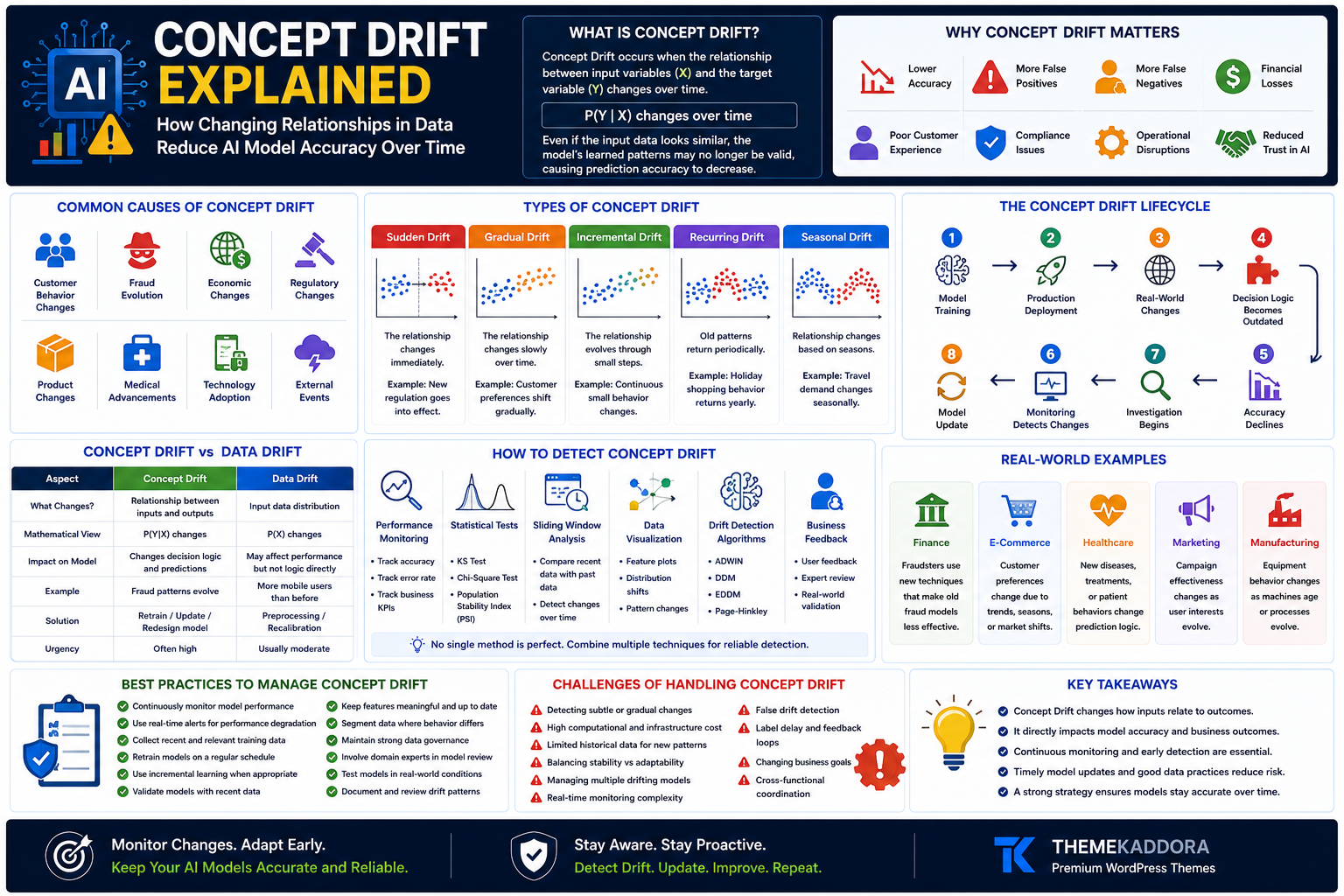
Concept Drift Explained: How Changing Relationships in Data Reduce AI Model Accuracy Over Time
Introduction
Artificial Intelligence models are trained to recognize patterns that exist in historical data. During training, the model learns how input features relate to expected outcomes. These learned relationships allow it to make predictions when new data arrives.
However, the world changes continuously. Consumer preferences evolve, fraud techniques become more sophisticated, diseases develop new variants, regulations change, financial markets fluctuate, and user behavior shifts.
Sometimes the input data itself remains relatively stable, but the meaning of that data changes.
This phenomenon is known as Concept Drift.
Concept Drift occurs when the relationship between input variables and the target outcome changes over time. Even if the data appears familiar, the model's learned decision patterns may no longer be valid.
Because Concept Drift directly affects prediction logic, it is one of the most significant causes of declining AI performance in production systems.
What Is Concept Drift?
Concept Drift occurs when the relationship between input variables (X) and the target variable (Y) changes after a model has been deployed.
Mathematically:
P(Y | X) changes over time
Unlike Data Drift, where the input distribution changes, Concept Drift changes how those inputs should be interpreted.
For example:
A fraud detection model may continue receiving transactions with similar amounts, locations, and payment methods. However, criminals develop new attack techniques that make previously safe transaction patterns suspicious.
The input data has not changed dramatically, but the relationship between the inputs and fraud has changed.
As a result, prediction accuracy decreases.
Why Concept Drift Matters
Concept Drift directly affects how an AI model makes decisions.
If left unmanaged, organizations may experience:
Lower prediction accuracy
More false positives
More false negatives
Poor customer experiences
Financial losses
Increased fraud
Compliance issues
Incorrect medical recommendations
Operational disruptions
Reduced trust in AI
Unlike simple data-quality issues, Concept Drift often requires updating the model's learned behavior.
Common Causes of Concept Drift
Several real-world factors can change the relationship between inputs and outputs.
Customer Behavior Changes
Buying habits, browsing patterns, and preferences evolve over time.
Fraud Evolution
Fraudsters constantly develop new techniques that invalidate older detection models.
Economic Changes
Inflation, unemployment, market shifts, and consumer confidence influence predictive relationships.
Regulatory Changes
New laws may change business processes or customer behavior.
Product Changes
Launching new products or pricing strategies changes customer decisions.
Medical Advancements
New diseases, treatments, and diagnostic methods alter healthcare predictions.
Technology Adoption
New devices, payment methods, software, or communication platforms influence user behavior.
External Events
Natural disasters, pandemics, political events, or supply-chain disruptions can rapidly change predictive relationships.
Types of Concept Drift
Concept Drift can occur in several ways.
Sudden Drift
The relationship changes immediately.
Example:
A new regulation instantly changes customer eligibility rules.
Gradual Drift
The relationship changes slowly over time.
Example:
Customers gradually adopt a new purchasing behavior.
Incremental Drift
The relationship evolves continuously through many small changes.
Example:
Consumer preferences slowly shift toward sustainable products.
Recurring Drift
Older patterns return periodically.
Example:
Holiday shopping behavior repeats every year.
Seasonal Drift
Predictive relationships change according to predictable seasonal cycles.
Example:
Travel demand changes during summer and winter.
How Concept Drift Happens
A typical Concept Drift lifecycle includes:
1. Model Training
The AI learns historical relationships between inputs and outputs.
2. Production Deployment
The model begins making predictions.
3. Real-World Changes
Business conditions, customer behavior, or external factors evolve.
4. Decision Logic Becomes Outdated
The learned relationships no longer match reality.
5. Prediction Accuracy Declines
The model begins making more incorrect predictions.
6. Monitoring Detects Performance Changes
Accuracy, error rates, and business KPIs reveal degradation.
7. Investigation Begins
Teams use AI Observability, monitoring dashboards, and business analysis to determine the cause.
8. Model Update
Organizations retrain, redesign, or replace the model using current data.
Concept Drift vs Data Drift
Concept Drift
Data Drift
Relationship between inputs and outputs changes
Input data distribution changes
P(Y|X) changes
P(X) changes
Directly affects prediction logic
Changes model inputs
Often requires retraining
May or may not require retraining
Usually detected through performance metrics
Usually detected through statistical analysis
Data Drift changes what the model receives. Concept Drift changes how the model should interpret what it receives.
Concept Drift vs Model Drift
Concept Drift
Model Drift
Specific cause of declining performance
Overall decline in model effectiveness
Changes predictive relationships
Measures prediction degradation
Focuses on changing concepts
Focuses on operational performance
Often causes Model Drift
Can result from multiple causes
Concept Drift is one important cause of Model Drift, but not the only one.
How Organizations Detect Concept Drift
Detecting Concept Drift often requires both technical metrics and business feedback.
Accuracy Monitoring
Track prediction accuracy over time.
Error Analysis
Monitor false positives, false negatives, precision, recall, and F1 score.
Ground Truth Comparison
Compare predictions with verified outcomes.
Business KPI Monitoring
Track fraud losses, conversion rates, customer satisfaction, revenue, and operational quality.
Window-Based Evaluation
Compare recent performance with historical performance using rolling time windows.
Statistical Drift Detection Algorithms
Common approaches include:
DDM (Drift Detection Method)
EDDM (Early Drift Detection Method)
ADWIN (Adaptive Windowing)
Page-Hinkley Test
CUSUM
AI Observability
Combine logs, traces, evaluations, and monitoring metrics to identify root causes.
Human Review
Domain experts evaluate whether business conditions have fundamentally changed.
How to Manage and Reduce Concept Drift
Organizations reduce Concept Drift through continuous AI lifecycle management.
Monitor Production Performance
Measure technical and business metrics continuously.
Retrain Models Regularly
Use recent, representative data to refresh decision logic.
Automate Drift Detection
Generate alerts when prediction quality declines.
Use Rolling Training Data
Replace outdated observations with newer examples.
Validate Before Deployment
Test retrained models thoroughly before release.
Maintain Human Oversight
Review uncertain or high-risk predictions.
Improve Documentation
Record drift events, retraining decisions, datasets, and model versions.
Monitor Business Changes
Coordinate with business teams to understand changes that may affect model behavior.
Real-World Applications
Concept Drift affects nearly every AI-powered industry.
Finance
Credit scoring
Fraud detection
Loan approval
Healthcare
Disease diagnosis
Patient risk prediction
Clinical decision support
Insurance
Claims prediction
Risk assessment
Premium pricing
Retail
Product recommendations
Customer segmentation
Demand forecasting
Manufacturing
Predictive maintenance
Quality inspection
Failure prediction
Cybersecurity
Threat detection
Malware classification
Intrusion detection
Customer Support
Intent detection
Chatbot responses
Ticket routing
Benefits of Detecting Concept Drift
Organizations that detect Concept Drift early gain many benefits.
Benefits include:
Higher prediction accuracy
Reduced financial losses
Better customer experiences
Lower operational risk
Faster retraining decisions
Improved AI reliability
Better regulatory readiness
Longer model lifespan
Higher business confidence
Better return on AI investments
Challenges and Limitations
Managing Concept Drift presents several challenges.
Common challenges include:
Delayed outcome labels
Complex foundation models
Continuous business change
False-positive alerts
Large production datasets
Seasonal effects
Third-party AI models
Difficult root-cause analysis
High retraining costs
Balancing automation with human review
Organizations should evaluate both technical metrics and business context before taking corrective action.
Concept Drift in Everyday Business
Many production AI systems experience Concept Drift.
Examples include:
Fraud detection
Credit approval
Personalized marketing
Medical diagnosis
Recommendation engines
Dynamic pricing
Predictive maintenance
AI customer support
Continuous monitoring helps organizations recognize when historical decision logic no longer reflects current reality.
Future of Concept Drift Management
Future developments include:
Self-adaptive AI models
Automated retraining pipelines
Real-time drift detection
Continuous evaluation systems
AI-powered root-cause analysis
Business-aware monitoring
Autonomous MLOps platforms
Integrated AI governance
Drift forecasting
Self-healing AI operations
As AI systems become more autonomous, managing Concept Drift will become increasingly automated while preserving human oversight for critical decisions.
Common Misconceptions
Several myths surround Concept Drift.
Common misconceptions include:
Concept Drift and Data Drift are identical.
Retraining always solves Concept Drift.
Drift only affects machine learning models.
Stable input data means stable predictions.
Monitoring alone prevents Concept Drift.
Drift only happens after long periods.
In reality, Concept Drift can occur suddenly, gradually, or repeatedly depending on changing real-world conditions.
Final Thoughts
Concept Drift is one of the most important challenges in production Artificial Intelligence. As customer behavior, business environments, regulations, and markets evolve, the relationships that AI models learned during training gradually become outdated.
Organizations that continuously monitor prediction quality, evaluate business outcomes, retrain models, and apply AI Observability can detect Concept Drift early and maintain reliable AI systems over time.
Understanding the difference between Data Drift, Model Drift, and Concept Drift is essential for building robust, trustworthy, and scalable enterprise AI solutions.
Frequently Asked Questions
What is Concept Drift?
Concept Drift occurs when the relationship between input variables and target outcomes changes after an AI model has been deployed.
How is Concept Drift different from Data Drift?
Data Drift changes the distribution of input data, while Concept Drift changes how those inputs relate to the expected outcome.
What causes Concept Drift?
Common causes include changing customer behavior, fraud evolution, economic changes, regulations, product updates, technology adoption, and external events.
How do organizations detect Concept Drift?
Organizations monitor accuracy, business KPIs, error rates, rolling evaluation windows, statistical drift algorithms, AI Observability, and verified outcomes.
Can Concept Drift be prevented?
It cannot be eliminated completely because real-world conditions continually evolve. Organizations manage it through continuous monitoring, retraining, validation, and governance.
Why is Concept Drift important?
Because it changes prediction logic itself, Concept Drift can significantly reduce model accuracy even when input data appears normal.
Comments (0)