
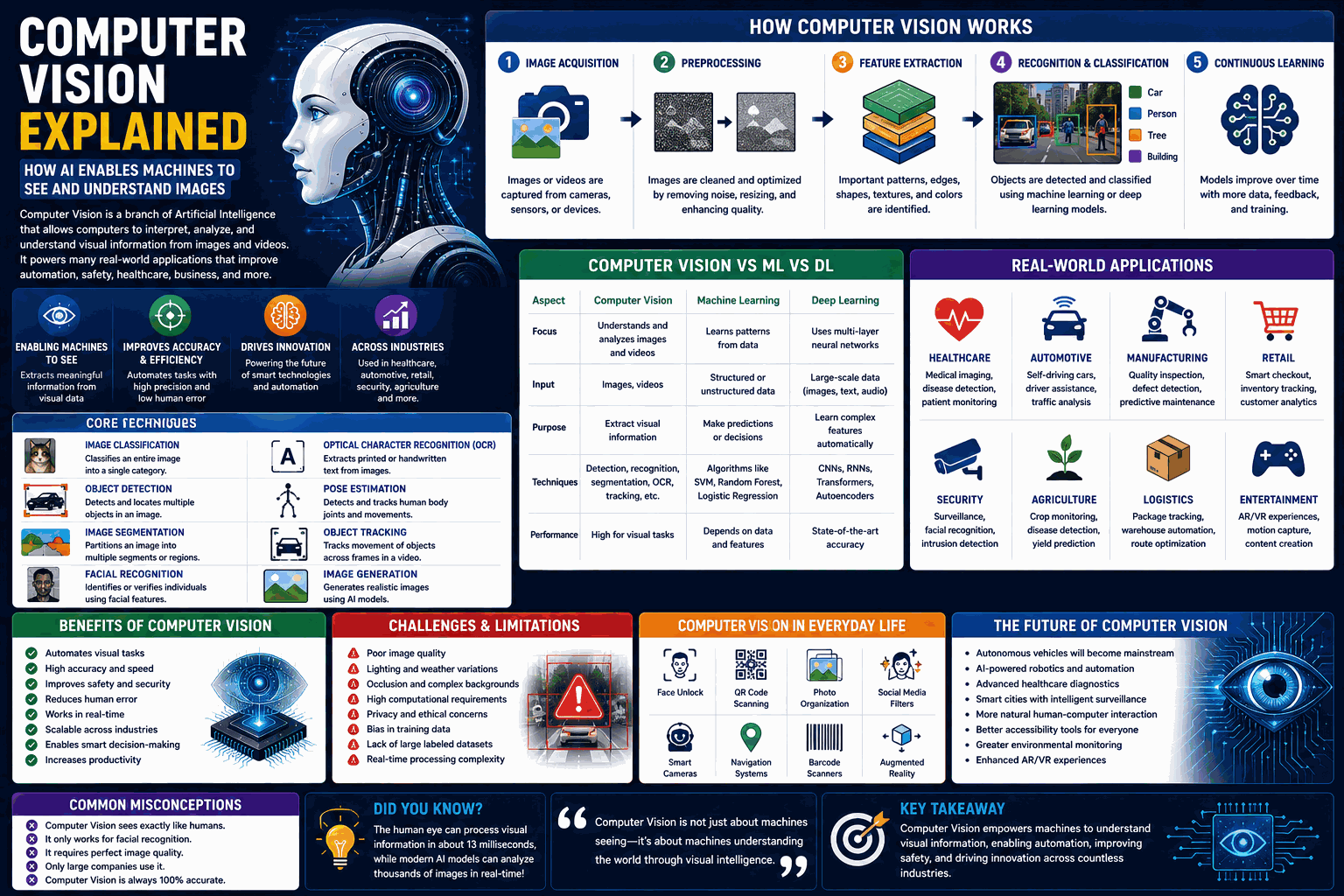
Computer Vision Explained: How AI Enables Machines to See and Understand Images
Introduction
Computer Vision is one of the most exciting and rapidly advancing fields within Artificial Intelligence (AI). It enables computers to interpret, analyze, and understand visual information from images and videos, allowing machines to "see" the world in ways that were once possible only for humans.
From facial recognition and self-driving cars to medical imaging, manufacturing quality inspection, security surveillance, and augmented reality, Computer Vision powers countless technologies that are transforming industries across the globe.
By combining Artificial Intelligence, Machine Learning, and Deep Learning, Computer Vision allows machines to identify objects, recognize faces, detect patterns, read text, analyze movements, and make intelligent decisions based on visual data.
As digital cameras, smartphones, drones, and IoT devices continue generating massive amounts of visual information, Computer Vision has become a critical technology for automation, safety, healthcare, business intelligence, and scientific research.
What Is Computer Vision?
Computer Vision is a branch of Artificial Intelligence that enables computers to acquire, process, analyze, and understand images and videos.
Unlike humans, who naturally recognize objects and scenes, computers require sophisticated algorithms to extract meaningful information from visual data.
Computer Vision systems can:
Detect objects
Recognize faces
Read printed text
Track movement
Analyze medical images
Classify images
Measure distances
Understand scenes
Modern Computer Vision systems use deep neural networks to achieve remarkable accuracy.
How Computer Vision Works
Although Computer Vision systems vary in complexity, most follow a structured workflow.
1. Image Acquisition
The system captures visual data from various sources.
Examples include:
Digital cameras
Smartphones
CCTV cameras
Medical scanners
Satellites
Drones
Industrial sensors
High-quality images improve analysis accuracy.
2. Image Preprocessing
Before analysis begins, images are cleaned and optimized.
Typical preprocessing includes:
Noise reduction
Image resizing
Color correction
Contrast enhancement
Image normalization
Edge enhancement
These steps improve recognition performance.
3. Feature Extraction
The AI identifies important visual features such as:
Edges
Shapes
Colors
Textures
Patterns
Corners
Objects
Deep learning models automatically learn these features during training.
4. Object Recognition and Classification
The model compares learned patterns with new images to identify:
People
Vehicles
Animals
Buildings
Products
Documents
Medical conditions
The system then classifies the detected objects into predefined categories.
5. Continuous Learning
Modern Computer Vision systems improve over time through:
Larger datasets
Better model training
Human feedback
Transfer learning
Model optimization
Continuous improvement leads to higher accuracy and better performance.
Core Computer Vision Techniques
Computer Vision includes several specialized techniques.
Image Classification
Assigns an entire image to a specific category.
Object Detection
Identifies and locates multiple objects within an image.
Image Segmentation
Separates different objects or regions inside an image.
Facial Recognition
Identifies or verifies individuals using facial features.
Optical Character Recognition (OCR)
Extracts printed or handwritten text from images.
Pose Estimation
Tracks body movements and joint positions.
Image Generation
Creates realistic images using deep learning models.
Computer Vision vs Machine Learning vs Deep Learning
Although related, these technologies have different roles.
Computer Vision
Machine Learning
Deep Learning
Focuses on visual understanding
Learns patterns from data
Uses deep neural networks
Processes images and videos
Broad AI learning method
Powers modern Computer Vision
Detects visual objects
Builds predictive models
Learns visual features automatically
Today's Computer Vision systems rely heavily on Deep Learning.
Real-World Applications of Computer Vision
Computer Vision is transforming many industries.
Healthcare
Medical image analysis
Disease detection
Radiology assistance
Automotive
Self-driving vehicles
Driver monitoring
Traffic analysis
Manufacturing
Product inspection
Defect detection
Robotic automation
Retail
Automated checkout
Inventory monitoring
Customer analytics
Agriculture
Crop monitoring
Disease detection
Precision farming
Security
Surveillance
Facial recognition
Intrusion detection
Benefits of Computer Vision
Computer Vision offers numerous advantages.
Benefits include:
Faster image analysis
Improved accuracy
Better automation
Enhanced safety
Reduced human error
Scalable monitoring
Real-time decision making
Increased operational efficiency
Organizations increasingly use Computer Vision to automate visual inspection and improve productivity.
Challenges and Limitations
Despite its capabilities, Computer Vision still faces several challenges.
These include:
Poor image quality
Lighting variations
Occlusion of objects
Privacy concerns
Dataset bias
High computational requirements
Real-time processing complexity
Ethical considerations
Ongoing research continues addressing these limitations.
Computer Vision in Everyday Life
Most people already use Computer Vision every day.
Examples include:
Smartphone face unlock
QR code scanning
Photo organization
Security cameras
Social media filters
Self-driving features
Barcode scanners
Augmented reality applications
Computer Vision has become an essential technology behind many modern digital experiences.
Future of Computer Vision
Future developments include:
Fully autonomous vehicles
Smarter healthcare diagnostics
AI-powered robotics
Advanced industrial automation
Smart city infrastructure
Precision agriculture
Mixed reality experiences
Enhanced environmental monitoring
Computer Vision will continue expanding as AI systems become more intelligent and efficient.
Common Misconceptions
Several myths exist about Computer Vision.
Common misconceptions include:
Computer Vision sees exactly like humans.
It only works for facial recognition.
It requires perfect image quality.
Only large companies use Computer Vision.
Computer Vision is always 100% accurate.
In reality, Computer Vision is a rapidly evolving technology that continues improving through better models, larger datasets, and more advanced AI systems.
Final Thoughts
Computer Vision is transforming how machines interpret the visual world. From medical diagnostics and autonomous driving to smart manufacturing and augmented reality, this technology enables computers to analyze images with remarkable speed and accuracy.
As Artificial Intelligence continues advancing, Computer Vision will remain one of its most influential technologies, helping businesses automate complex visual tasks, improve safety, and create smarter digital experiences. Understanding Computer Vision provides valuable insight into how AI is reshaping industries and the future of intelligent automation.
Frequently Asked Questions
What is Computer Vision?
Computer Vision is a branch of Artificial Intelligence that enables computers to understand and analyze images and videos.
Is Computer Vision part of AI?
Yes. Computer Vision is one of the major fields within Artificial Intelligence.
Does Computer Vision use Deep Learning?
Yes. Most modern Computer Vision systems use Deep Learning models such as Convolutional Neural Networks (CNNs).
What industries use Computer Vision?
Healthcare, manufacturing, retail, automotive, agriculture, security, robotics, logistics, education, and many others.
Why is Computer Vision important?
Computer Vision enables machines to understand visual information, making automation, healthcare, transportation, and many intelligent applications possible.
Comments (0)