
Business Workflow Optimization Guide: How to Improve Efficiency and Productivity
Introduction
Every business depends on workflows to complete daily operations. Whether responding to customers, processing invoices, publishing content, or managing projects, every task follows a sequence of steps.
As organizations grow, these workflows often become more complex. Manual processes, duplicated work, communication delays, and outdated systems can reduce productivity and increase operational costs.
Business Workflow Optimization focuses on improving how work moves through an organization. By removing unnecessary steps, automating repetitive tasks, and improving collaboration, businesses can operate more efficiently while delivering better experiences for customers and employees.
Whether you manage a startup, an ecommerce business, a marketing agency, or a WordPress-powered website, optimizing workflows creates a strong foundation for long-term success.
What Is Business Workflow Optimization?
Business Workflow Optimization is the process of analyzing, improving, and managing business workflows to increase efficiency and reduce unnecessary effort.
A workflow may include:
Customer inquiries
Sales approvals
Content publishing
Invoice processing
Employee onboarding
Marketing campaigns
Project management
Product fulfillment
The objective is to complete work faster, more accurately, and with fewer resources.
Why Workflow Optimization Matters
Businesses optimize workflows to:
Improve productivity
Reduce operational costs
Eliminate bottlenecks
Increase collaboration
Improve customer satisfaction
Reduce manual errors
Support business scalability
Efficient workflows help organizations respond faster to changing business needs.
Steps to Optimize Business Workflows
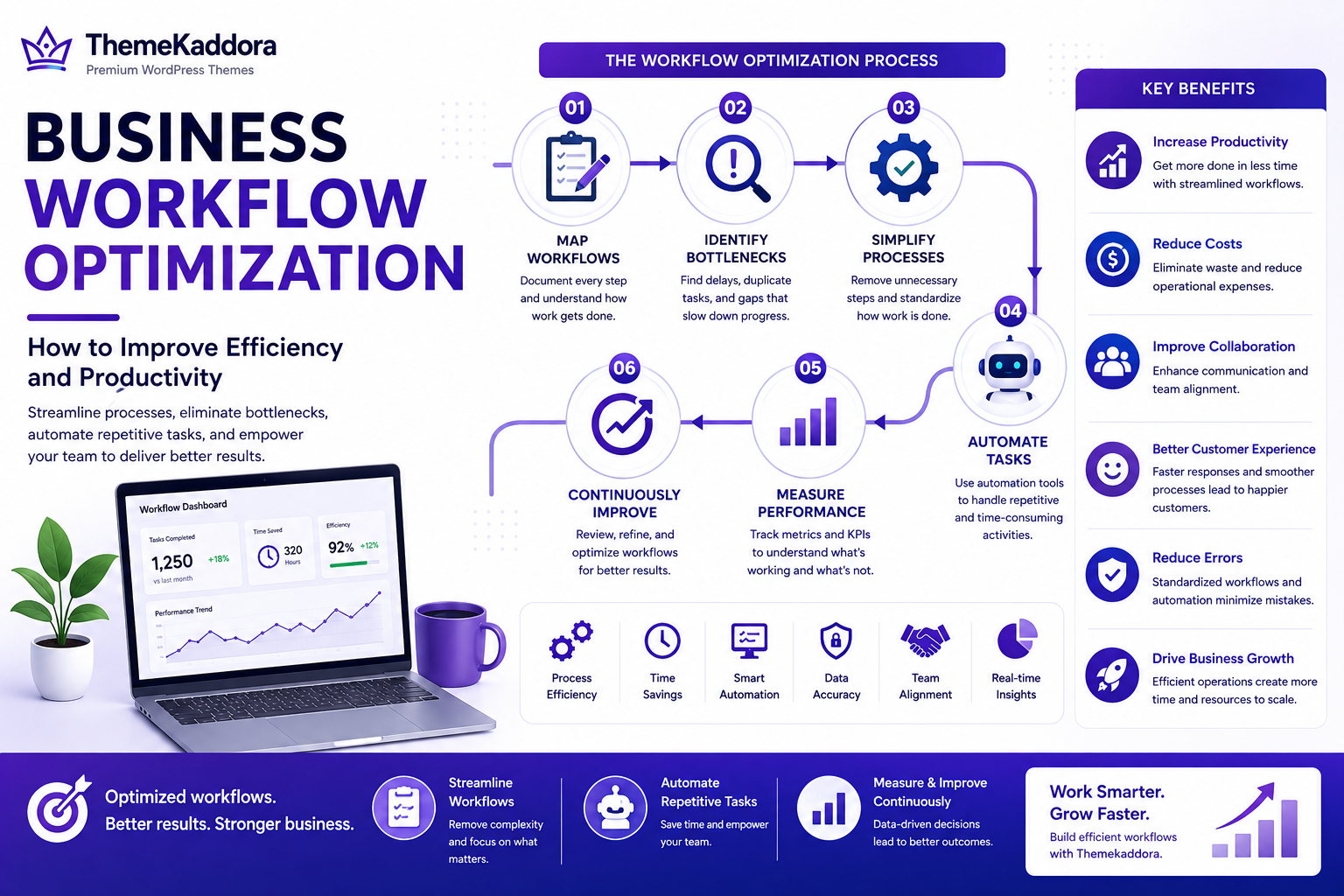
1. Map Existing Workflows
Document each step of your current process to understand how work moves through your organization.
2. Identify Bottlenecks
Look for delays, duplicated tasks, unnecessary approvals, and communication gaps that slow productivity.
3. Simplify Processes
Remove unnecessary steps and standardize repetitive activities wherever possible.
4. Introduce Automation
Automate repetitive tasks such as notifications, approvals, reporting, scheduling, and data entry using appropriate business tools.
5. Measure Performance
Track key metrics including processing time, completion rates, error frequency, customer satisfaction, and employee productivity.
6. Continuously Improve
Review workflows regularly as your business grows and customer expectations evolve.
Common Workflow Challenges
Businesses frequently experience:
Manual processes
Poor communication
Duplicate work
Outdated software
Lack of documentation
Limited visibility into projects
Addressing these issues improves both operational efficiency and customer experience.
Best Practices
Document important workflows.
Standardize routine tasks.
Automate repetitive activities.
Encourage cross-team collaboration.
Monitor workflow performance.
Train employees regularly.
Review and improve processes continuously.
Workflow Optimization Across Different Businesses
Small Businesses
Improve scheduling, invoicing, customer communication, and administrative workflows to save time.
Ecommerce Businesses
Optimize order processing, inventory updates, shipping, customer support, and returns management.
Marketing Agencies
Improve campaign planning, client approvals, content production, reporting, and project management.
Enterprise Organizations
Coordinate departments through standardized workflows, automation, governance, and performance monitoring.
WordPress Websites
WordPress businesses can optimize content publishing, WooCommerce order management, lead generation, customer support, email marketing, and website maintenance through efficient workflows and automation.
Business Workflow Optimization Checklist
Before improving workflows, make sure you:
✅ Map existing processes
✅ Identify bottlenecks
✅ Eliminate unnecessary steps
✅ Standardize workflows
✅ Automate repetitive tasks
✅ Train employees
✅ Measure workflow performance
✅ Improve collaboration
✅ Review processes regularly
✅ Continuously optimize
Why Choose Themekaddora?
Efficient workflows benefit from a reliable website.
Themekaddora WordPress themes provide:
Lightweight architecture
Fast loading performance
SEO-friendly code
Responsive layouts
WooCommerce compatibility
Flexible customization
Accessibility-conscious design
Clean HTML5 and CSS3 standards
Cross-browser compatibility
Regular updates
Professional support
These features help businesses build fast, scalable WordPress websites that support streamlined workflows and long-term operational efficiency.
Conclusion
Business Workflow Optimization is an ongoing process that helps organizations improve productivity, reduce costs, and deliver better customer experiences. By analyzing workflows, removing bottlenecks, introducing automation, and measuring results, businesses can create more efficient operations that support sustainable growth.
Whether you're managing a startup, an ecommerce platform, or a WordPress website, optimizing workflows today prepares your business for tomorrow's opportunities.
Frequently Asked Questions (FAQs)
What is Business Workflow Optimization?
Business Workflow Optimization is the process of improving business workflows to increase efficiency, reduce delays, and improve productivity.
Why is workflow optimization important?
It helps businesses eliminate bottlenecks, reduce operational costs, improve customer satisfaction, and support long-term growth.
How can businesses optimize workflows?
Businesses can map existing processes, identify inefficiencies, simplify tasks, automate repetitive work, monitor performance, and continuously improve operations.
Can small businesses benefit from workflow optimization?
Yes. Small businesses can improve efficiency by streamlining scheduling, invoicing, customer communication, and administrative processes.
Why choose Themekaddora?
Themekaddora provides lightweight, SEO-friendly WordPress themes with responsive layouts, WooCommerce compatibility, fast performance, accessibility-conscious design, regular updates, and professional support—helping businesses build websites that support efficient workflows and sustainable business growth.
Comments (0)