
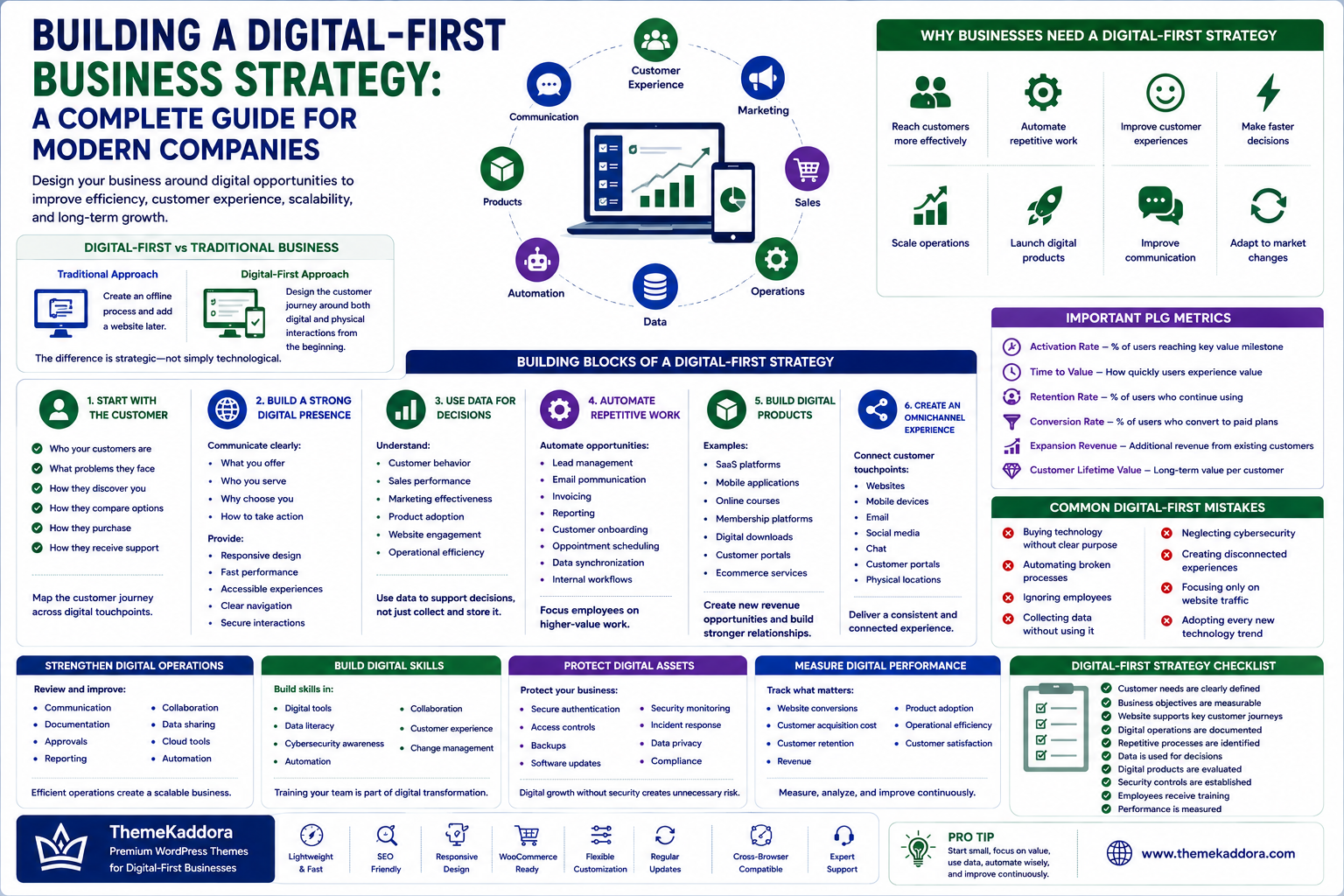
Building a Digital-First Business Strategy: A Complete Guide for Modern Companies
Introduction
Digital technology is no longer a separate department within most businesses.
Websites, ecommerce platforms, cloud software, online payments, automation, analytics, artificial intelligence, customer portals, and digital communication are now part of everyday business operations.
This shift has created a new strategic approach: the digital-first business.
A digital-first strategy does not mean replacing every traditional process with technology.
It means designing business operations, customer experiences, products, and decision-making around the opportunities created by digital technology.
For modern businesses, becoming digital-first can improve efficiency, customer experience, scalability, and the ability to respond to changing markets.
What Is a Digital-First Business Strategy?
A digital-first business strategy places digital channels and technologies at the center of how an organization creates and delivers value.
It considers digital technology across:
Customer experience
Marketing
Sales
Operations
Products
Communication
Data
Automation
Decision-making
The goal is to use digital capabilities strategically rather than simply adding more software.
Digital-First vs Traditional Business
A traditional approach may treat digital channels as supporting tools.
A digital-first approach considers digital experiences from the beginning.
For example:
Traditional approach:
Create an offline process and add a website later.
Digital-first approach:
Design the customer journey around both digital and physical interactions from the beginning.
The difference is strategic—not simply technological.
Why Businesses Need a Digital-First Strategy
A strong digital-first strategy can help businesses:
Reach customers more effectively
Automate repetitive work
Improve customer experiences
Make faster decisions
Scale operations
Launch digital products
Improve communication
Adapt to market changes
Digital capabilities can become a competitive advantage when they are aligned with business objectives.
Start With the Customer
Digital-first businesses should begin with customer needs.
Understand:
Who your customers are
What problems they experience
How they discover your business
How they compare options
How they purchase
How they receive support
Map the customer journey across digital touchpoints.
Build a Strong Digital Presence
A business website is often the foundation of a digital-first strategy.
Your website should clearly communicate:
What you offer
Who you serve
Why customers should choose you
How customers can take action
It should also provide:
Responsive design
Fast performance
Accessible experiences
Clear navigation
Secure interactions
Use Data for Decision-Making
Digital businesses generate valuable information.
Organizations can use data to understand:
Customer behavior
Sales performance
Marketing effectiveness
Product adoption
Website engagement
Operational efficiency
Data should support decisions rather than simply being collected and stored.
Automate Repetitive Work
Automation can help digital-first businesses reduce manual effort.
Potential opportunities include:
Lead management
Email communication
Invoicing
Reporting
Customer onboarding
Appointment scheduling
Data synchronization
Internal workflows
The objective is to allow employees to focus on higher-value work.
Build Digital Products
Digital-first businesses can create products and services that operate primarily through technology.
Examples include:
SaaS platforms
Mobile applications
Online courses
Membership platforms
Digital downloads
Customer portals
Ecommerce services
Digital products can create new revenue opportunities and improve customer relationships.
Create an Omnichannel Experience
Customers may interact with businesses through:
Websites
Mobile devices
Social media
Chat
Customer portals
Physical locations
These interactions should feel connected rather than fragmented.
An omnichannel strategy creates a more consistent customer journey.
Strengthen Digital Operations
Digital-first organizations should review internal workflows.
Look for opportunities to improve:
Communication
Documentation
Approvals
Reporting
Collaboration
Data sharing
Cloud tools and automation can reduce unnecessary manual processes.
Build Digital Skills
Technology alone cannot create a digital-first business.
Employees need appropriate skills in areas such as:
Digital tools
Data literacy
Cybersecurity awareness
Automation
Collaboration
Customer experience
Training should be treated as part of digital transformation.
Protect Digital Assets
Digital-first businesses depend heavily on technology.
Protect important assets through:
Secure authentication
Access controls
Backups
Software updates
Security monitoring
Incident response planning
Digital growth without digital security creates unnecessary risk.
Measure Digital Performance
Define measurable objectives.
Useful metrics include:
Website conversions
Customer acquisition cost
Customer retention
Revenue
Product adoption
Operational efficiency
Customer satisfaction
Choose metrics that connect directly to business goals.
Common Digital-First Strategy Mistakes
Avoid:
Buying technology without a clear purpose
Automating broken processes
Ignoring employees
Collecting data without using it
Neglecting cybersecurity
Creating disconnected customer experiences
Focusing only on website traffic
Adopting every new technology trend
Digital-first does not mean technology-first.
The business objective should remain central.
Digital-First Strategy for WordPress Businesses
WordPress can become an important part of a digital-first ecosystem.
Businesses can use WordPress for:
Corporate websites
Ecommerce
Content marketing
Membership platforms
Online communities
Customer portals
Digital publishing
WordPress can also connect with external services through APIs, automation platforms, analytics tools, CRM systems, and ecommerce solutions.
The key is designing the website as part of the wider business system.
Digital-First Business Strategy Checklist
Before implementing your strategy, confirm:
✅ Customer needs are clearly defined
✅ Business objectives are measurable
✅ Website supports key customer journeys
✅ Digital operations are documented
✅ Repetitive processes are identified
✅ Data is used for decisions
✅ Digital products are evaluated
✅ Security controls are established
✅ Employees receive appropriate training
✅ Performance is measured
Why Choose Themekaddora?
A digital-first business needs a website foundation that can support changing customer expectations and business requirements.
Themekaddora WordPress themes provide:
Lightweight architecture
Fast loading performance
Responsive layouts
SEO-friendly code
WooCommerce compatibility
Flexible customization
Accessibility-conscious design
Clean HTML5 and CSS3 standards
Cross-browser compatibility
Regular updates
Professional support
These capabilities help businesses create professional WordPress websites that can become an important part of their broader digital-first strategy.
Conclusion
Building a digital-first business is not simply about purchasing more technology.
It is about redesigning how the business creates value, serves customers, operates internally, uses data, and responds to change.
The strongest digital-first strategies combine:
Customer-centric thinking
Efficient operations
Digital products
Automation
Data-driven decisions
Secure technology
Continuous improvement
Businesses that approach digital transformation strategically can create stronger customer experiences and more adaptable operations.
The future of business will not simply be digital.
For many organizations, being digital will be fundamental to how the business operates.
Frequently Asked Questions (FAQs)
What is a digital-first business strategy?
A digital-first business strategy places digital channels, technologies, data, and customer experiences at the center of how a business operates and creates value.
Is digital-first the same as digital transformation?
They are closely related but not identical. Digital transformation describes the broader process of changing business operations through technology, while a digital-first strategy establishes digital thinking as a core part of business strategy.
How can a small business become digital-first?
Start with a strong website, digital customer communication, online payments, cloud tools, automation, data-driven decisions, and secure digital operations. Focus on practical improvements rather than adopting technology for its own sake.
Can WordPress support a digital-first business?
Yes. WordPress can support websites, ecommerce, memberships, content platforms, customer portals, and integrations with many external digital services.
What is the most important part of a digital-first strategy?
Start with the customer and business objectives. Technology should solve meaningful problems and create measurable value rather than becoming the strategy itself.
Why choose Themekaddora?
Themekaddora provides lightweight, SEO-friendly WordPress themes with responsive layouts, WooCommerce compatibility, fast performance, flexible customization, accessibility-conscious design, regular updates, and professional support—helping businesses build digital foundations that support long-term growth.
Comments (0)