
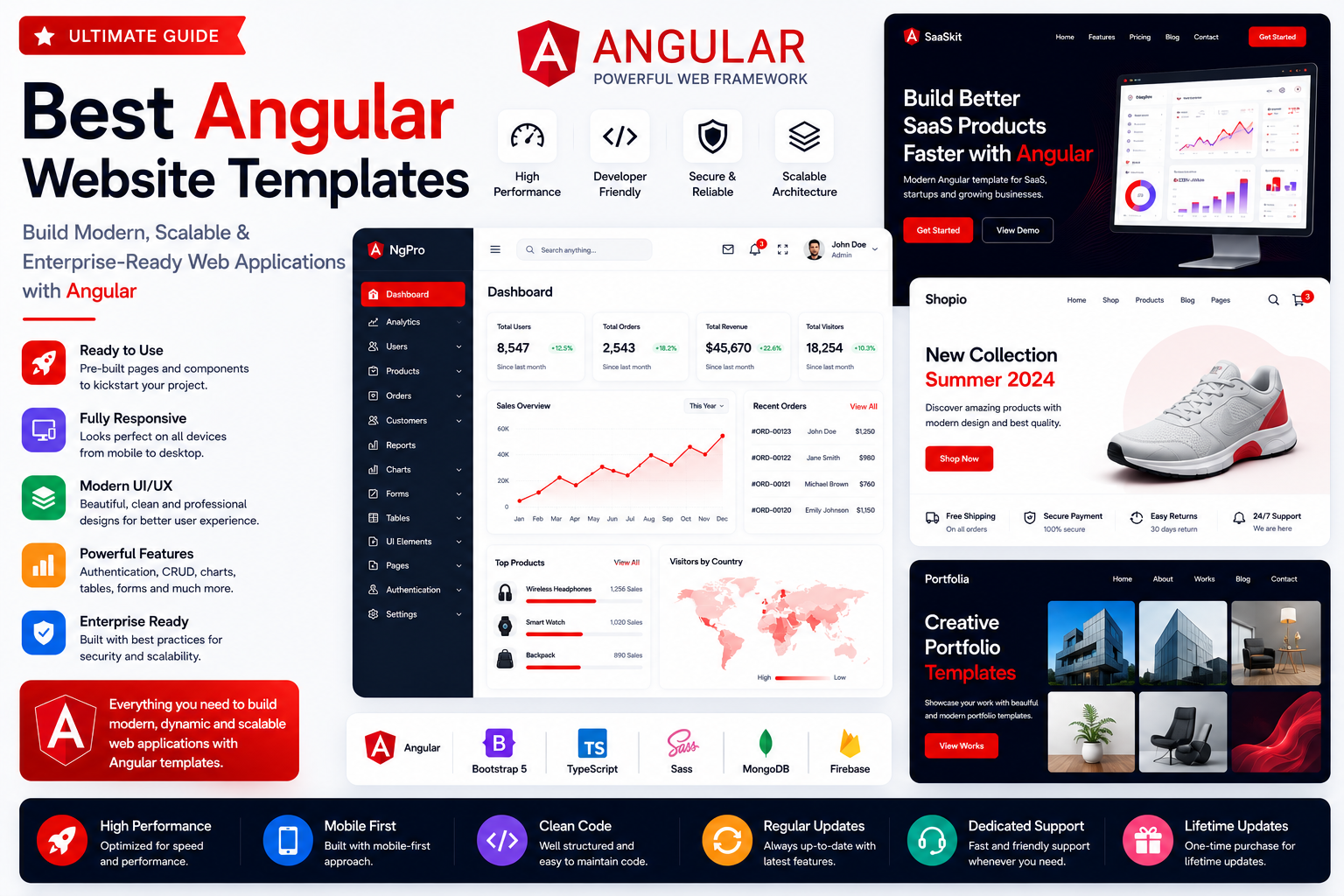
Best Angular Website Templates for Building Enterprise-Ready Web Applications
Introduction
Angular is a powerful TypeScript-based framework developed for building large-scale, maintainable, and feature-rich web applications. Its structured architecture, dependency injection, modular design, and extensive tooling make it a popular choice for enterprise software, business platforms, and complex web applications.
Angular website templates help developers reduce setup time by providing professionally designed layouts, reusable components, authentication flows, dashboards, forms, tables, charts, and complete project structures. Rather than creating every interface from scratch, developers can customize a template to match their branding and business requirements.
From SaaS products and CRM systems to ERP platforms, financial dashboards, healthcare portals, educational platforms, and business websites, Angular templates provide a reliable starting point for modern application development.
This guide explains the advantages of Angular templates, common template categories, and the most important factors to consider before choosing one.
What Are Angular Website Templates?
Angular website templates are pre-built projects created using the Angular framework.
Most templates include:
Responsive layouts
Authentication pages
Admin dashboards
User management
Navigation systems
Forms
Tables
Charts
Profile pages
Settings panels
Reusable UI components
These templates provide a structured foundation for building scalable applications.
Why Angular Is Popular
Angular continues to be widely adopted because it provides:
Component-based architecture
TypeScript integration
Dependency injection
Modular application structure
Strong CLI tools
Built-in routing
Form handling
Large enterprise ecosystem
These capabilities help teams build maintainable applications over time.
Benefits of Angular Templates
Using Angular templates can help you:
Accelerate development
Maintain consistent UI design
Improve project organization
Reduce repetitive coding
Build responsive interfaces
Simplify long-term maintenance
Templates allow developers to spend more time implementing features rather than creating common layouts.
Types of Angular Templates
Popular categories include:
Business websites
SaaS platforms
Admin dashboards
CRM systems
ERP systems
Finance applications
Healthcare portals
Education platforms
eCommerce websites
Portfolios
Landing pages
Analytics dashboards
Help desk systems
HR management systems
Inventory management systems
Choosing a template that closely matches your project reduces customization work.
Business Website Templates
Business templates often include:
Hero sections
Services
About pages
Team profiles
Testimonials
Contact forms
These layouts help companies present a professional online presence.
Admin Dashboard Templates
Dashboard templates commonly feature:
Analytics
Reports
Charts
Data tables
Notifications
User management
Settings panels
These interfaces are suitable for internal business tools and SaaS platforms.
SaaS Templates
SaaS templates usually provide:
Product showcases
Pricing pages
Customer dashboards
Feature highlights
Subscription-focused layouts
These templates support software businesses and online services.
CRM & ERP Templates
Business management templates often include:
Customer records
Sales tracking
Inventory management
Employee management
Financial reporting
Workflow dashboards
They provide a strong starting point for enterprise solutions.
eCommerce Templates
Angular eCommerce templates commonly include:
Product listings
Product detail pages
Shopping carts
Checkout flows
Customer accounts
Order management interfaces
These templates help accelerate online store development.
Portfolio Templates
Portfolio templates showcase creative work through:
Project galleries
Case studies
Client testimonials
Contact pages
They are suitable for freelancers, agencies, and creative professionals.
Authentication Templates
Authentication modules frequently include:
Login
Registration
Password recovery
Email verification
User profile management
These features simplify secure user onboarding.
Performance & Scalability
When evaluating Angular templates, consider:
Lazy loading support
Component organization
Code quality
Responsive design
Accessibility
Asset optimization
These factors contribute to maintainable, high-performance applications.
Enterprise Development
Angular is commonly used for enterprise software because it supports:
Large development teams
Modular architecture
Long-term maintainability
Consistent coding standards
Scalable application structures
Templates following these principles are easier to extend over time.
How to Choose the Right Angular Template
Before selecting a template, evaluate:
Angular version compatibility
Documentation
Component architecture
Performance
Accessibility
Update frequency
Licensing
Community support
Choose a template that aligns with both your current needs and future growth.
Common Mistakes to Avoid
Avoid:
Choosing based only on visual appearance
Ignoring documentation
Using outdated Angular versions
Overlooking accessibility
Forgetting responsive testing
Careful evaluation helps create more reliable and maintainable projects.
Best Practices
Keep Angular updated.
Organize reusable components.
Optimize assets.
Follow Angular style guidelines.
Test across devices.
Monitor performance regularly.
Final Thoughts
Angular website templates provide a solid foundation for building scalable, enterprise-ready web applications. By selecting templates with clean architecture, responsive layouts, strong documentation, and active maintenance, developers can accelerate delivery while creating applications that remain reliable and adaptable over time.
Frequently Asked Questions
What is an Angular website template?
An Angular website template is a pre-built project created with Angular that includes layouts, reusable components, and application structure for faster development.
Are Angular templates suitable for enterprise applications?
Yes. Angular is widely used for enterprise software because of its modular architecture, TypeScript support, and scalability.
Can Angular templates be customized?
Yes. Developers can customize components, layouts, styling, and functionality to meet project requirements.
Who should use Angular templates?
Angular templates are suitable for developers, software companies, agencies, startups, and businesses building complex web applications.
Are Angular templates responsive?
Most modern Angular templates are designed to work across desktop, tablet, and mobile devices.
Comments (0)