
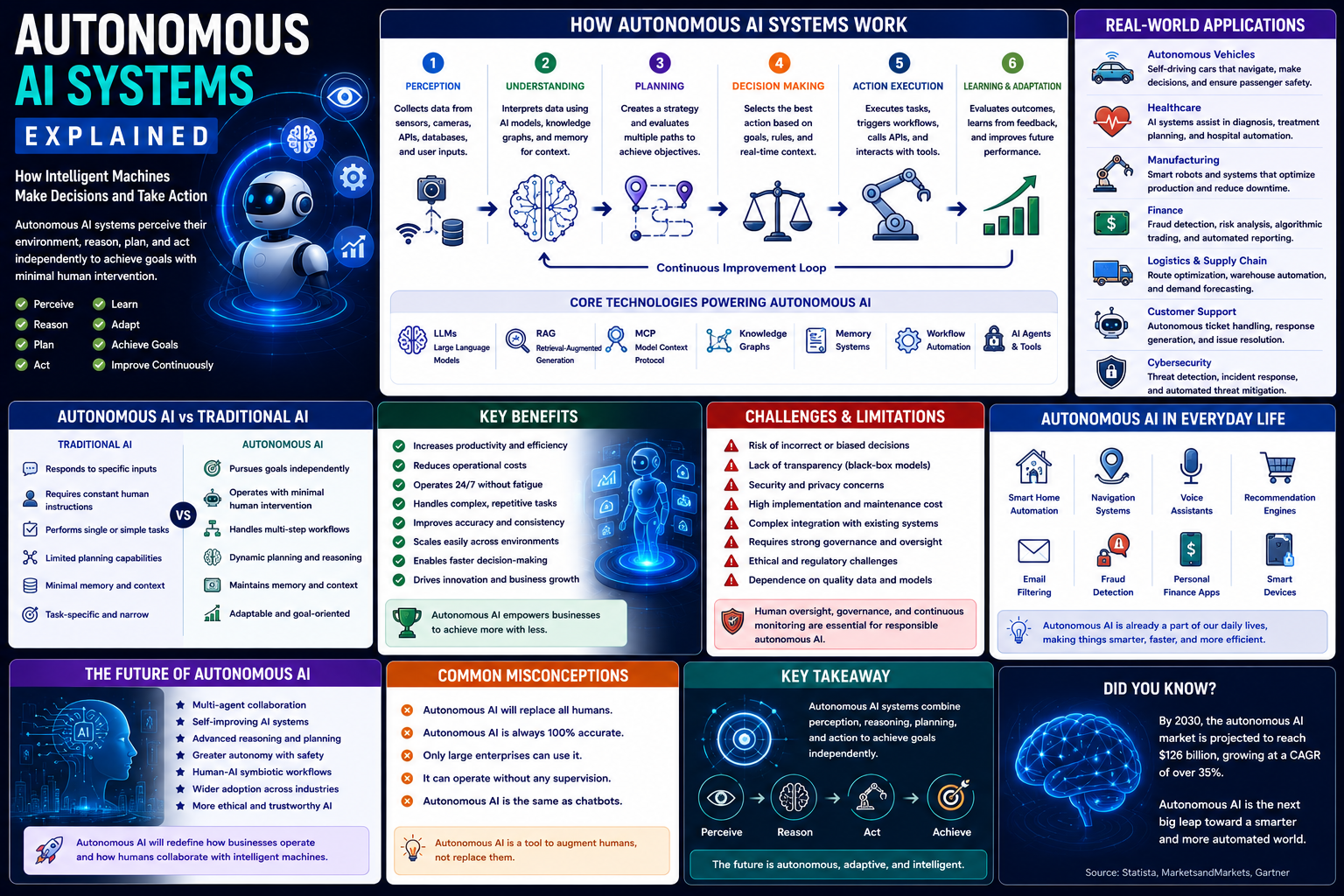
Autonomous AI Systems Explained: How Intelligent Machines Make Decisions and Take Action
Introduction
Artificial Intelligence is rapidly evolving from systems that simply answer questions into systems that can independently analyze situations, make decisions, execute tasks, and continuously improve their performance.
These advanced technologies are known as Autonomous AI Systems.
Unlike traditional AI tools that require constant human instructions, autonomous AI systems can perform complex workflows with minimal supervision. They combine machine learning, reasoning, planning, perception, memory, and automation to accomplish real-world objectives.
From self-driving vehicles and industrial robots to AI-powered customer support and enterprise automation, autonomous AI is reshaping industries by enabling intelligent systems to operate independently while still allowing human oversight when necessary.
What Are Autonomous AI Systems?
Autonomous AI Systems are Artificial Intelligence systems capable of perceiving their environment, making decisions, taking actions, and adapting to changing conditions with limited human intervention.
These systems can:
Analyze information
Plan actions
Make decisions
Execute tasks
Learn from outcomes
Improve performance
Handle dynamic environments
Work toward defined objectives
Autonomous AI combines multiple AI technologies into an intelligent decision-making system.
Why Autonomous AI Systems Matter
Organizations increasingly need AI systems that can do more than generate text.
Autonomous AI helps by:
Automating complex workflows
Improving operational efficiency
Reducing repetitive work
Supporting faster decision-making
Operating continuously
Improving accuracy
Scaling business operations
Enhancing customer experiences
Autonomous systems allow organizations to automate increasingly sophisticated tasks.
How Autonomous AI Systems Work
Most autonomous AI systems follow a continuous decision-making cycle.
1. Perception
The system gathers information from multiple sources.
Examples include:
Cameras
Sensors
Documents
APIs
Databases
User requests
2. Context Understanding
The AI interprets incoming information using:
Large Language Models
Knowledge Graphs
Vector Databases
Memory
Business Rules
3. Planning
The system creates a strategy to achieve the requested objective.
It may evaluate multiple approaches before selecting the best one.
4. Decision Making
Using reasoning models and predefined policies, the AI chooses appropriate actions.
5. Action Execution
The AI performs tasks such as:
Updating databases
Sending emails
Creating reports
Scheduling meetings
Triggering workflows
Calling APIs
6. Continuous Learning
The system evaluates results, receives feedback, and improves future performance.
Core Components of Autonomous AI
Several technologies work together.
Large Language Models (LLMs)
Enable reasoning and natural language understanding.
AI Agents
Perform specialized tasks.
Model Context Protocol (MCP)
Connects AI to enterprise tools.
Retrieval-Augmented Generation (RAG)
Provides accurate, up-to-date information.
Knowledge Graphs
Supply contextual relationships.
Workflow Automation
Executes multi-step business processes.
Memory Systems
Maintain context across interactions.
Autonomous AI vs Traditional AI
Traditional AI
Autonomous AI
Responds to prompts
Pursues objectives
Limited automation
Multi-step automation
Human-driven workflows
Self-directed workflows
Minimal planning
Dynamic planning
Task-specific
Goal-oriented
Autonomous AI extends traditional AI by combining reasoning, planning, and execution.
Real-World Applications
Autonomous AI is transforming many industries.
Healthcare
Clinical decision support
Hospital workflow automation
Medical scheduling
Finance
Fraud investigations
Risk analysis
Investment monitoring
Manufacturing
Smart factories
Predictive maintenance
Industrial robotics
Logistics
Warehouse automation
Delivery optimization
Fleet management
Customer Support
Autonomous ticket handling
Knowledge retrieval
Intelligent routing
Cybersecurity
Threat detection
Incident response
Automated monitoring
Benefits of Autonomous AI Systems
Organizations gain numerous advantages.
Benefits include:
Increased productivity
Reduced operational costs
Continuous operation
Faster decision-making
Higher scalability
Better customer experiences
Reduced manual effort
Improved business agility
Autonomous AI enables organizations to automate complex business operations.
Challenges and Limitations
Despite its potential, Autonomous AI presents challenges.
These include:
Hallucinations
Decision transparency
Security risks
Regulatory compliance
Human oversight
Integration complexity
Ethical concerns
High implementation costs
Responsible governance remains essential.
Autonomous AI in Everyday Life
Many people already interact with autonomous AI.
Examples include:
Self-driving vehicles
Smart warehouses
AI customer support
Smart home automation
Personal AI assistants
Financial monitoring
Healthcare scheduling
Enterprise workflow automation
Autonomous AI is becoming part of everyday digital infrastructure.
Future of Autonomous AI
Future developments include:
Multi-agent collaboration
Self-improving AI systems
Enterprise AI orchestration
AI workforce assistants
Industry-specific autonomous platforms
Smarter robotics
Human-AI collaboration
Fully autonomous business workflows
Autonomous AI is expected to become one of the defining technologies of the next decade.
Common Misconceptions
Several myths surround Autonomous AI.
Common misconceptions include:
Autonomous AI replaces all human workers.
Autonomous AI makes perfect decisions.
Only large enterprises can use autonomous AI.
Autonomous AI requires no supervision.
Autonomous AI is the same as AI chatbots.
In reality, autonomous AI works best when combined with human oversight, governance, and clearly defined objectives.
Final Thoughts
Autonomous AI Systems represent the next major evolution of Artificial Intelligence. By combining reasoning, planning, memory, workflow automation, and continuous learning, these systems can perform increasingly sophisticated tasks with minimal supervision.
As businesses continue adopting AI-powered automation, autonomous systems will become central to digital transformation, enabling organizations to operate more efficiently, respond faster to change, and unlock new levels of innovation while maintaining responsible governance and human oversight.
Frequently Asked Questions
What is an Autonomous AI System?
An Autonomous AI System is an AI platform that can analyze information, make decisions, execute tasks, and improve performance with limited human intervention.
How is Autonomous AI different from AI Copilots?
AI copilots assist users, while autonomous AI systems can independently complete multi-step tasks and workflows.
Which industries use Autonomous AI?
Healthcare, finance, manufacturing, logistics, cybersecurity, retail, education, telecommunications, and many others.
Does Autonomous AI replace humans?
No. It automates repetitive and complex tasks while humans continue providing oversight, strategy, and accountability.
Why is Autonomous AI important?
It enables organizations to improve efficiency, reduce manual work, accelerate decision-making, and automate complex business operations.
Comments (0)