
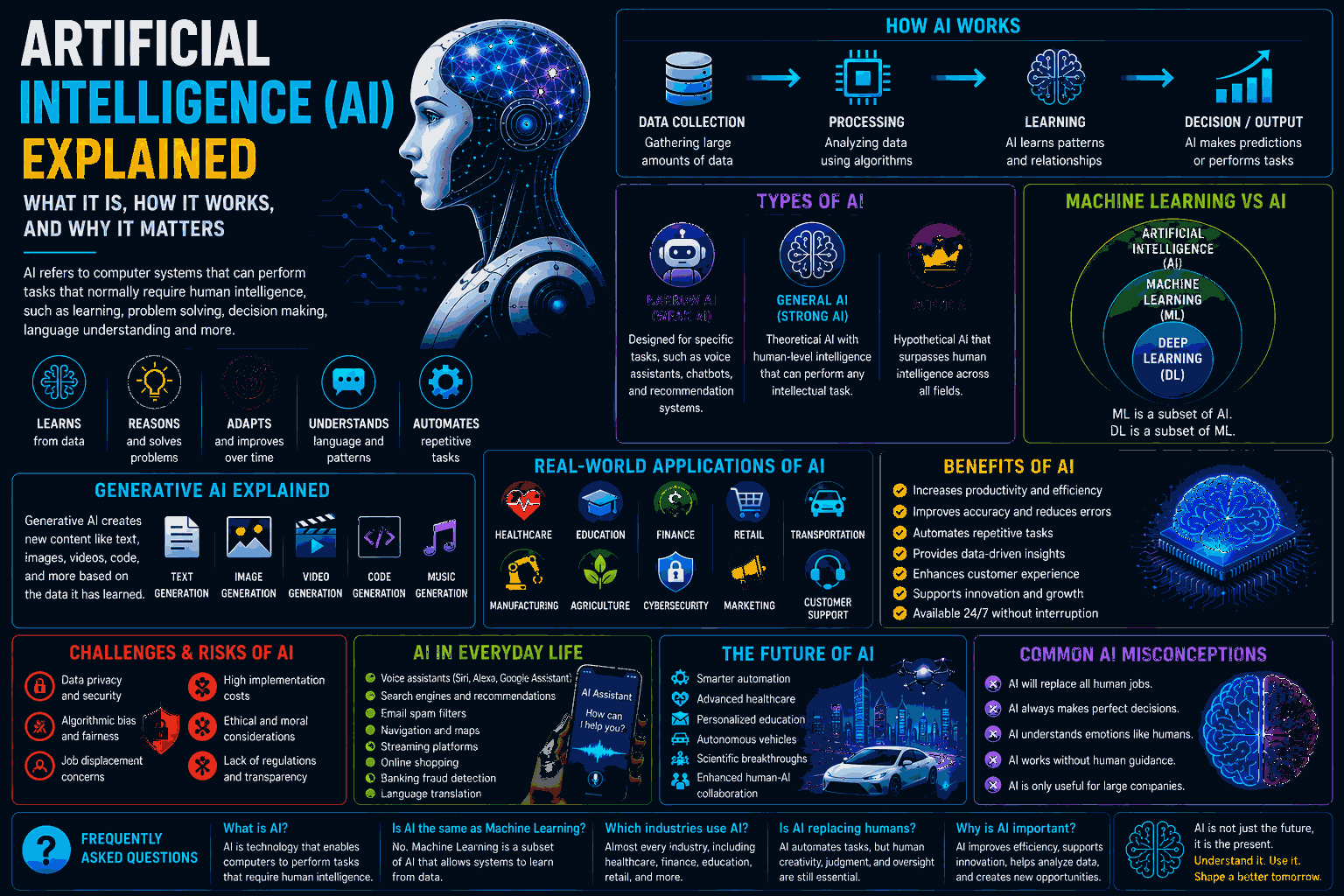
Artificial Intelligence (AI) Explained: What It Is, How It Works, and Why It Matters
Introduction
Artificial Intelligence (AI) is one of the most influential technologies of the 21st century. From virtual assistants and recommendation systems to self-driving vehicles and advanced medical research, AI is changing the way people interact with technology.
Businesses, governments, researchers, educators, and consumers are increasingly adopting AI-powered solutions to improve efficiency, automate repetitive tasks, analyze large amounts of data, and create new digital experiences.
Understanding AI is becoming an essential digital skill, regardless of your profession or industry.
What Is Artificial Intelligence?
Artificial Intelligence refers to computer systems designed to perform tasks that typically require human intelligence.
These tasks include:
Learning
Problem solving
Language understanding
Image recognition
Decision making
Pattern recognition
Planning
Automation
Rather than simply following fixed instructions, many AI systems improve their performance by learning from data.
How AI Works
Artificial Intelligence combines several technologies.
These include:
Machine Learning
Deep Learning
Neural Networks
Natural Language Processing (NLP)
Computer Vision
Robotics
Predictive Analytics
AI systems analyze large datasets, identify patterns, make predictions, and continuously improve based on new information.
Types of Artificial Intelligence
AI is commonly grouped into several categories.
Narrow AI
Designed for specific tasks such as:
Voice assistants
Recommendation engines
Spam filtering
General AI
A theoretical form of AI capable of performing any intellectual task that humans can.
Super AI
A hypothetical future stage where AI surpasses human intelligence across virtually all domains.
Machine Learning vs Artificial Intelligence
Artificial Intelligence is the broader field.
Machine Learning is a subset of AI that enables systems to learn from data without being explicitly programmed for every scenario.
Deep Learning is a further specialization that uses neural networks to solve complex problems.
Generative AI Explained
Generative AI creates new content rather than simply analyzing existing information.
Examples include:
Writing text
Creating images
Producing videos
Generating code
Composing music
Designing graphics
Generative AI has become one of the fastest-growing areas within artificial intelligence.
Real-World Applications of AI
Artificial Intelligence supports many industries.
Examples include:
Healthcare
Education
Finance
Manufacturing
Retail
Transportation
Agriculture
Cybersecurity
Marketing
Customer support
AI is helping organizations automate workflows and improve decision-making.
Benefits of Artificial Intelligence
AI offers numerous advantages.
These include:
Increased productivity
Faster decision making
Improved automation
Better customer experiences
Enhanced data analysis
Reduced operational costs
Personalized recommendations
Continuous availability
Organizations use AI to improve both efficiency and innovation.
Challenges and Risks of AI
Despite its benefits, AI presents important challenges.
These include:
Data privacy
Algorithmic bias
Job displacement concerns
Security risks
Ethical questions
Regulatory uncertainty
Misinformation
Responsible AI development requires transparency and ongoing oversight.
AI in Everyday Life
Many people already use AI without realizing it.
Examples include:
Search engines
Email spam filters
Voice assistants
Navigation apps
Streaming recommendations
Online shopping
Banking fraud detection
Language translation
AI has become deeply integrated into daily digital experiences.
Future of Artificial Intelligence
The future of AI is expected to include continued innovation across industries.
Potential developments include:
More advanced automation
Smarter healthcare systems
Personalized education
Autonomous transportation
Improved scientific research
Enhanced business intelligence
More capable digital assistants
As AI evolves, understanding its capabilities and limitations will become increasingly important.
Common AI Misconceptions
Some common myths include:
AI can replace every job.
AI always makes perfect decisions.
AI understands emotions like humans.
AI operates without human guidance.
AI is only useful for large companies.
In reality, AI is a powerful tool that works best when combined with human expertise.
Final Thoughts
Artificial Intelligence is transforming how people live, work, and interact with technology. From everyday digital assistants to advanced business applications, AI is becoming a foundational technology across nearly every industry.
Understanding how AI works, where it is used, and what opportunities and challenges it presents will help individuals and organizations make informed decisions as this technology continues to evolve.
Frequently Asked Questions
What is Artificial Intelligence?
Artificial Intelligence is technology that enables computers to perform tasks requiring human-like intelligence.
Is AI the same as Machine Learning?
No. Machine Learning is a subset of Artificial Intelligence.
What industries use AI?
Healthcare, finance, education, manufacturing, retail, transportation, cybersecurity, agriculture, and many others.
Is AI replacing humans?
AI automates certain tasks, but human creativity, judgment, and oversight remain essential.
Why is AI important?
AI improves efficiency, supports innovation, helps analyze data, and enables new digital products and services.
Comments (0)