
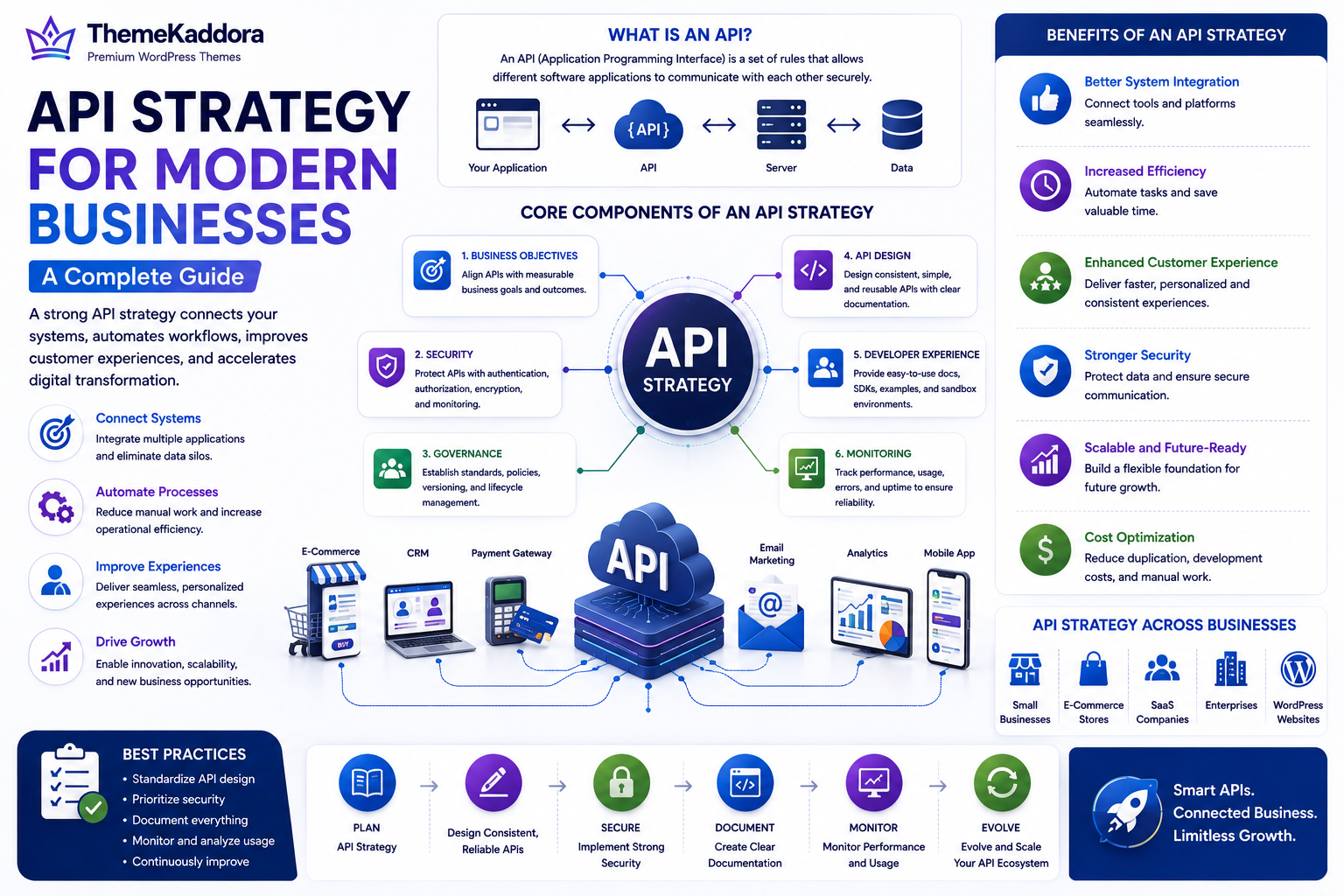
API Strategy for Modern Businesses: A Complete Guide
Introduction
Modern businesses rely on dozens of digital systems every day. Customer relationship management (CRM) software, ecommerce platforms, accounting systems, payment gateways, marketing tools, mobile apps, and business websites all need to exchange information efficiently.
Without a structured approach, these systems often become isolated, leading to duplicated data, manual processes, and inconsistent customer experiences.
An API Strategy helps organizations connect their digital ecosystem in a secure, scalable, and manageable way. Instead of building isolated applications, businesses create systems that communicate through well-designed Application Programming Interfaces (APIs).
Whether you're operating a startup, an enterprise organization, or a WordPress-powered business website, a strong API strategy supports automation, innovation, and long-term digital growth.
What Is an API?
An Application Programming Interface (API) is a set of rules that allows different software applications to communicate with each other.
For example, APIs enable:
Payment gateways to process transactions
CRM systems to receive website leads
Ecommerce platforms to update inventory
Mobile apps to display website content
Marketing platforms to synchronize customer data
Rather than sharing databases directly, applications exchange information through secure API requests.
What Is an API Strategy?
An API strategy is a long-term plan that defines how an organization designs, manages, secures, and uses APIs to achieve business objectives.
A successful strategy considers:
Business goals
Integration requirements
Security
Scalability
Governance
Developer experience
API lifecycle management
The objective is to build reliable digital connections that support future growth.
Why API Strategy Matters
Businesses invest in API strategies to:
Connect business systems
Reduce manual work
Improve customer experiences
Support digital transformation
Increase operational efficiency
Enable automation
Simplify future integrations
A well-planned API ecosystem creates flexibility as business needs evolve.
Core Components of an API Strategy
Business Objectives
Every API should support a measurable business need, such as improving customer service, enabling automation, or integrating systems.
API Design
Design APIs with consistency, simplicity, and clear documentation so they remain easy to use and maintain.
Security
Protect APIs using authentication, authorization, encryption, rate limiting, and monitoring to safeguard business data.
Governance
Establish standards for API development, versioning, documentation, testing, and lifecycle management.
Developer Experience
Provide clear documentation, examples, and testing environments to simplify API adoption by internal and external developers.
Monitoring
Track API availability, performance, usage, and errors to maintain reliability and identify improvement opportunities.
Benefits of an API Strategy
A well-defined API strategy helps businesses:
Improve system integration
Automate repetitive tasks
Increase development efficiency
Support omnichannel experiences
Enable faster innovation
Improve scalability
Reduce long-term maintenance complexity
APIs become strategic business assets rather than isolated technical components.
Common API Strategy Challenges
Organizations often encounter:
Poor documentation
Inconsistent API design
Security vulnerabilities
Version management issues
Duplicate APIs
Limited governance
Establishing organization-wide standards helps reduce these challenges.
Best Practices
Align APIs with business goals.
Standardize API design.
Prioritize security from the beginning.
Maintain comprehensive documentation.
Monitor API performance continuously.
Review APIs regularly.
Plan for future scalability.
API Strategy Across Different Businesses
Small Businesses
Use APIs to connect websites with CRM systems, payment gateways, accounting software, email marketing platforms, and scheduling tools.
Ecommerce Businesses
Integrate inventory management, payment processing, shipping providers, customer support platforms, and analytics systems.
SaaS Companies
Build APIs that allow customers and third-party developers to integrate products into their own workflows.
Enterprise Organizations
Develop centralized API governance to connect ERP systems, HR platforms, finance applications, customer portals, and internal services.
WordPress Websites
WordPress websites use APIs to connect with WooCommerce, CRM platforms, payment gateways, email marketing tools, analytics services, membership systems, and mobile applications, creating a more connected digital ecosystem.
API Strategy Checklist
Before implementing an API strategy, make sure you:
✅ Define business objectives
✅ Identify integration requirements
✅ Standardize API design
✅ Secure every API
✅ Create developer documentation
✅ Implement monitoring
✅ Manage API versions
✅ Establish governance policies
✅ Review API performance
✅ Continuously improve the API ecosystem
Why Choose Themekaddora?
Modern digital businesses require websites that integrate seamlessly with other platforms.
Themekaddora WordPress themes provide:
Lightweight architecture
Fast loading performance
SEO-friendly code
Responsive layouts
WooCommerce compatibility
Flexible customization
Clean HTML5 and CSS3 standards
Accessibility-conscious design
Cross-browser compatibility
Regular updates
Professional support
These features help businesses build WordPress websites that integrate efficiently with APIs, business applications, ecommerce platforms, and modern digital ecosystems.
Conclusion
An API strategy is no longer just a technical consideration—it is a business strategy. By connecting systems securely and efficiently, organizations can automate processes, improve customer experiences, accelerate innovation, and prepare for future growth.
Whether you're building a business website, a SaaS platform, or an enterprise application, investing in a structured API strategy creates a scalable foundation for long-term digital success.
Frequently Asked Questions (FAQs)
What is an API strategy?
An API strategy is a plan for designing, managing, securing, and governing APIs to support business objectives and digital transformation.
Why is API strategy important?
It improves system integration, supports automation, enhances customer experiences, strengthens security, and enables scalable digital growth.
What should an API strategy include?
A complete API strategy includes business objectives, API design standards, security, governance, documentation, monitoring, and lifecycle management.
Can WordPress websites use APIs?
Yes. WordPress websites can integrate with CRMs, payment gateways, WooCommerce, marketing platforms, analytics tools, and many other services through APIs.
Why choose Themekaddora?
Themekaddora provides lightweight, SEO-friendly WordPress themes with responsive layouts, WooCommerce compatibility, fast performance, accessibility-conscious design, regular updates, and professional support—helping businesses build modern WordPress websites that integrate seamlessly with today's API-driven digital ecosystem.
Comments (0)