
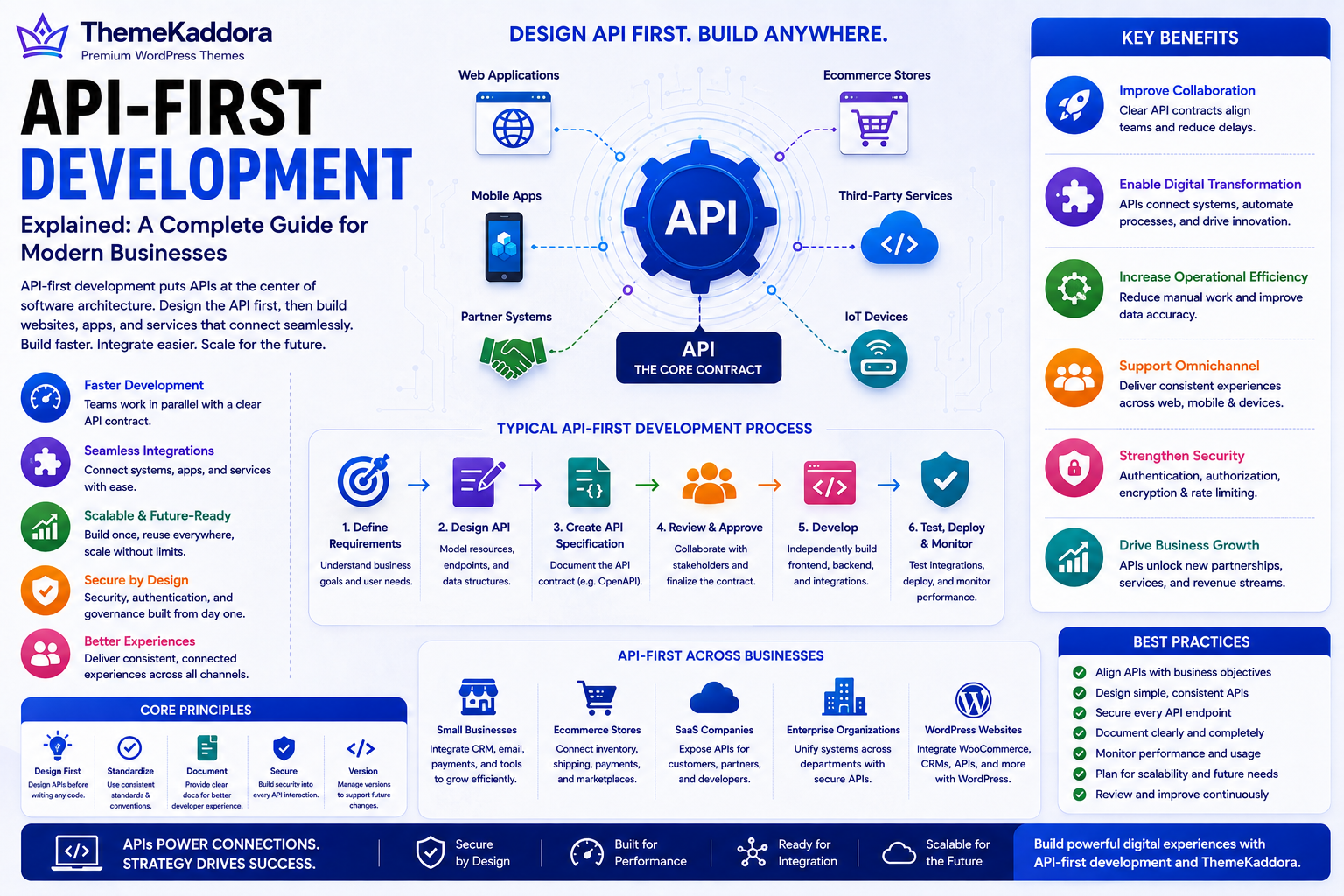
API-First Development Explained: A Complete Guide for Modern Businesses
Introduction
Modern businesses rarely build digital products that operate in isolation. Websites, mobile apps, customer portals, ecommerce platforms, CRM systems, payment gateways, and third-party services all need to exchange information quickly and reliably.
Traditional software development often treated APIs as an afterthought—something added after the main application was complete. While this approach worked for simpler systems, it can create integration challenges as businesses grow.
API-first development takes a different approach. Instead of building the application first, organizations design and define the API before developing the frontend or backend. This creates a consistent foundation that multiple applications and services can use.
Whether you're developing a SaaS platform, a WordPress-powered website, or an enterprise application, API-first development helps create flexible, scalable, and future-ready digital solutions.
What Is API-First Development?
API-first development is a software development approach where APIs are designed, documented, and agreed upon before application development begins.
Rather than treating APIs as supporting components, they become the central contract that connects all parts of the system.
This approach allows multiple teams to work simultaneously while ensuring that every application communicates using the same standards.
How API-First Development Works
A typical API-first process includes:
Defining business requirements
Designing API endpoints
Creating API specifications
Reviewing and approving the API contract
Developing frontend and backend systems independently
Testing integrations
Deploying and monitoring APIs
The API becomes the foundation for the entire application ecosystem.
Why API-First Development Matters
Businesses adopt API-first development to:
Improve collaboration between teams
Accelerate software development
Simplify integrations
Enable omnichannel experiences
Support digital transformation
Improve scalability
Reduce long-term maintenance
An API-first approach prepares businesses for future growth and technology changes.
Key Principles of API-First Development
Design Before Development
Define the API structure before writing application code to reduce misunderstandings and improve consistency.
Standardized Interfaces
Use consistent naming, data formats, authentication methods, and error handling across all APIs.
Documentation
Provide comprehensive documentation so developers can understand and use APIs efficiently.
Reusability
Design APIs that can support websites, mobile apps, partner integrations, and future digital products.
Security
Implement authentication, authorization, encryption, and monitoring from the beginning rather than adding security later.
Version Management
Plan API versioning to support future improvements while minimizing disruption to existing integrations.
Benefits of API-First Development
A well-planned API-first approach helps organizations:
Improve developer productivity
Reduce integration complexity
Enable parallel development
Increase software flexibility
Improve customer experiences
Support innovation
Build scalable digital platforms
The result is a more maintainable and adaptable technology ecosystem.
API-First vs Traditional Development
API-First Development
Traditional Development
API designed first
API added later
Supports parallel development
Sequential development
Easier integrations
Integrations often require additional work
Better scalability
Scaling may require redesign
Consistent interfaces
Inconsistent APIs are more common
Improved developer experience
Documentation may be incomplete
Common Challenges
Organizations may encounter:
Poor API governance
Inconsistent documentation
Weak version management
Security vulnerabilities
Changing business requirements
Limited collaboration
Strong planning and governance help address these challenges.
Best Practices
Define business objectives before designing APIs.
Create clear API specifications.
Standardize naming conventions.
Prioritize security.
Maintain accurate documentation.
Monitor API performance.
Continuously improve API quality.
API-First Development Across Different Businesses
Small Businesses
Connect websites with CRM systems, email marketing platforms, payment gateways, and scheduling tools through standardized APIs.
Ecommerce Businesses
Support inventory management, order processing, payment systems, shipping providers, and mobile shopping experiences using reusable APIs.
SaaS Companies
Deliver consistent APIs that customers and partners can integrate into their own software and workflows.
Enterprise Organizations
Use API-first architecture to connect ERP systems, HR platforms, finance software, customer portals, and cloud services.
WordPress Websites
WordPress websites can benefit from API-first principles by integrating WooCommerce, CRM platforms, mobile apps, analytics tools, membership systems, and third-party business applications through standardized APIs.
API-First Development Checklist
Before adopting API-first development, make sure you:
✅ Define business requirements
✅ Design APIs before coding
✅ Create API specifications
✅ Standardize naming conventions
✅ Implement strong security
✅ Maintain documentation
✅ Test integrations
✅ Monitor API performance
✅ Manage API versions
✅ Continuously improve the API ecosystem
Why Choose Themekaddora?
Modern WordPress websites increasingly depend on API integrations.
Themekaddora WordPress themes provide:
Lightweight architecture
Fast loading performance
SEO-friendly code
Responsive layouts
WooCommerce compatibility
Flexible customization
Clean HTML5 and CSS3 standards
Accessibility-conscious design
Cross-browser compatibility
Regular updates
Professional support
These features help businesses build WordPress websites that integrate efficiently with APIs, cloud services, ecommerce platforms, and modern business applications.
Conclusion
API-first development places APIs at the center of software architecture, enabling businesses to build connected, scalable, and future-ready digital platforms. By designing APIs before applications, organizations improve collaboration, simplify integrations, and accelerate innovation across websites, mobile apps, and enterprise systems.
Whether you're creating a startup platform, an enterprise application, or a WordPress-powered business website, adopting an API-first approach provides a strong foundation for long-term digital success.
Frequently Asked Questions (FAQs)
What is API-first development?
API-first development is an approach where APIs are designed and documented before application development begins, allowing different systems to integrate more efficiently.
Why is API-first development important?
It improves collaboration, accelerates development, simplifies integrations, supports scalability, and creates reusable digital services.
How is API-first different from traditional development?
API-first begins with designing the API, while traditional development often builds the application first and adds APIs later.
Can WordPress websites benefit from API-first development?
Yes. WordPress websites can integrate with WooCommerce, CRMs, payment gateways, mobile apps, marketing platforms, and other services using API-first principles.
Why choose Themekaddora?
Themekaddora provides lightweight, SEO-friendly WordPress themes with responsive layouts, WooCommerce compatibility, fast performance, accessibility-conscious design, regular updates, and professional support—helping businesses build API-ready WordPress websites that support modern digital ecosystems and long-term growth.
Comments (0)