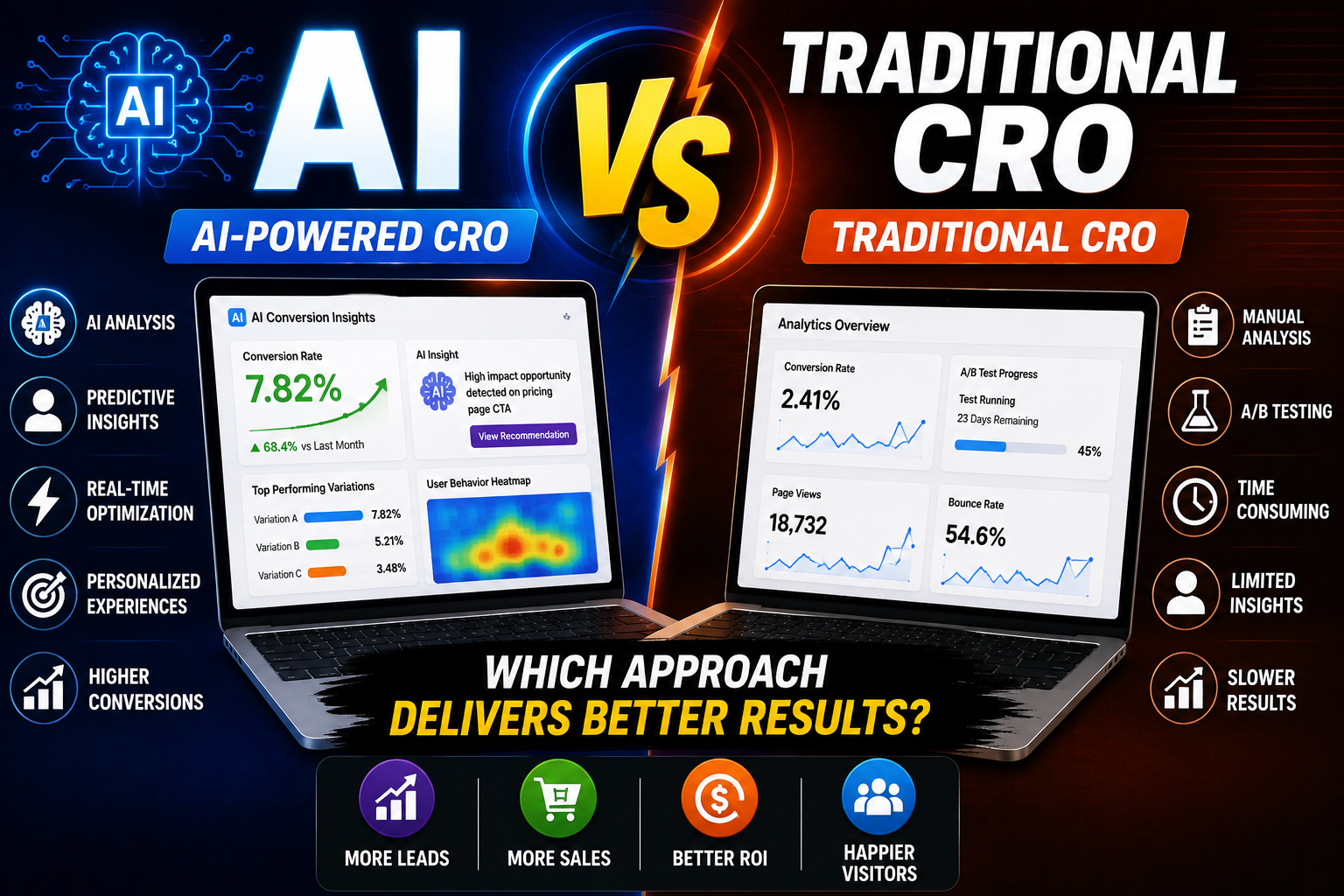
AI vs Traditional CRO: Which Conversion Optimization Approach Delivers Better Results?
Conversion Rate Optimization (CRO) has become essential for businesses looking to maximize leads, sales, and revenue from their existing website traffic.
For years, businesses relied on traditional CRO methods such as manual analysis, A/B testing, and user behavior tracking. However, Artificial Intelligence (AI) is rapidly changing how conversion optimization works.
Today, businesses can leverage AI-powered tools to analyze visitor behavior, identify opportunities, and automate optimization processes.
But which approach is better?
In this guide, we'll compare AI vs Traditional CRO and help you determine which strategy is best for your business.
What Is Traditional CRO?
Traditional Conversion Rate Optimization involves manually analyzing website performance and making improvements based on collected data.
Common traditional CRO techniques include:
A/B Testing
Heatmap analysis
User surveys
Funnel analysis
Session recordings
Landing page optimization
These methods have been effective for many years and remain important today.
What Is AI-Powered CRO?
AI-powered CRO uses Artificial Intelligence and machine learning algorithms to analyze visitor behavior and recommend optimization opportunities automatically.
Instead of relying solely on manual analysis, AI continuously evaluates large amounts of data and identifies patterns that humans may overlook.
AI-powered CRO can:
Analyze visitor intent
Predict user behavior
Personalize experiences
Identify conversion bottlenecks
Automate optimization decisions
This allows businesses to optimize websites faster and more efficiently.
AI vs Traditional CRO: Key Differences
1. Data Analysis Speed
Traditional CRO
Traditional analysis often requires:
Manual data collection
Spreadsheet reviews
Multiple reporting tools
Human interpretation
This process can take days or weeks.
AI-Powered CRO
AI processes thousands of data points instantly and identifies actionable insights in real time.
Winner: AI CRO
2. User Behavior Analysis
Traditional CRO
Traditional methods rely on:
Heatmaps
Surveys
Session recordings
While useful, identifying patterns often requires significant manual effort.
AI-Powered CRO
AI automatically detects:
Visitor intent
Engagement trends
Conversion opportunities
User friction points
Winner: AI CRO
3. Personalization Capabilities
Traditional CRO
Creating personalized experiences manually can be complex and time-consuming.
Most businesses provide the same experience to all visitors.
AI-Powered CRO
AI can personalize:
Landing pages
Product recommendations
CTAs
Offers
User journeys
This improves engagement and conversion rates.
Winner: AI CRO
4. A/B Testing Efficiency
Traditional CRO
Traditional A/B tests often require:
Long testing periods
Significant traffic volume
Manual result analysis
Businesses may wait weeks before identifying winners.
AI-Powered CRO
AI can:
Analyze tests faster
Detect winning variations earlier
Automatically allocate traffic
Optimization cycles become significantly shorter.
Winner: AI CRO
5. Cost of Implementation
Traditional CRO
Traditional CRO tools are often less expensive initially.
However, businesses may require:
Analysts
CRO specialists
Additional software
Costs can increase over time.
AI-Powered CRO
AI solutions may require higher initial investment but often reduce manual workload and improve long-term efficiency.
Winner: Depends on Business Size
6. Scalability
Traditional CRO
As traffic grows, manual analysis becomes increasingly difficult.
Large websites often struggle to optimize every page effectively.
AI-Powered CRO
AI can analyze millions of interactions simultaneously without additional effort.
This makes optimization highly scalable.
Winner: AI CRO
7. Decision-Making Accuracy
Traditional CRO
Human analysis can be influenced by assumptions and biases.
Important opportunities may be overlooked.
AI-Powered CRO
AI evaluates actual user behavior and data patterns objectively.
This often results in more accurate recommendations.
Winner: AI CRO
AI vs Traditional CRO Comparison Table
Feature
Traditional CRO
AI-Powered CRO
Data Analysis
Manual
Automated
Optimization Speed
Slow
Fast
Personalization
Limited
Advanced
Scalability
Moderate
High
User Intent Analysis
Limited
Advanced
A/B Testing
Manual
AI-Assisted
Conversion Insights
Human-Driven
Data-Driven
Real-Time Optimization
No
Yes
Why Businesses Are Moving Toward AI CRO
Modern websites generate enormous amounts of user data.
Manually analyzing this information becomes increasingly difficult as traffic grows.
AI helps businesses:
Identify opportunities faster
Improve conversion rates
Personalize user experiences
Reduce manual effort
Improve marketing ROI
This explains why AI-powered optimization is becoming a preferred solution.
How Kaddora AI Conversion Optimizer Bridges the Gap
While traditional CRO still provides valuable insights, combining it with AI can significantly improve results.
The Kaddora AI Conversion Optimizer Plugin helps businesses leverage AI-powered analysis without requiring extensive technical expertise.
Key capabilities include:
AI-powered visitor behavior analysis
Landing page optimization insights
CTA performance recommendations
Conversion opportunity detection
User engagement tracking
Conversion-focused reporting
Businesses can use these insights to make smarter optimization decisions and achieve better results.
Kaddora AI Conversion Optimizer Plugin
Should You Replace Traditional CRO Completely?
No.
The most effective strategy is often combining traditional CRO methods with AI-powered insights.
Traditional CRO provides:
Human understanding
Strategic thinking
Creative experimentation
AI provides:
Speed
Scale
Automation
Predictive analytics
Together, they create a powerful optimization framework.
Frequently Asked Questions
Is AI better than traditional CRO?
AI generally provides faster insights, better scalability, and more advanced personalization capabilities. However, traditional CRO still plays an important role in strategy and experimentation.
Can small businesses benefit from AI CRO?
Yes. AI-powered optimization tools are becoming increasingly accessible and can help businesses improve conversions regardless of size.
Does AI replace A/B testing?
No. AI enhances A/B testing by helping identify winning variations faster and providing deeper insights.
What is the biggest advantage of AI CRO?
The ability to analyze large amounts of data quickly and uncover optimization opportunities automatically.
Conclusion
Traditional CRO has helped businesses improve website performance for years, but AI is transforming the industry by delivering faster insights, deeper analysis, and scalable optimization capabilities.
Businesses that combine traditional conversion optimization techniques with AI-powered tools are often able to improve conversions more efficiently and achieve stronger long-term growth.
As competition continues to increase online, AI-driven CRO is quickly becoming a competitive advantage rather than an optional enhancement.
Boost Website Conversions with Kaddora AI Conversion Optimizer
Comments (0)