
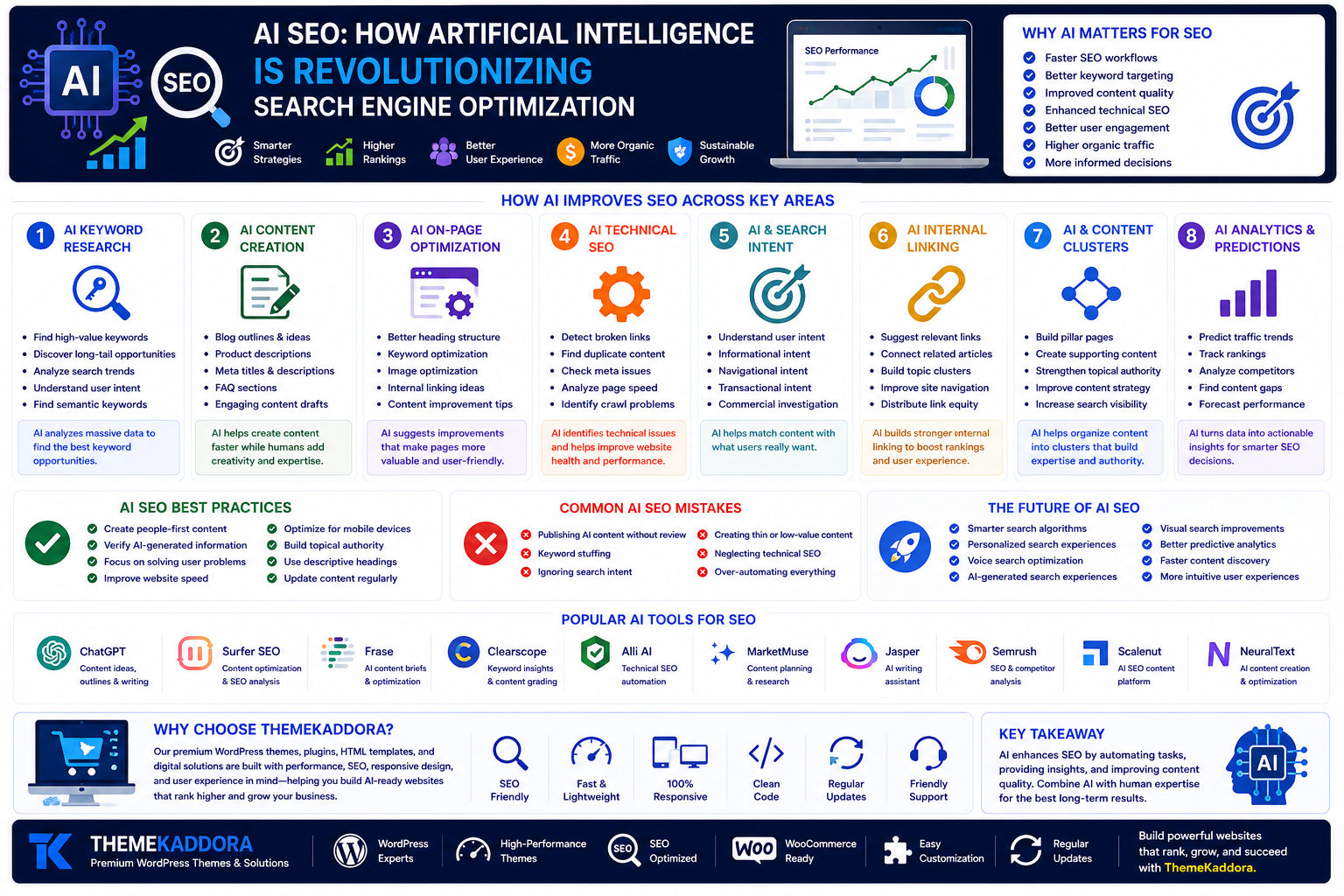
AI SEO: How Artificial Intelligence Is Revolutionising Search Engine Optimization
Introduction
Search Engine Optimization (SEO) has always been about helping people discover valuable content. As search engines become more intelligent, businesses must adapt their strategies to meet changing user expectations. Artificial Intelligence (AI) is now playing a major role in how websites are optimized, how content is created, and how search engines understand user intent.
Instead of replacing traditional SEO, AI enhances it by automating repetitive tasks, analyzing massive amounts of data, identifying optimization opportunities, and helping marketers create content that truly answers users' questions.
Whether you manage a business website, an online store, a SaaS platform, or a digital agency, understanding AI SEO can help you improve visibility, increase organic traffic, and create better experiences for your visitors.
In this guide, you'll learn how AI is transforming SEO, why it matters, and how you can use it effectively.
What Is AI SEO?
AI SEO refers to using Artificial Intelligence technologies to improve various aspects of Search Engine Optimization.
AI analyzes search data, understands user intent, identifies ranking opportunities, and provides recommendations that help websites perform better in search results.
Instead of manually analyzing thousands of keywords or pages, AI can process enormous amounts of information in seconds.
AI commonly supports:
Keyword research
Content optimization
Technical SEO
Search intent analysis
Internal linking
Competitor research
Content planning
Website performance optimization
Why AI Matters for Modern SEO
Search engines increasingly prioritize helpful, relevant, and user-focused content. AI helps marketers meet these expectations by providing insights that improve both content quality and user experience.
Key benefits include:
Faster SEO workflows
Better keyword targeting
Improved content quality
Smarter internal linking
Enhanced technical SEO
Better user engagement
Increased organic traffic
More informed decision-making
AI allows businesses to spend less time on repetitive tasks and more time creating valuable content.
AI-Powered Keyword Research
Successful SEO starts with understanding what your audience is searching for.
AI-powered keyword research tools help identify:
High-value keywords
Long-tail keyword opportunities
Semantic keywords
Related search queries
Search trends
User intent
Rather than focusing only on search volume, AI helps businesses target keywords that are more likely to attract qualified visitors.
AI for Content Creation
High-quality content remains one of the strongest ranking factors in SEO.
AI assists content creators by generating:
Blog outlines
Topic ideas
Product descriptions
FAQ sections
Meta titles
Meta descriptions
Content briefs
While AI accelerates content production, human expertise is essential for adding originality, real-world experience, and trust.
AI for On-Page SEO
On-page optimization helps search engines understand your content while improving user experience.
AI can recommend improvements such as:
Better heading structure
Improved readability
Keyword placement
Image optimization
Meta tag enhancements
Internal linking opportunities
Content expansion
These optimizations make pages more valuable for both users and search engines.
AI for Technical SEO
Technical SEO ensures websites are easy to crawl, index, and navigate.
AI tools can identify:
Broken links
Duplicate content
Missing metadata
Slow-loading pages
Mobile usability issues
Structured data errors
Crawl problems
Fixing technical issues helps improve both search visibility and user satisfaction.
AI and Search Intent
Modern SEO is no longer about matching keywords—it is about understanding why users are searching.
AI helps identify whether a visitor wants to:
Learn something
Compare solutions
Find a specific website
Purchase a product or service
Creating content that matches search intent increases engagement and improves ranking potential.
AI for Internal Linking
Internal links help users discover related content while helping search engines understand your website's structure.
AI can recommend:
Relevant articles
Pillar pages
Topic clusters
Supporting resources
Contextual anchor text
A strong internal linking strategy improves navigation, crawlability, and topical authority.
AI and Content Clusters
Search engines increasingly reward websites that demonstrate expertise within a topic.
Instead of publishing isolated articles, create connected content clusters.
For example:
Artificial Intelligence
What Is Artificial Intelligence?
How AI Is Transforming Digital Marketing
Best AI Tools for Businesses
AI SEO Guide
AI Content Marketing
AI for Customer Support
AI for eCommerce
AI Productivity Tools
This structure helps search engines understand your expertise and encourages visitors to explore more content.
AI SEO Best Practices
To maximize the benefits of AI:
Create people-first content.
Verify AI-generated information.
Focus on solving user problems.
Improve website speed.
Optimize for mobile devices.
Build topic clusters.
Use descriptive headings.
Include FAQ sections.
Update older content regularly.
AI should support your SEO strategy—not replace thoughtful planning and human creativity.
Common AI SEO Mistakes
Avoid these common mistakes:
Publishing AI-generated content without review
Keyword stuffing
Ignoring user intent
Creating thin content
Neglecting technical SEO
Over-automating every process
Successful SEO combines AI efficiency with human expertise.
The Future of AI SEO
Artificial Intelligence will continue transforming search through:
Smarter search algorithms
Personalized search experiences
Voice search optimization
Visual search improvements
Better predictive analytics
AI-generated search experiences
Faster content recommendations
Businesses that embrace AI responsibly will be better prepared for the future of search.
Why ThemeKaddora Focuses on AI-Ready Websites
At ThemeKaddora, we believe modern websites should be built for both people and intelligent search systems. Our premium WordPress themes, plugins, HTML templates, and digital solutions are designed with performance, responsive layouts, clean code, SEO-friendly architecture, and user experience in mind.
Whether you're launching a business website, SaaS platform, online store, or agency portfolio, choosing a well-optimized foundation helps improve performance, search visibility, and long-term growth.
Explore ThemeKaddora to discover professionally designed digital products that help you build faster, smarter, and more search-friendly websites.
Conclusion
Artificial Intelligence is changing the way SEO is planned, executed, and optimized. From keyword research and technical analysis to content creation and search intent optimization, AI empowers businesses to make smarter decisions and create better experiences for users.
The most successful SEO strategies combine AI-powered insights with high-quality content, technical excellence, and a genuine focus on helping users. By using AI responsibly and consistently publishing valuable content, businesses can improve rankings, strengthen authority, and build sustainable organic growth.
Frequently Asked Questions
What is AI SEO?
AI SEO is the use of Artificial Intelligence to improve keyword research, content creation, technical optimization, search intent analysis, and overall search engine performance.
Does Google allow AI-generated content?
Yes. Google evaluates content based on its quality, originality, and usefulness rather than how it was created.
Can AI improve website rankings?
AI helps identify optimization opportunities and improve SEO workflows, but rankings depend on creating valuable, relevant, and user-focused content.
Is AI replacing SEO experts?
No. AI assists SEO professionals by automating repetitive tasks and providing insights, while human expertise remains essential for strategy and quality.
Why is AI important for the future of SEO?
AI enables businesses to better understand user intent, automate optimization tasks, improve content quality, and adapt to evolving search technologies, making it an increasingly important part of modern SEO.
Comments (0)