
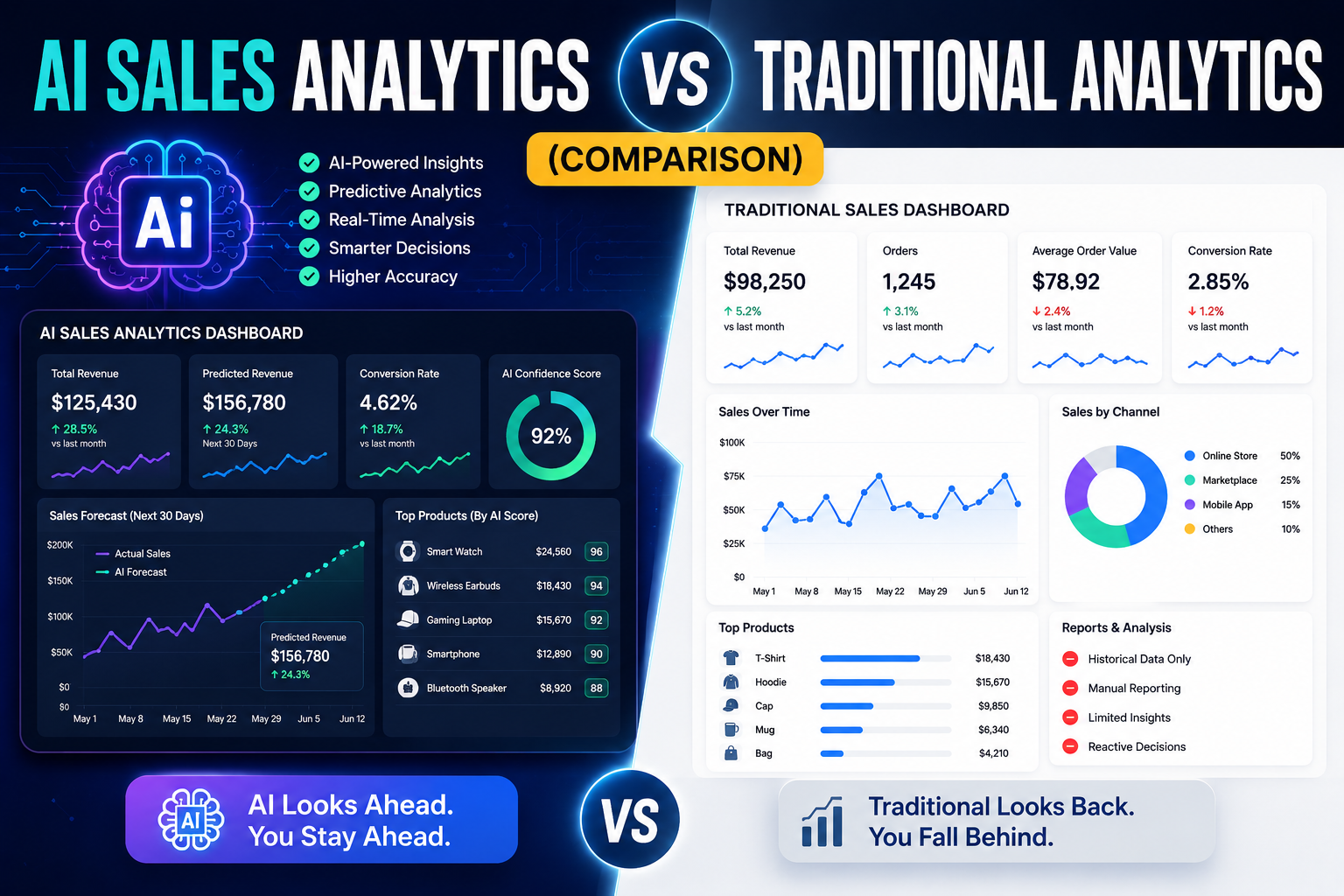
AI Sales Analytics vs Traditional Analytics
Analytics has always been a key part of running a successful online business. Every order, customer interaction, and product sale creates valuable data that can guide better decisions.
For many years, businesses relied on traditional analytics tools to generate reports and monitor performance. These reports are still useful today, but as online stores grow and data becomes more complex, many businesses are adopting AI-powered analytics to gain deeper insights and improve decision-making.
So, which approach is right for your WooCommerce store?
In this guide, we'll compare AI sales analytics with traditional analytics, explain their strengths and limitations, and help you decide which solution best fits your business needs.
Quick Answer
What's the difference between AI sales analytics and traditional analytics?
Traditional analytics focuses on reporting historical data, while AI sales analytics analyzes historical and real-time data to identify patterns, forecast trends, detect anomalies, and provide actionable recommendations. AI supports faster, more informed decision-making, whereas traditional analytics typically requires more manual interpretation.
What Is Traditional Analytics?
Traditional analytics tools collect and organize business data into reports and dashboards.
Typical reports include:
Revenue
Orders
Customers
Products
Coupons
Refunds
These reports help answer questions such as:
How much revenue was generated?
Which products sold the most?
How many orders were placed?
Traditional analytics is valuable for understanding past performance, but users often need to interpret the data manually.
What Is AI Sales Analytics?
AI sales analytics builds on traditional reporting by using artificial intelligence to analyze large datasets, identify trends, detect unusual activity, and generate predictive insights.
Instead of only explaining what happened, AI can help answer:
Why did sales increase?
Which products may perform well next month?
Which customers are likely to return?
Which campaigns deserve more budget?
Which KPIs require attention?
AI helps businesses move from reactive reporting to proactive planning.
Key Differences
Feature
Traditional Analytics
AI Sales Analytics
Historical Reports
✅
✅
Real-Time Insights
Limited
✅
Trend Detection
Manual
Automated
Revenue Forecasting
Limited
✅
Customer Behavior Analysis
Basic
Advanced
Product Recommendations
Manual
AI-Assisted
KPI Monitoring
Basic
Advanced
Automated Insights
❌
✅
Decision Support
Limited
Strong
Benefits of Traditional Analytics
Traditional analytics remains valuable because it:
Provides reliable historical reporting
Is often included with WooCommerce
Is familiar to many users
Supports basic performance monitoring
Requires minimal setup
For smaller stores with simple reporting needs, these features may be sufficient.
Benefits of AI Sales Analytics
AI-powered analytics offers additional capabilities that help businesses scale.
Predictive Insights
AI analyzes historical trends to estimate future sales and identify potential opportunities.
Automated Pattern Recognition
Instead of manually reviewing reports, AI can highlight important changes automatically.
Customer Intelligence
AI helps identify:
High-value customers
Repeat purchase trends
Customer segments
Buying behavior
These insights support more effective marketing strategies.
Revenue Optimization
AI can surface opportunities to improve average order value, product mix, and campaign performance.
Faster Decision-Making
Business owners spend less time creating reports and more time acting on meaningful insights.
When Traditional Analytics Is Enough
Traditional analytics may be suitable if:
Your store is new
You have a small product catalog
You only need basic sales reports
Your reporting requirements are simple
When AI Sales Analytics Makes Sense
AI analytics becomes more valuable when:
Your business is growing quickly
You manage many products
You run multiple marketing campaigns
You need revenue forecasting
You want customer insights
You monitor many KPIs
You prefer proactive recommendations instead of manual analysis
Common Mistakes
Avoid these assumptions:
❌ AI replaces business expertise.
❌ Traditional analytics is obsolete.
❌ More reports always lead to better decisions.
❌ Forecasts are guaranteed outcomes.
The best results come from combining accurate data, AI-powered analysis, and informed business judgment.
Best Practices
Keep business data clean and accurate.
Review dashboards consistently.
Focus on metrics that align with your business goals.
Validate AI-generated insights before making major strategic changes.
Compare current performance with historical trends.
How Kaddora AI Sales Analytics Bridges the Gap
Many WooCommerce businesses don't want to abandon traditional reporting—they want to enhance it.
Key Features
Real-time sales dashboard
AI-generated business insights
Revenue forecasting
Customer analytics
Product performance reports
KPI monitoring
Automated reporting
WooCommerce integration
This approach allows businesses to continue monitoring historical performance while benefiting from predictive analytics and intelligent recommendations.
Which Option Should You Choose?
Your choice depends on your business goals.
Choose Traditional Analytics if you:
Need basic reporting
Operate a smaller store
Have limited reporting requirements
Choose AI Sales Analytics if you:
Want predictive insights
Need revenue forecasting
Monitor multiple KPIs
Want deeper customer intelligence
Plan to scale your WooCommerce business
Many growing stores use traditional reports as a foundation and adopt AI analytics as their reporting needs become more advanced.
Frequently Asked Questions
Is AI sales analytics better than traditional analytics?
AI sales analytics provides additional capabilities such as forecasting, automated trend detection, and predictive insights. Traditional analytics remains useful for historical reporting, and many businesses benefit from using both approaches together.
Can AI replace traditional analytics?
Not entirely. AI complements traditional analytics by adding predictive and automated insights rather than replacing standard reports.
Is AI analytics suitable for small businesses?
Yes. Small businesses can use AI to improve decision-making, provided they have sufficient quality data to analyze.
Does WooCommerce include AI analytics?
WooCommerce includes built-in analytics, but AI-powered forecasting and advanced business intelligence generally require dedicated analytics solutions.
Which WooCommerce solution offers AI-powered analytics?
Businesses seeking AI-powered reporting, forecasting, KPI monitoring, customer analytics, and centralized dashboards can explore Kaddora AI Sales Analytics.
Final Thoughts
Traditional analytics helps you understand the past, while AI sales analytics helps you prepare for the future.
As your WooCommerce business grows, the amount of data you generate increases significantly. AI can help transform that data into practical insights that support better planning, stronger marketing decisions, and sustainable growth.
If you're ready to move beyond basic reports and gain deeper visibility into your business, Kaddora AI Sales Analytics combines traditional reporting with AI-powered intelligence in one easy-to-use platform.
Comments (0)