
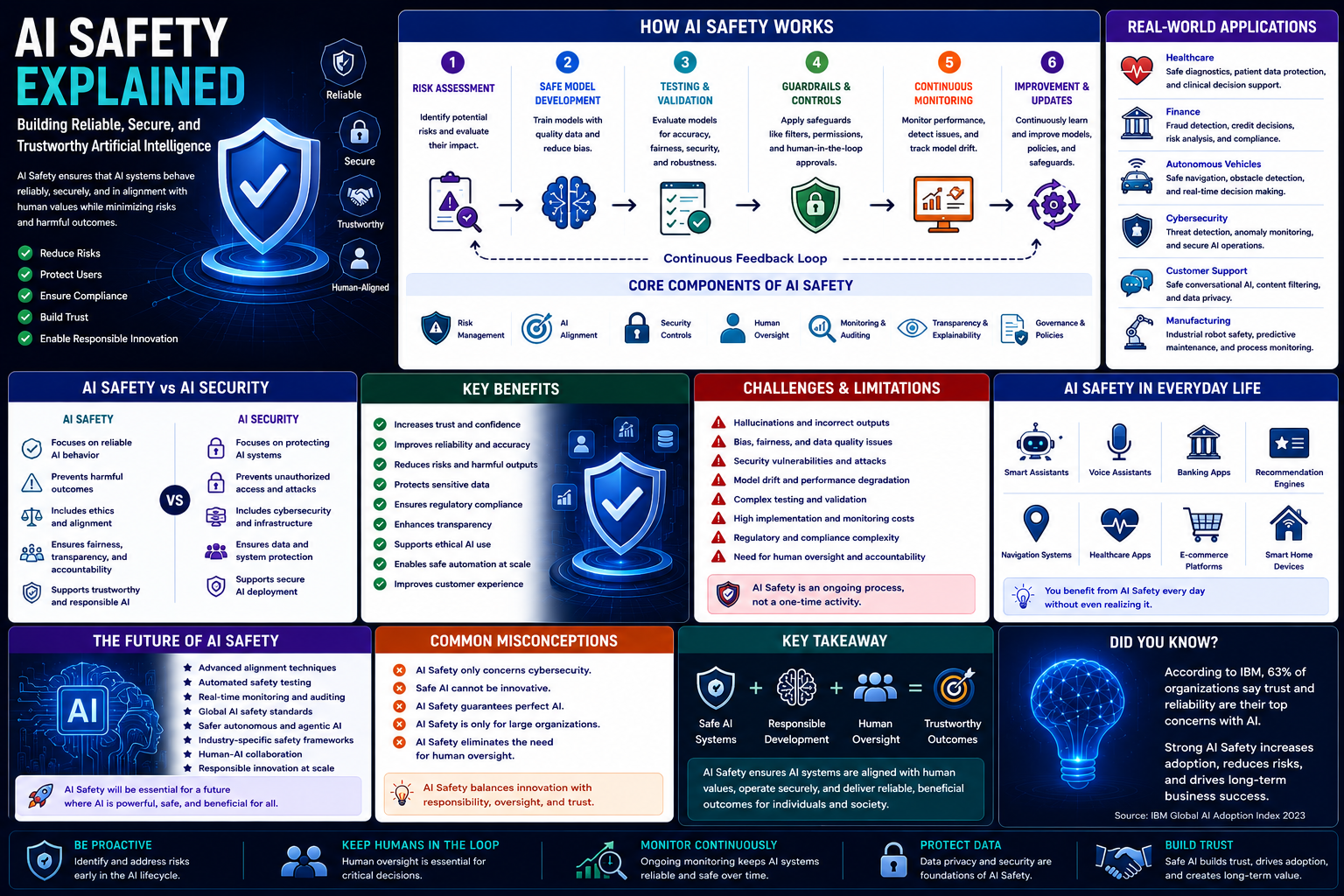
AI Safety Explained: Building Reliable, Secure, and Trustworthy Artificial Intelligence
Introduction
Artificial Intelligence is becoming deeply integrated into healthcare, finance, transportation, education, manufacturing, cybersecurity, and countless everyday applications. As AI systems become more capable and autonomous, ensuring they operate safely, securely, and responsibly has become a top priority.
This is where AI Safety plays a critical role.
AI Safety focuses on designing, testing, deploying, and monitoring AI systems to minimize harmful outcomes while ensuring that AI behaves according to human intentions and organizational policies. It combines technical safeguards, governance frameworks, human oversight, and continuous evaluation to reduce risks without limiting innovation.
From preventing incorrect medical recommendations to protecting sensitive enterprise data, AI Safety helps organizations build AI systems that users can trust.
What Is AI Safety?
AI Safety is the discipline of developing Artificial Intelligence systems that behave reliably, securely, and in alignment with human goals.
Its objective is to ensure AI systems:
Produce reliable outputs
Minimize harmful behavior
Protect sensitive information
Follow organizational policies
Operate securely
Remain transparent
Support human oversight
Continue performing safely after deployment
AI Safety covers the entire AI lifecycle, from development to long-term monitoring.
Why AI Safety Matters
Modern AI systems are increasingly responsible for important decisions and automated actions.
Without proper safety measures, AI systems may:
Generate incorrect information
Reveal confidential data
Produce biased outcomes
Execute unsafe actions
Be manipulated through malicious prompts
Make unreliable recommendations
Drift over time
Create compliance risks
AI Safety reduces these risks while improving trust and reliability.
How AI Safety Works
Most AI Safety programs follow a structured process.
1. Risk Assessment
Organizations identify potential technical, ethical, security, and operational risks before deployment.
2. Safe Model Development
Developers train AI models using carefully curated datasets while reducing bias and improving robustness.
3. Testing and Validation
AI systems undergo rigorous evaluation for:
Accuracy
Fairness
Reliability
Security
Robustness
Explainability
4. Guardrails and Controls
Organizations implement safeguards such as:
Access controls
Content filtering
Permission management
Rate limiting
Human approval workflows
5. Continuous Monitoring
After deployment, AI systems are monitored for:
Model drift
Hallucinations
Security threats
Performance degradation
Unexpected behavior
Regular updates help maintain safe operation.
Core Components of AI Safety
Several elements contribute to trustworthy AI.
Risk Management
Identifies and mitigates AI-related risks.
AI Alignment
Ensures AI objectives remain consistent with human intentions.
Security Controls
Protect AI systems against misuse and cyber threats.
Human Oversight
Keeps people involved in high-impact decisions.
Monitoring and Auditing
Tracks model performance and detects anomalies.
Governance
Applies policies, compliance requirements, and accountability throughout the AI lifecycle.
AI Safety vs AI Security
AI Safety
AI Security
Focuses on reliable AI behavior
Focuses on protecting AI systems from attacks
Prevents harmful outcomes
Prevents unauthorized access
Includes ethics and alignment
Includes cybersecurity practices
Covers model reliability
Covers infrastructure protection
Supports trustworthy AI
Supports secure AI deployment
Both disciplines are essential for responsible AI adoption.
Real-World Applications
AI Safety is critical across many industries.
Healthcare
Clinical decision support
Diagnostic validation
Patient data protection
Finance
Fraud prevention
Credit decision review
Regulatory compliance
Autonomous Vehicles
Collision avoidance
Sensor validation
Emergency decision-making
Cybersecurity
Threat detection
Secure AI operations
Incident response
Customer Service
Safe conversational AI
Data privacy
Content moderation
Manufacturing
Industrial robotics safety
Predictive maintenance
Operational monitoring
Benefits of AI Safety
Organizations gain many advantages.
Benefits include:
Increased trust
Better regulatory compliance
Improved reliability
Reduced operational risks
Stronger data protection
More transparent AI
Safer automation
Higher customer confidence
AI Safety enables organizations to scale AI responsibly.
Challenges and Limitations
Despite its importance, AI Safety presents challenges.
These include:
Rapid AI evolution
Hallucinations
Bias detection
Complex testing
Adversarial attacks
Regulatory uncertainty
Monitoring costs
Balancing innovation with safety
Continuous improvement is essential as AI technologies evolve.
AI Safety in Everyday Life
Many everyday technologies rely on AI Safety practices.
Examples include:
AI chatbots
Voice assistants
Banking systems
Recommendation engines
Healthcare applications
Smart home devices
Navigation systems
Autonomous vehicles
Users often benefit from AI Safety without realizing the safeguards operating behind the scenes.
Future of AI Safety
Future developments include:
Automated AI safety testing
Advanced alignment techniques
Continuous model monitoring
Safer autonomous agents
Global AI safety standards
Real-time AI auditing
Industry-specific safety frameworks
Human-centered AI design
AI Safety will become increasingly important as autonomous and agentic AI systems become more widespread.
Common Misconceptions
Several myths surround AI Safety.
Common misconceptions include:
AI Safety only concerns cybersecurity.
Safe AI cannot be innovative.
AI Safety is only necessary for large organizations.
AI Safety guarantees perfect AI.
AI Safety eliminates the need for human oversight.
In reality, AI Safety balances innovation with responsible development and continuous oversight.
Final Thoughts
AI Safety is a fundamental pillar of responsible Artificial Intelligence. As AI systems become more autonomous and integrated into critical business processes, organizations must ensure these systems operate securely, reliably, and in alignment with human values.
By combining rigorous testing, strong governance, technical safeguards, and continuous monitoring, AI Safety enables organizations to innovate confidently while protecting users, businesses, and society from unintended consequences.
Frequently Asked Questions
What is AI Safety?
AI Safety is the practice of designing, testing, deploying, and monitoring AI systems to ensure they behave reliably, securely, and in alignment with human goals.
Why is AI Safety important?
It helps reduce risks, improve reliability, protect sensitive information, and build trustworthy AI systems.
What is the difference between AI Safety and AI Governance?
AI Safety focuses on preventing harmful AI behavior, while AI Governance establishes the policies and oversight needed to manage AI responsibly throughout its lifecycle.
Which industries use AI Safety?
Healthcare, finance, manufacturing, transportation, cybersecurity, education, retail, government, and many others.
Can AI Safety eliminate all risks?
No. AI Safety reduces risks significantly, but continuous monitoring, governance, and human oversight remain essential.
Comments (0)