AI Risk Management Explained: How Organizations Identify, Assess, and Control Artificial Intelligence Risks
Introduction
Artificial Intelligence is helping organizations automate operations, analyze data, detect fraud, personalize services, and make faster decisions. However, AI systems can also introduce technical, ethical, legal, security, privacy, financial, and operational risks.
An inaccurate recommendation may disrupt a business process. A biased model may create unfair outcomes. A compromised AI system may expose sensitive information. An autonomous agent may take an unintended action. Poor monitoring may allow performance problems to remain undetected.
Organizations therefore need a structured way to identify, evaluate, prioritize, and control these risks.
This discipline is known as AI Risk Management.
AI Risk Management applies governance, technical testing, security controls, human oversight, documentation, and continuous monitoring throughout the AI lifecycle. Its goal is not to eliminate innovation but to help organizations use AI with an acceptable and clearly understood level of risk.
What Is AI Risk Management?
AI Risk Management is the structured process of identifying, assessing, prioritizing, mitigating, monitoring, and reporting risks associated with Artificial Intelligence systems.
It covers the complete AI lifecycle, including:
Planning
Data collection
Model development
Validation
Deployment
Monitoring
Incident response
Model retirement
AI Risk Management helps organizations understand what can go wrong, how serious the consequences may be, and which controls should be implemented.
Why AI Risk Management Matters
AI systems increasingly influence high-impact business and personal decisions.
Poorly managed AI can lead to:
Incorrect decisions
Algorithmic discrimination
Privacy violations
Security breaches
Regulatory penalties
Financial losses
Operational disruption
Reputational damage
Unsafe automated actions
Loss of customer trust
A strong risk management program enables organizations to adopt AI more responsibly and confidently.
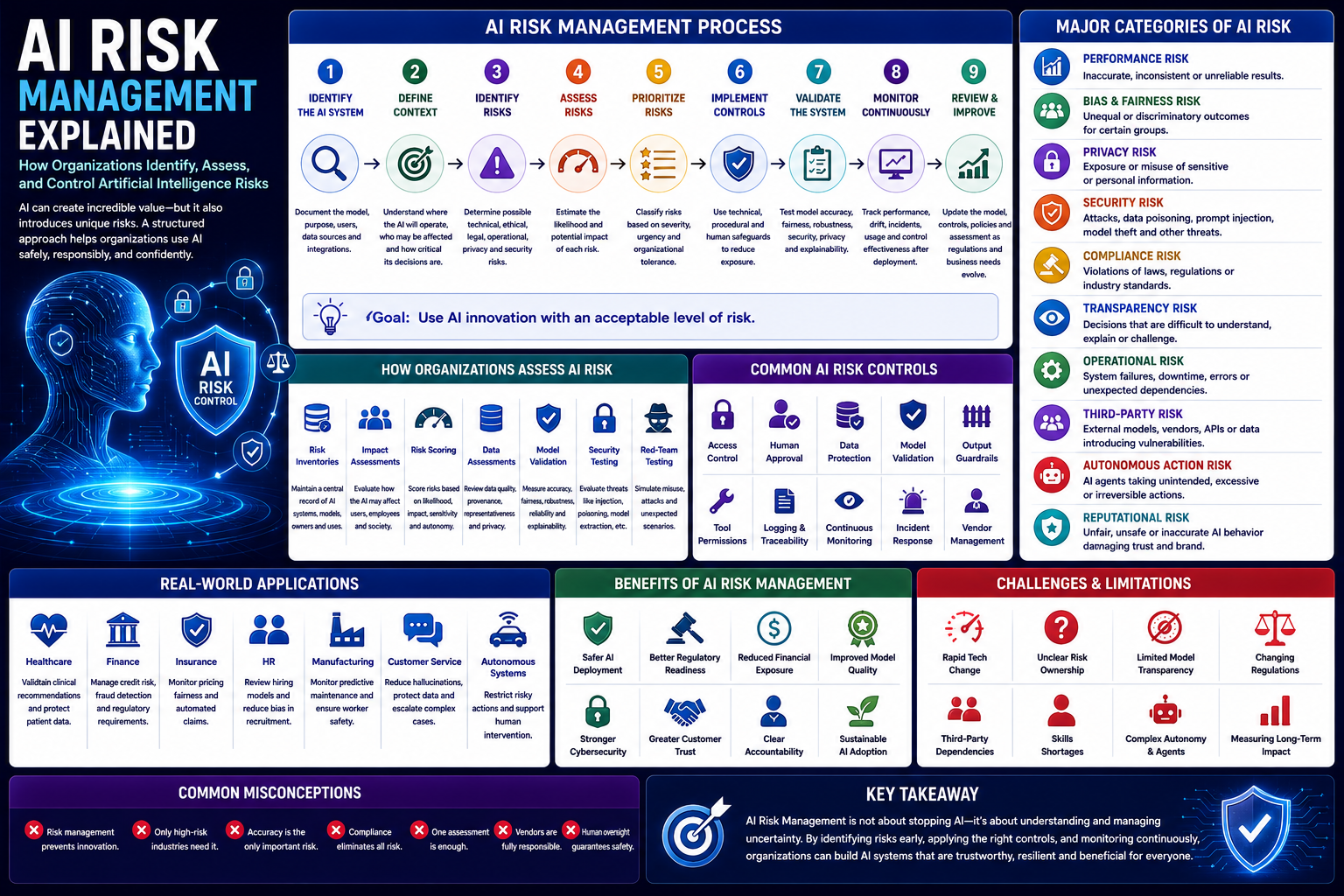
Major Categories of AI Risk
AI risks can be grouped into several major categories.
Performance Risk
The model may produce inaccurate, inconsistent, or unreliable results.
Bias and Fairness Risk
The AI may produce unequal or discriminatory outcomes for certain groups.
Privacy Risk
Sensitive, confidential, or personal information may be exposed or misused.
Security Risk
Attackers may manipulate models, prompts, data, APIs, or infrastructure.
Compliance Risk
The system may violate laws, regulations, contractual obligations, or industry standards.
Transparency Risk
Users and reviewers may be unable to understand or challenge AI decisions.
Operational Risk
The AI may fail, interrupt business processes, or create unexpected dependencies.
Third-Party Risk
External models, datasets, APIs, and vendors may introduce vulnerabilities or compliance issues.
Autonomous Action Risk
Agents or automated systems may execute unintended, excessive, or irreversible actions.
Reputational Risk
Unfair, unsafe, or inaccurate AI behavior may damage stakeholder confidence.
How the AI Risk Management Process Works
Most AI risk programs follow a structured lifecycle.
1. Identify the AI System
Document the model, purpose, users, data sources, integrations, and expected outcomes.
2. Define the Context
Understand where the AI will operate, who may be affected, and how important its decisions are.
3. Identify Risks
Determine possible technical, ethical, legal, operational, privacy, and security failures.
4. Assess Risk
Estimate the likelihood and potential impact of each risk.
5. Prioritize Risk
Classify risks based on severity, urgency, and organizational tolerance.
6. Implement Controls
Use technical, procedural, contractual, and human safeguards to reduce exposure.
7. Validate the System
Test model accuracy, fairness, robustness, security, privacy, and explainability.
8. Monitor Continuously
Track model behavior, drift, incidents, usage patterns, and control effectiveness after deployment.
9. Review and Improve
Update the model, controls, policies, and risk assessment when business conditions or regulations change.
AI Risk Management vs AI Governance
AI Risk Management
AI Governance
Identifies and controls risks
Establishes organizational oversight
Evaluates likelihood and impact
Defines policies and responsibilities
Focuses on risk treatment
Covers the complete AI lifecycle
Supports operational decisions
Provides strategic direction
Monitors specific risk indicators
Coordinates standards, audits, and accountability
AI Governance provides the overall framework, while AI Risk Management handles the detailed process of identifying and controlling risks.
How Organizations Assess AI Risk
Organizations use several methods to evaluate AI systems.
Risk Inventories
Maintain a central record of AI models, tools, vendors, owners, and use cases.
Impact Assessments
Evaluate how an AI system may affect users, employees, customers, and society.
Risk Scoring
Assign scores based on likelihood, impact, sensitivity, autonomy, and reversibility.
Data Assessments
Review data quality, provenance, representativeness, consent, and privacy.
Model Validation
Measure accuracy, robustness, fairness, explainability, and reliability.
Security Testing
Evaluate threats such as:
Prompt injection
Data poisoning
Model extraction
Adversarial inputs
Unauthorized tool access
Red-Team Testing
Simulate misuse, attacks, unsafe behavior, and unexpected scenarios.
Human Review
Ask domain experts, legal teams, security professionals, and affected stakeholders to evaluate risks.
Common AI Risk Controls
Organizations can reduce risk through layered safeguards.
Access Control
Restrict who can use, modify, or deploy AI systems.
Human Approval
Require manual review for high-impact or irreversible actions.
Data Protection
Apply encryption, minimization, anonymization, retention controls, and secure storage.
Model Validation
Test performance before deployment and after significant changes.
Output Guardrails
Filter unsafe, irrelevant, private, or non-compliant outputs.
Tool Permissions
Limit which external systems an AI agent can access and what actions it can perform.
Logging and Traceability
Record prompts, outputs, decisions, model versions, and operational events.
Continuous Monitoring
Track model drift, fairness, latency, accuracy, usage, and security signals.
Incident Response
Define procedures for investigation, containment, correction, notification, and recovery.
Vendor Management
Assess third-party models, APIs, datasets, and service providers.
Real-World Applications
AI Risk Management is important across many industries.
Healthcare
Validating clinical recommendations
Protecting patient data
Monitoring diagnostic performance
Finance
Managing credit-model risk
Reviewing fraud alerts
Meeting regulatory obligations
Insurance
Assessing pricing fairness
Monitoring automated claims
Protecting customer information
Human Resources
Reviewing hiring models
Detecting discriminatory patterns
Protecting candidate privacy
Manufacturing
Monitoring predictive maintenance
Controlling industrial automation
Protecting worker safety
Customer Service
Reducing hallucinations
Preventing sensitive data exposure
Escalating complex cases
Autonomous Systems
Restricting dangerous actions
Supporting human intervention
Testing failure scenarios
Benefits of AI Risk Management
A structured risk program provides many advantages.
Benefits include:
Safer AI deployment
Better regulatory readiness
Reduced financial exposure
Improved model quality
Stronger cybersecurity
Greater customer trust
Clearer accountability
Faster incident response
More reliable automation
Sustainable AI adoption
Risk management can also accelerate innovation by giving teams clear boundaries and approval processes.
Challenges and Limitations
Managing AI risk can be difficult.
Common challenges include:
Rapid technological change
Unclear risk ownership
Limited model transparency
Incomplete documentation
Changing regulations
Third-party dependencies
Skills shortages
Complex autonomous systems
Measuring long-term impact
Balancing risk and innovation
No risk framework can predict every failure. Organizations must continuously review assumptions and adapt controls.
AI Risk Management in Everyday Business
AI risk controls may operate behind many familiar services.
Examples include:
Reviewing loan decisions
Monitoring customer-service chatbots
Validating medical recommendations
Detecting fraudulent transactions
Auditing recruitment tools
Protecting enterprise AI assistants
Restricting autonomous workflow actions
Monitoring recommendation systems
These controls help organizations detect problems before they become serious incidents.
Future of AI Risk Management
Emerging developments include:
Automated AI risk assessments
Real-time risk dashboards
Continuous control monitoring
Agent-specific security controls
Standardized AI impact assessments
Industry-specific risk frameworks
AI assurance and certification
Improved red-team automation
Integrated governance platforms
Risk-based regulatory enforcement
As AI systems become more autonomous, risk management will become an essential operational capability.
Common Misconceptions
Several myths surround AI Risk Management.
Common misconceptions include:
Risk management prevents innovation.
Only high-risk industries need it.
Model accuracy is the only important risk.
Compliance automatically removes AI risk.
One assessment before deployment is enough.
Vendors are responsible for all third-party risks.
Human oversight guarantees safe outcomes.
In reality, AI risk must be managed continuously through technical controls, governance, monitoring, and organizational accountability.
Final Thoughts
AI Risk Management is essential for organizations that want to use Artificial Intelligence safely and responsibly. It provides a structured approach for understanding what may go wrong, evaluating potential consequences, and implementing controls that keep risks within acceptable limits.
Effective risk management combines accurate inventories, impact assessments, model validation, security testing, human oversight, monitoring, documentation, and incident response.
As AI becomes more powerful and autonomous, organizations that manage risk proactively will be better positioned to innovate, comply with regulations, protect stakeholders, and build lasting trust in intelligent systems.
Frequently Asked Questions
What is AI Risk Management?
AI Risk Management is the process of identifying, assessing, prioritizing, mitigating, monitoring, and reporting risks associated with Artificial Intelligence systems.
Why is AI Risk Management important?
It helps organizations reduce technical failures, security threats, unfair outcomes, privacy violations, compliance issues, financial losses, and reputational damage.
What are the main categories of AI risk?
Common categories include performance, bias, privacy, security, compliance, transparency, operational, third-party, autonomous-action, and reputational risks.
Is AI Risk Management the same as AI Governance?
No. AI Governance provides the overall organizational framework, while AI Risk Management focuses specifically on identifying and controlling risks.
When should organizations assess AI risk?
Risk should be assessed before development, before deployment, after major changes, when incidents occur, and continuously throughout the AI lifecycle.
Comments (0)