
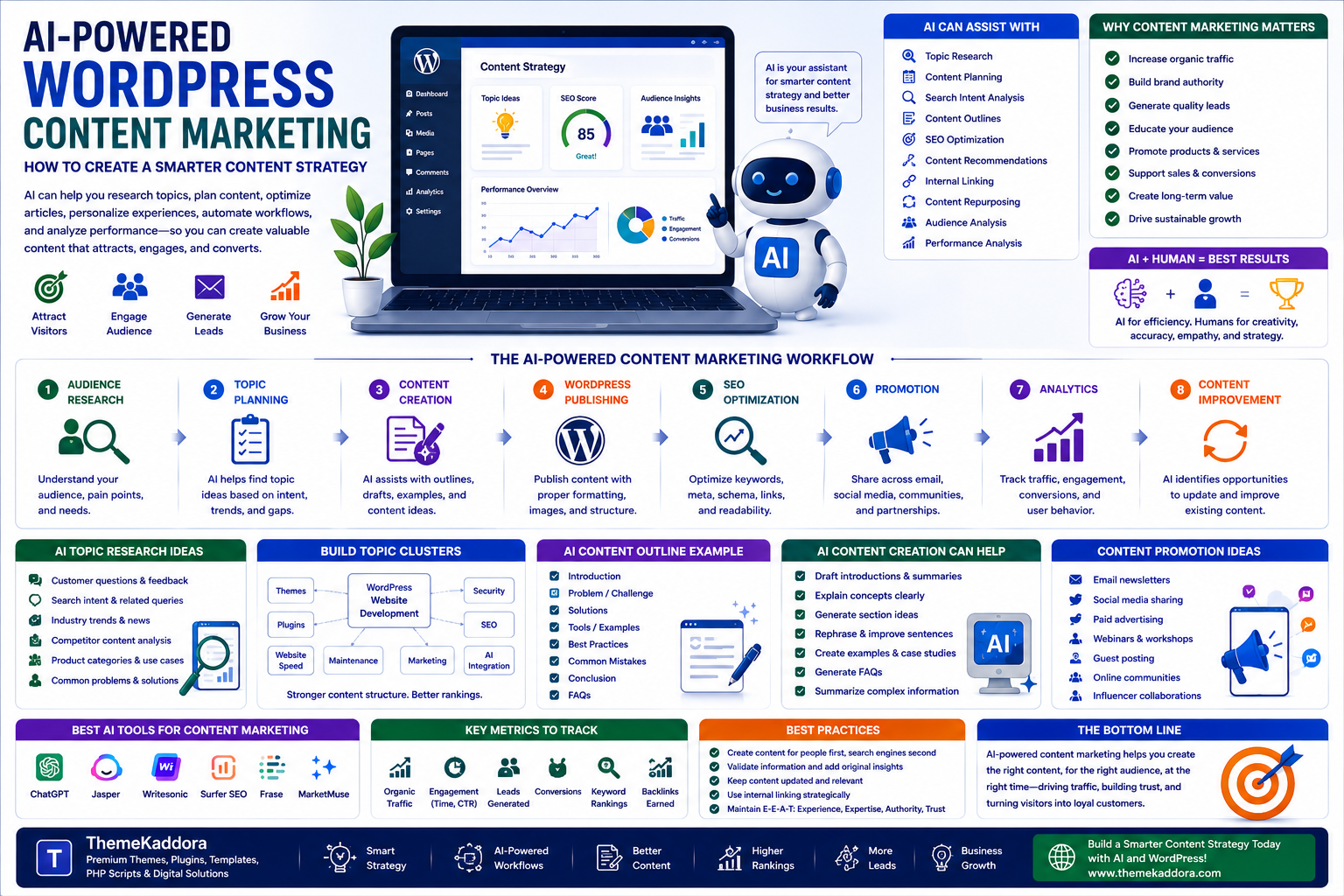
AI-Powered WordPress Content Marketing: How to Create a Smarter Content Strategy
Introduction
Content remains one of the strongest ways for businesses to attract visitors, educate customers, build authority, and generate leads.
But creating successful content consistently is not easy.
Businesses need to research topics, understand their audience, create articles, optimize pages, add internal links, promote content, analyze results, and update older posts.
Artificial intelligence can help simplify many of these activities.
When AI is combined with WordPress, plugins, SEO tools, analytics, automation, and marketing strategy, businesses can create a more organized content marketing system.
The goal is not to allow AI to create everything automatically.
The goal is to use AI as a productivity and strategy assistant while keeping human expertise, originality, and editorial judgment at the center.
What Is AI-Powered WordPress Content Marketing?
AI-powered WordPress content marketing combines artificial intelligence with WordPress publishing and marketing workflows.
AI can assist with:
Topic research
Content planning
Search intent analysis
Content outlines
SEO optimization
Content recommendations
Internal linking
Content repurposing
Audience analysis
Performance analysis
WordPress provides the publishing foundation, while plugins and external tools can extend its capabilities.
A simple workflow can look like:
Audience Research
↓
Topic Planning
↓
Content Creation
↓
WordPress Publishing
↓
SEO Optimization
↓
Promotion
↓
Analytics
↓
Content Improvement
AI can assist throughout this process.
Why Businesses Need a Content Strategy
Publishing random articles is unlikely to produce consistent business results.
A content strategy connects content with specific goals.
These goals may include:
Increasing organic traffic
Building brand authority
Generating leads
Educating customers
Promoting products
Supporting sales
Increasing conversions
For example, a WordPress theme business might create content around:
WordPress Basics
→ Theme Selection
→ Website Design
→ Plugins
→ SEO
→ Marketing
→ Business Growth
This creates a logical content ecosystem.
AI Can Help With Topic Research
One of the hardest parts of content marketing is deciding what to write.
AI can help marketers organize potential topics based on:
Customer questions
Search intent
Industry trends
Existing content
Product categories
Common problems
However, businesses should validate topics using reliable research and real audience needs.
AI should help generate ideas, not replace research.
Build Topic Clusters
Topic clusters can help businesses organize their content.
Instead of creating unrelated articles, businesses can build groups around a central subject.
For example:
Main Topic
WordPress Website Development
Supporting Topics
WordPress Themes
WordPress Plugins
Website Speed
WordPress Security
SEO
AI Integration
Website Maintenance
These articles can be connected with internal links.
This creates a stronger information structure for users and search engines.
AI and Search Intent
A keyword alone does not explain what a visitor actually wants.
Search intent can generally involve:
Learning something
Comparing solutions
Finding a product
Solving a problem
Taking an action
AI can help marketers think through different search intents.
For example:
Keyword: WordPress security plugins
Possible intent:
The visitor wants to discover and compare security solutions.
That suggests a comparison or educational article may be more useful than a generic promotional page.
AI for Content Outlines
Creating an outline before writing can improve organization.
An AI tool can help marketers identify possible sections such as:
Introduction
Problem
Solutions
Tools
Examples
Best practices
Mistakes
Conclusion
FAQs
The final outline should be reviewed and customized by the writer.
A useful outline should reflect the actual audience rather than simply following a generic structure.
AI-Assisted Content Creation
AI can help speed up certain writing activities.
It can assist with:
Drafting introductions
Explaining concepts
Creating section ideas
Rewriting sentences
Generating examples
Summarizing information
Creating FAQs
But businesses should not rely on AI to produce unverified content without human review.
High-quality content should contain:
Original insights
Accurate information
Useful examples
Clear explanations
Brand expertise
AI should support the writer rather than replace expertise.
WordPress Makes Content Publishing Flexible
WordPress provides a flexible platform for publishing different types of content.
Businesses can create:
Blog posts
Pages
Tutorials
Case studies
Landing pages
Product content
Documentation
News
Resource libraries
Plugins can extend the platform with additional marketing and SEO functionality.
This makes WordPress suitable for building a long-term content ecosystem.
AI and WordPress SEO
SEO remains an important part of content marketing.
AI can assist marketers with:
Keyword ideas
Search intent
Content structure
Meta descriptions
Title ideas
Internal linking opportunities
Content gaps
Topic organization
But SEO should not become an exercise in inserting keywords repeatedly.
Useful content should remain the priority.
Creating Better SEO Titles
A title needs to communicate value clearly.
For example:
Basic Title:
WordPress Plugins
Stronger Title:
How WordPress Plugins Can Improve Business Websites
The second title communicates a clearer purpose.
AI can help generate title variations, but marketers should choose the title that accurately reflects the content.
AI and Meta Descriptions
Meta descriptions can help explain what a page is about.
A good description should:
Clearly describe the content
Include relevant language
Encourage a useful click
Match the actual page
AI can help generate variations, but descriptions should always be reviewed before publishing.
AI and Internal Linking
Internal linking connects related pages on a website.
For example:
WordPress Themes
→ WordPress Plugins
→ WordPress SEO
→ WordPress Performance
→ WordPress Security
AI can help identify potentially related pages, but marketers should review every suggested link.
Internal links should be useful to readers rather than added simply to increase the number of links.
AI for Content Updates
Creating new content is only one part of content marketing.
Older articles can become outdated.
Businesses should regularly review:
Statistics
Product information
Links
Screenshots
Recommendations
Examples
Technical details
AI can help identify sections that may need review.
Updating valuable older content can often be more efficient than constantly publishing completely new articles.
AI and Content Repurposing
One article can become multiple marketing assets.
For example:
Blog Post
↓
LinkedIn Post
↓
Email Newsletter
↓
Short Social Post
↓
Video Script
↓
Infographic Idea
AI can help adapt the same core information to different formats.
However, each format should be customized for its audience and platform.
AI for Social Media Content
WordPress content can support social media marketing.
After publishing an article, businesses can create social posts highlighting:
Key insights
Statistics
Tips
Questions
Quotes
Practical takeaways
Automation tools can help distribute content, but social posts should still feel natural and relevant.
AI and Email Marketing
Blog content can also support email campaigns.
For example:
New Blog Published
↓
Email Newsletter
↓
Article Read
↓
Relevant Resource
↓
Lead
AI can help marketers segment audiences and develop content ideas for different customer groups.
This connects content marketing with lead generation.
AI-Powered Content Personalization
Different audiences have different needs.
For example, a WordPress website may attract:
Developers
Designers
Agencies
Entrepreneurs
Bloggers
Small businesses
A developer may want technical information.
A business owner may want practical business benefits.
AI can help marketers identify these differences and create more relevant experiences.
AI and Product Content
Content marketing can support product discovery.
For a WordPress resource platform, articles might naturally connect with:
Themes
Plugins
Templates
Graphics
WooCommerce resources
Business tools
For example:
Article:
How to Build a Professional Business Website
↓
Related Resource:
Business WordPress Themes
The connection should be helpful rather than overly promotional.
AI and Content Funnels
Content can support different stages of the customer journey.
Awareness
Educational articles introduce a topic.
Consideration
Comparison guides help users evaluate solutions.
Decision
Product pages, demos, and case studies support purchasing decisions.
Retention
Tutorials and documentation help existing customers.
AI can help marketers organize content around these different stages.
AI for Content Performance Analysis
Publishing content is not the end of the process.
Businesses should measure results.
Important metrics can include:
Organic traffic
Engagement
Click-through rates
Leads
Conversions
Time on page
Returning visitors
Top-performing articles
AI can help identify patterns within these metrics.
For example:
Articles about WordPress performance generate more leads than general WordPress articles.
That insight can influence future content planning.
AI and Content Gap Analysis
A content gap occurs when an audience has questions that a website does not adequately answer.
AI can help marketers organize potential gaps based on:
Customer questions
Existing articles
Competitor topics
Product categories
Search behavior
The final decision should be based on actual business relevance.
Not every missing topic needs to become an article.
Avoid Low-Quality AI Content
AI makes content production faster, but faster does not always mean better.
Businesses should avoid publishing large amounts of generic content simply because AI makes it easy.
Low-quality content may be:
Repetitive
Generic
Inaccurate
Unoriginal
Poorly researched
Over-optimized
A better approach is:
AI Assistance + Human Expertise + Original Value
This creates stronger content.
AI and Brand Voice
Every business should have a recognizable voice.
AI-generated drafts can sometimes sound generic.
Businesses should define:
Writing style
Terminology
Audience
Brand values
Communication standards
Human editors should ensure that AI-assisted content sounds like the actual brand.
For Themekaddora, this means maintaining a consistent connection between WordPress, technology, business, and practical digital advice.
AI Content Automation
Businesses can automate parts of their content workflow.
For example:
Topic Approved
↓
Content Brief
↓
Draft Created
↓
Human Review
↓
SEO Review
↓
WordPress Publishing
↓
Social Distribution
↓
Performance Tracking
Automation can reduce administrative work while keeping human approval in the process.
AI and WordPress Plugins
Plugins can extend WordPress content workflows.
Depending on the requirement, businesses can use plugins for:
SEO
Analytics
Forms
Social sharing
Email marketing
Content management
Internal linking
Performance
AI integration
The goal should be to create a reliable toolkit rather than installing every available plugin.
Too many unnecessary plugins can increase maintenance and performance challenges.
AI Content Marketing for Small Businesses
Small businesses often have limited content teams.
AI can help them work more efficiently.
A small business can begin with:
A WordPress website
A clear content strategy
A keyword and topic research process
An editorial calendar
AI-assisted drafting
Human review
SEO optimization
Content analytics
This can create a sustainable publishing system without requiring a large marketing department.
AI Content Marketing for Agencies
Agencies can use AI to streamline content operations for multiple clients.
Possible uses include:
Content briefs
Topic research
Editorial calendars
Draft assistance
SEO analysis
Content repurposing
Reporting
Agencies still need experienced strategists and editors to maintain quality.
AI can increase efficiency, but strategy remains essentia
Why Choose Themekaddora?
1. WordPress-Centered Approach
Themekaddora focuses on resources and knowledge related to WordPress and modern website development.
2. Technology and AI Content
The platform covers emerging technologies that are changing how businesses build and operate websites.
3. Marketing Resources
Users can explore content related to SEO, content marketing, digital marketing, and online growth.
4. Business-Focused Information
Themekaddora connects website technology with practical business requirements.
5. Themes, Plugins, and Digital Resources
Users can explore resources that help them build and extend websites.
6. Educational Knowledge Hub
Themekaddora can help users understand not only what tools exist but also how those tools can fit into a broader website strategy.
7. Future-Focused Ecosystem
The combination of WordPress, AI, marketing, automation, and business technology creates a strong foundation for a modern digital resource platform.
How to Build an AI-Powered WordPress Content Strategy
Businesses can follow a practical process.
Step 1: Define the Audience
Understand who the content is intended to help.
Step 2: Identify Business Goals
Decide whether the goal is traffic, leads, sales, authority, or customer education.
Step 3: Research Topics
Identify questions and problems that matter to the audience.
Step 4: Create Topic Clusters
Organize related articles around important subjects.
Step 5: Use AI for Assistance
Use AI for research organization, outlines, ideas, optimization, and repurposing.
Step 6: Add Human Expertise
Review facts, improve examples, and add original insights.
Step 7: Publish Through WordPress
Optimize the article structure, metadata, links, images, and user experience.
Step 8: Promote the Content
Use email, social media, communities, and other appropriate channels.
Step 9: Measure Performance
Track traffic, engagement, leads, and conversions.
Step 10: Update and Improve
Refresh successful content and improve pages that underperform.
Common AI Content Marketing Mistakes
Publishing Without Review
AI-generated information should be checked before publication.
Focusing Only on Keywords
Content should solve audience problems rather than simply target keywords.
Creating Repetitive Articles
A large number of similar articles can weaken a content strategy.
Ignoring Existing Content
Older valuable articles should be improved instead of forgotten.
Over-Automating
Human strategy and editorial judgment remain important.
Forgetting the Business Goal
Every major content project should have a clear purpose.
The Future of AI-Powered Content Marketing
Content marketing is likely to become increasingly connected with AI.
Future workflows may combine:
AI Research
Human Strategy
WordPress
SEO
Marketing Automation
Analytics
Personalization
The biggest change may not be simply faster content production.
It may be the ability to build more intelligent content systems.
Businesses will increasingly be able to understand what audiences need, create useful resources, distribute them across channels, and improve them based on performance.
The companies that succeed will not necessarily be those publishing the most content.
They will be the ones creating the most useful content for the right audience.
Conclusion
AI-powered WordPress content marketing can help businesses plan, create, optimize, distribute, and improve content more efficiently.
AI can assist with:
Topic research
Content planning
SEO
Internal linking
Content updates
Repurposing
Personalization
Analytics
Marketing automation
But AI should remain a supporting technology.
Human expertise, originality, accuracy, brand voice, and audience understanding are still essential.
WordPress provides the publishing platform.
Plugins provide functionality.
AI improves efficiency.
SEO helps people discover content.
Marketing distributes it.
Analytics show what works.
And business strategy turns content into long-term value.
The future of content marketing is not simply about creating more articles.
It is about creating smarter, more useful, and more connected content experiences.
Frequently Asked Questions
1. What is AI-powered WordPress content marketing?
AI-powered WordPress content marketing combines artificial intelligence with WordPress publishing, SEO, marketing, analytics, and automation to create a more efficient content strategy.
2. Can AI write WordPress blog posts?
AI can assist with outlines, drafts, ideas, and editing. However, human review is important for accuracy, originality, expertise, and brand voice.
3. Can AI improve WordPress SEO?
AI can assist with topic research, search intent, titles, meta descriptions, content structure, internal linking, and content analysis.
4. Can AI help find content ideas?
Yes. AI can organize potential topics based on audience questions, industry subjects, existing content, and business goals.
5. What are topic clusters?
Topic clusters organize related articles around a central subject and connect them through internal links.
6. Can AI update old WordPress content?
AI can help identify potentially outdated sections and suggest improvements, but important factual and technical changes should be reviewed before publication.
7. Can AI content be automated in WordPress?
Parts of the workflow can be automated, including content planning, notifications, publishing schedules, social distribution, and reporting. Human review should remain part of the process.
8. Should businesses publish large amounts of AI content?
No. Businesses should prioritize useful, accurate, original, and audience-focused content rather than publishing large volumes of generic material.
9. Why Choose Themekaddora?
Themekaddora provides digital resources across WordPress, themes, plugins, AI, SEO, marketing, WooCommerce, automation, templates, and other technology categories.
It also provides educational content that helps users understand modern website development and digital business strategies.
10. What is the future of AI and WordPress content marketing?
The future is likely to combine AI-assisted research and creation with WordPress publishing, SEO, personalization, automation, analytics, and human expertise to create more useful digital experiences.
Comments (0)