
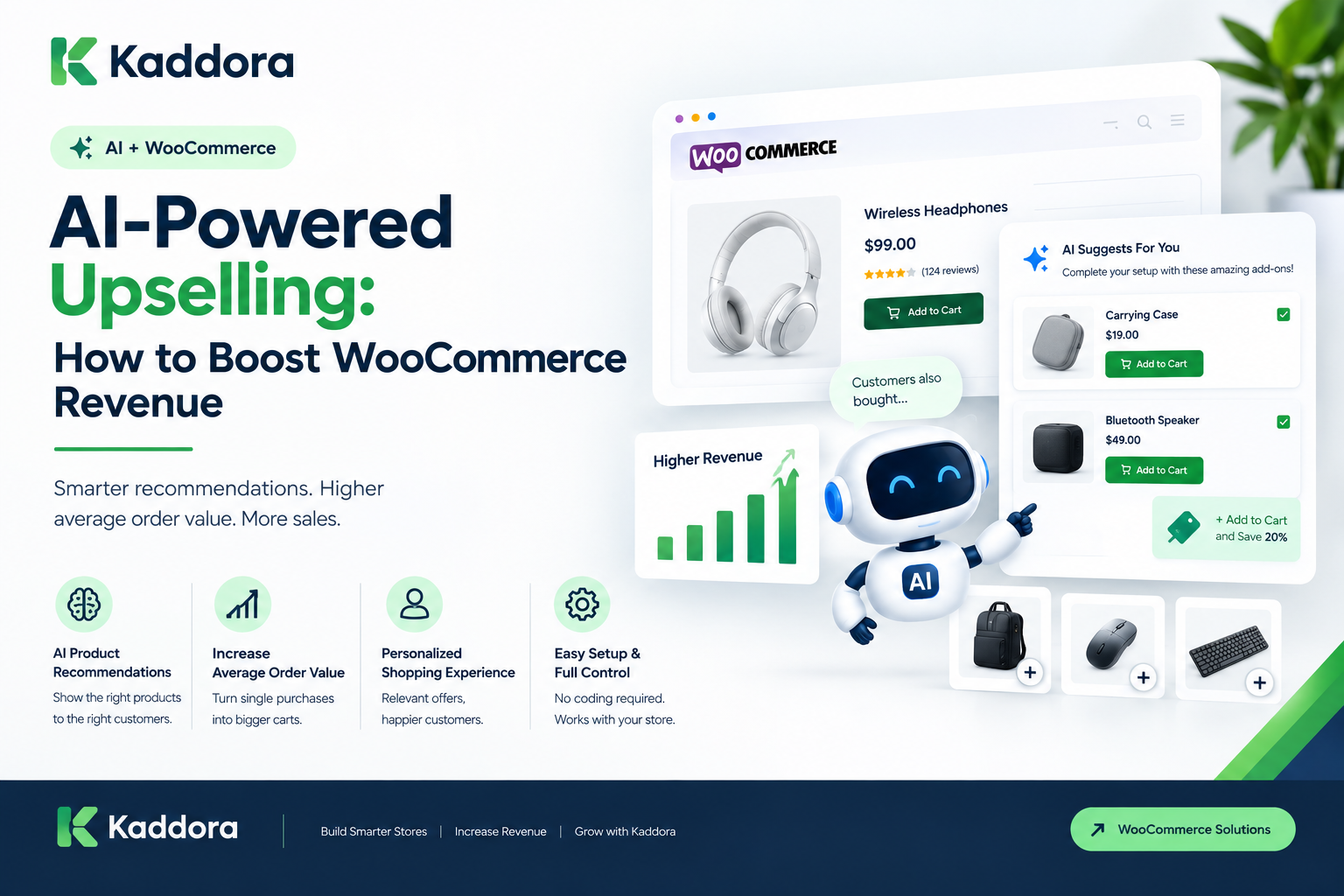
AI-Powered Upselling: How to Boost WooCommerce Revenue
Introduction
Increasing revenue from an existing WooCommerce store does not always require finding more customers.
Another approach is to help existing customers discover products that are relevant to what they are already purchasing.
This is where upselling and AI-powered product recommendations can become useful.
Traditional upselling often relies on manually configured rules.
For example:
Product A ↓ Recommend Product B
But customer behavior can be much more complex.
Different customers may have different interests, budgets, purchase histories, and browsing patterns.
AI can analyze available data and help generate more personalized recommendations.
A WooCommerce store could use AI to identify patterns such as:
Customer Behavior ↓ Product Interest ↓ AI Analysis ↓ Relevant Recommendation ↓ Potential Upsell
In this guide, we will explain what AI-powered upselling means, how it works with WooCommerce, which data can be used, where recommendations can appear, how to implement an AI upselling strategy, and what businesses should consider before deploying it.
What Is AI-Powered Upselling?
AI-powered upselling uses artificial intelligence and customer or product data to recommend products that may be relevant to a customer's current purchase or interests.
Traditional upselling might use fixed rules:
Buy Laptop ↓ Recommend Laptop Bag
AI-based systems can potentially consider more signals:
Product Customer History Browsing Behavior Cart Purchase Patterns Product Relationships ↓ AI / Recommendation Engine ↓ Recommended Products
The objective is to make product recommendations more relevant to the individual customer.
What Is Upselling in WooCommerce?
Upselling means encouraging a customer to consider a higher-value or enhanced product.
For example:
Customer Views: Basic Product — ₹999 Upsell: Premium Product — ₹1,499
The recommendation should be relevant rather than simply more expensive.
For example:
Basic laptop → higher-spec laptop
Standard hosting plan → premium hosting plan
Basic camera → advanced camera
Standard product → premium version
The suitability of an upsell depends on the product and customer context.
Upselling vs Cross-Selling
These concepts are related but different.
Upselling
Encourages the customer to consider an alternative or upgraded product.
Basic Product ↓ Premium Product
Cross-Selling
Recommends complementary products.
Laptop + Laptop Bag + Mouse
AI recommendation systems can support both approaches.
Why AI Can Improve WooCommerce Upselling
Manual recommendations can work well for simple stores.
However, a large catalog can make manual configuration difficult.
Imagine a store with:
10,000 Products
Manually creating recommendation relationships for every product can require significant effort.
AI and recommendation algorithms can analyze product and customer data to identify relationships automatically or semi-automatically.
How AI-Powered WooCommerce Upselling Works
A simplified architecture looks like this:
WooCommerce ↓ Customer Activity ↓ Data Processing ↓ Recommendation Engine ↓ AI / ML Models ↓ Product Ranking ↓ Recommendation
The recommendation system may consider different signals depending on the implementation.
Data Used for AI Upselling
AI-powered recommendations can potentially use several types of data.
Product Data
Such as:
Product title
Category
Price
Attributes
Tags
Description
Variations
Customer Data
Where appropriate and permitted:
Purchase history
Previous orders
Product interactions
Preferences
Behavioral Data
Potential signals include:
Product views
Searches
Cart additions
Purchases
Category browsing
Contextual Data
The system may also consider:
Current product
Current cart
Device context
Session activity
The specific data used should depend on the business, privacy requirements, and recommendation architecture.
AI Product Recommendation Example
Imagine a WooCommerce electronics store.
A customer views:
Wireless Headphones
The recommendation engine may identify:
Wireless Headphones ↓ Purchase History ↓ Product Relationships ↓ Customer Preferences ↓ Recommendations
Possible recommendations:
Premium headphones
Protective case
Charging accessory
Compatible adapter
The actual recommendations should be based on relevant data rather than simply displaying random high-priced products.
AI Upselling on the Product Page
The product page is one possible location for recommendations.
For example:
Product ------------------------ Wireless Headphones ₹2,999 [Add to Cart] You May Also Consider Premium Headphones ₹4,999 [View Product]
The recommendation can be positioned below the primary product information or in another appropriate location.
AI Upselling in the Shopping Cart
The cart is another useful location.
For example:
Your Cart Laptop ₹50,000 ------------------------ Complete Your Setup Laptop Bag ₹2,500 Wireless Mouse ₹1,200
The recommendations should complement the existing cart.
AI Upselling During Checkout
Checkout recommendations need to be implemented carefully because excessive distractions can negatively affect the purchasing experience.
A simple approach may be:
Checkout ↓ Relevant Optional Recommendation ↓ Continue Purchase
The recommendation should not interfere with essential checkout functionality.
AI Upselling After Purchase
Post-purchase recommendations can also be useful.
For example:
Order Completed ↓ Purchase Analysis ↓ Relevant Follow-Up Products
A customer who purchased a camera might later receive recommendations for:
Camera bag
Memory card
Tripod
Additional battery
The timing and communication method should respect customer preferences and applicable requirements.
AI Upselling Through Email
AI-generated product recommendations can potentially be used in email campaigns.
For example:
Previous Purchase ↓ Recommendation Engine ↓ Relevant Products ↓ Email
The recommendations should be based on meaningful product or customer signals.
AI Upselling Through WooCommerce Search
Search behavior can also provide recommendation signals.
For example:
Customer Searches: "mechanical keyboard" ↓ Recommendation Engine ↓ Mechanical Keyboard Premium Keyboard Keyboard Accessories
Search intent can help improve product discovery.
AI-Powered Personalized Recommendations
Personalization means that different customers can receive different recommendations.
For example:
Customer A ↓ Recommendation Set A Customer B ↓ Recommendation Set B
The recommendation engine can use relevant customer signals to determine which products to display.
Collaborative Filtering
One common recommendation approach is collaborative filtering.
A simplified concept is:
Customer A → Product 1 Customer A → Product 2 Customer B → Product 1 Customer B → Product 2 Customer B → Product 3
The system can identify relationships between users and products.
A recommendation may then be generated based on behavior patterns.
Content-Based Recommendations
Another approach is content-based recommendation.
The system compares product characteristics.
For example:
Product A Category: Running Shoes Type: Trail Material: Mesh ↓ Find Similar Products ↓ Product B Category: Running Shoes Type: Trail Material: Mesh
This can be useful when product attributes are well structured.
Hybrid Recommendation Systems
A hybrid system can combine multiple methods.
For example:
Customer Behavior + Product Similarity + Purchase History + Cart Context ↓ Hybrid Recommendation Engine
This can provide a broader recommendation strategy.
AI Upselling and Average Order Value
One important metric for upselling is Average Order Value (AOV).
A simplified calculation is:
AOV = Revenue ÷ Number of Orders
For example:
Revenue = ₹1,000,000 Orders = 2,000 AOV = ₹500
If an upselling strategy increases the amount customers purchase per order, AOV may increase.
However, businesses should evaluate the complete impact rather than assuming every recommendation causes higher revenue.
Measuring AI Upselling Performance
Important metrics can include:
Recommendation impressions
Recommendation clicks
Add-to-cart rate
Conversion rate
Revenue from recommendations
Average order value
Revenue per visitor
Revenue per session
Acceptance rate
A simplified funnel is:
Recommendation Shown ↓ Recommendation Clicked ↓ Product Added ↓ Order Completed
Tracking each stage can help identify where improvements are needed.
AI Upselling Conversion Rate
A recommendation conversion rate can be defined based on the specific recommendation event being measured.
For example:
Recommendation Conversions ÷ Recommendation Interactions × 100
The exact definition should remain consistent when comparing performance over time.
A/B Testing AI Recommendations
Testing can help determine whether recommendations actually improve outcomes.
For example:
Group A No AI Recommendation Group B AI Recommendation
Compare relevant metrics between the groups.
Possible measurements include:
AOV
Conversion rate
Revenue
Click-through rate
Cart additions
Testing should use a sufficiently representative sample and a consistent measurement period.
AI Upselling Without Being Intrusive
Too many recommendations can make a store feel cluttered.
A useful strategy is to prioritize relevance.
Instead of:
Recommended Products 20 Items
consider:
Recommended for You 3–5 Relevant Products
The appropriate number depends on the design and product catalog.
AI Upselling Based on Purchase History
Purchase history can help identify future product opportunities.
Example:
Previous Purchase: Running Shoes Potential Recommendations: Running Socks Running Jacket Sports Bag
The recommendation should account for product compatibility and customer context.
AI Upselling Based on Cart Contents
Cart-based recommendations are especially useful because the system already knows what the customer intends to purchase.
For example:
Cart: Camera Lens ↓ Recommendations: Camera Bag Memory Card Tripod
The system can prioritize products that complement the existing cart.
AI Upselling Based on Product Similarity
Product similarity can identify alternatives.
For example:
Current Product ↓ Similar Products ↓ Higher-Value Alternatives
This can be useful for customers comparing products within the same category.
AI Upselling for Variable Products
WooCommerce stores often use product variations.
For example:
T-Shirt ├── Small ├── Medium ├── Large └── XL
An intelligent recommendation system should understand the product structure and avoid recommending invalid or unavailable combinations.
AI Upselling and Product Availability
Recommendations should ideally account for inventory.
There is little value in recommending a product that cannot currently be purchased.
A simplified process is:
Potential Recommendation ↓ Check Availability ↓ In Stock? ↙ ↘ Yes No ↓ ↓ Show Exclude
Inventory synchronization becomes important for larger stores.
AI Upselling and Product Pricing
Pricing can influence recommendation relevance.
For example:
Current Product: ₹1,000 Potential Upsell: ₹1,200 ₹1,500 ₹3,500
A recommendation engine can use price relationships as one signal, depending on the implementation.
AI Upselling for WooCommerce Subscriptions
Subscription businesses can also use recommendations.
Potential applications include:
Plan upgrades
Additional services
Complementary products
Add-ons
For example:
Basic Subscription ↓ Premium Subscription
The recommendation should match the customer's needs and the subscription structure.
AI Upselling for Digital Products
AI recommendations can also work with digital products.
For example:
WordPress Theme ↓ Recommended: Plugin Template Extension Course
Product relationships can be based on purchase history, product categories, and other relevant signals.
AI Upselling for Physical Products
Physical stores can use recommendations for:
Accessories
Premium products
Bundles
Related products
Replacement products
Inventory availability is particularly important for physical products.
AI Upselling and Product Bundles
AI can help identify products that are frequently purchased together.
For example:
Product A + Product B + Product C
The business can then evaluate whether a bundle makes sense.
AI Upselling and Dynamic Recommendations
Dynamic recommendations change based on available data.
For example:
Customer Activity ↓ Real-Time Context ↓ Recommendation Update
This can make recommendations more relevant to the customer's current session.
AI Upselling and Customer Segmentation
Customers can be grouped into segments based on relevant behavior.
For example:
New Customers Returning Customers High-Value Customers Category-Focused Customers Inactive Customers
Different segments can receive different recommendation strategies.
AI Upselling and WooCommerce Analytics
Analytics provides the data needed to evaluate recommendations.
A connected architecture can look like:
WooCommerce ↓ Analytics ↓ Customer + Product Data ↓ AI Recommendation Engine ↓ Personalized Products
The analytics system can then measure recommendation performance.
AI Upselling and ERP Integration
Businesses using ERP systems can potentially combine:
Inventory
Customer information
Sales
Purchasing
Product data
with recommendation workflows.
For example:
WooCommerce ↓ ERP ↓ Business Data ↓ Recommendation Engine ↓ WooCommerce
The architecture depends on the specific ERP and integration.
AI Upselling Architecture for WordPress
A WordPress implementation can be structured around several components.
WooCommerce ↓ Data Layer ↓ Recommendation Service ↓ AI / Algorithm Layer ↓ Recommendation Cache ↓ WooCommerce Frontend
The system should be designed to avoid unnecessary API requests and performance bottlenecks.
Should Every Recommendation Use an AI API?
No.
Some recommendation tasks can be handled using traditional algorithms.
For example:
Frequently bought together
Product similarity
Category matching
Rule-based upsells
AI APIs can be useful when more advanced analysis is required.
A hybrid architecture can therefore be practical:
Rules + Analytics + Recommendation Algorithms + AI
AI API Cost Considerations
AI APIs can introduce usage costs.
If a store has thousands of visitors, sending every recommendation request to an external AI API may become expensive.
A better architecture can use:
User Activity ↓ Data Processing ↓ Cached Recommendation ↓ Display
AI can periodically generate or update recommendations instead of processing every request in real time.
Caching AI Recommendations
Caching can improve performance and reduce API usage.
For example:
AI Recommendation ↓ Cache ↓ Multiple Visitors
Recommendations can be refreshed when appropriate.
WooCommerce AI Upselling Performance
Recommendation systems should not make the store significantly slower.
Potential performance strategies include:
Caching
Background processing
Precomputed recommendations
Lazy loading
Batch processing
Database optimization
Limited API calls
The implementation should be tested under realistic traffic conditions.
Privacy Considerations
AI-powered personalization may process customer or behavioral data.
Businesses should understand:
What data is collected
Why it is collected
Where it is stored
Whether it is sent to third parties
How long it is retained
What customer choices or controls apply
Privacy requirements depend on the jurisdiction, business, data, and services involved.
Only send the data required for the recommendation task.
Security Considerations
AI recommendation systems should protect:
Customer data
API keys
Order information
Behavioral information
Product data
Use:
Secure API credentials
Proper authorization
Input validation
Output handling
HTTPS
Access controls
Logging
Rate limiting
Common AI Upselling Mistakes
1. Recommending Irrelevant Products
Personalization is only useful when recommendations are relevant.
2. Showing Too Many Recommendations
Too many products can overwhelm customers.
3. Ignoring Inventory
Do not prioritize unavailable products.
4. Ignoring Product Compatibility
Recommendations should make sense together.
5. Sending Every Request to an AI API
This can increase latency and cost unnecessarily.
6. Not Measuring Performance
Without analytics, it is difficult to determine whether recommendations are useful.
7. Ignoring Privacy
Customer data should be handled responsibly.
8. Making the Checkout Too Complicated
Recommendations should not interfere with the primary purchase process.
How to Implement AI-Powered Upselling in WooCommerce
Step 1: Define the Goal
Decide what you want to improve.
Examples:
AOV
Product discovery
Cross-selling
Upselling
Customer engagement
Step 2: Identify Available Data
Determine what customer and product information can legitimately be used.
Step 3: Choose a Recommendation Strategy
Possible options include:
Rule-based
Product similarity
Collaborative filtering
AI-powered
Hybrid
Step 4: Create Product Relationships
Make sure products have structured categories, attributes, tags, and other relevant information.
Step 5: Build the Recommendation Layer
Create a system that generates and ranks recommendations.
Step 6: Add Caching
Avoid unnecessary repeated calculations or API calls.
Step 7: Display Recommendations
Possible locations include:
Product pages
Cart
Checkout
Account pages
Post-purchase pages
Emails
Step 8: Track Performance
Measure clicks, conversions, revenue, and AOV.
Step 9: Test
Compare different recommendation strategies.
Step 10: Optimize
Improve recommendations based on measured results.
WooCommerce AI Upselling Checklist
Use this checklist when planning an AI upselling system:
Define business objective
Identify recommendation locations
Structure product data
Define customer data requirements
Choose recommendation method
Implement product matching
Check product availability
Add caching
Protect API credentials
Add privacy controls
Track recommendation impressions
Track clicks
Track conversions
Measure AOV
Monitor performance
Test recommendation strategies
Advanced AI Upselling Strategy
A mature recommendation system can combine multiple signals.
For example:
Product ↓ Customer History → Recommendation Engine ← Cart ↑ Browsing Behavior ↑ Product Similarity ↑ Inventory ↓ Ranked Results
The system can then select the most relevant products.
Why Choose Kaddora?
Kaddora focuses on WordPress, WooCommerce, AI, analytics, ERP, automation, plugins, themes, and digital business solutions.
AI-powered WooCommerce functionality can connect product recommendations with broader store operations.
Kaddora's WooCommerce-focused solutions can support areas such as:
AI recommendations
Smart upselling
WooCommerce analytics
Product optimization
Store automation
ERP workflows
Customer operations
Business intelligence
The goal is to help WooCommerce businesses explore practical ways to use automation and AI while keeping store performance, usability, privacy, and scalability in mind.
Conclusion
AI-powered upselling can give WooCommerce stores another way to improve product discovery and potentially increase the value generated from existing traffic.
A basic recommendation workflow might look like:
Customer ↓ Product / Cart Activity ↓ Data Analysis ↓ Recommendation Engine ↓ Relevant Products ↓ Customer Interaction ↓ Purchase ↓ Analytics
The important part is not simply adding AI.
A useful AI upselling system should provide relevant recommendations, respect inventory availability, maintain good website performance, protect customer data, control API costs, and measure actual business outcomes.
WooCommerce stores can combine traditional product rules, analytics, recommendation algorithms, and AI rather than relying exclusively on one technology.
When implemented carefully, AI-powered recommendations can become part of a broader eCommerce optimization strategy that includes personalization, cross-selling, product discovery, analytics, and automation.
Frequently Asked Questions
What is AI-powered upselling?
AI-powered upselling uses AI and relevant customer, product, and behavioral data to recommend products that may be more suitable or valuable to a customer.
What is WooCommerce AI upselling?
WooCommerce AI upselling uses AI-powered recommendation techniques within a WooCommerce store to suggest relevant products or upgrades.
Can AI increase WooCommerce revenue?
AI-powered recommendations can potentially influence metrics such as product engagement, conversion, and average order value. Actual results depend on implementation, product relevance, customer behavior, and other business factors.
What is the difference between upselling and cross-selling?
Upselling generally encourages a customer to consider a higher-value or upgraded option, while cross-selling recommends complementary products.
Can WooCommerce use AI product recommendations?
Yes. AI recommendation functionality can be implemented through plugins, custom development, external AI services, or recommendation engines.
Can AI recommend products that are out of stock?
A well-designed recommendation system should check availability and exclude or deprioritize products that cannot currently be purchased.
Can AI upselling work with WooCommerce product variations?
Yes. The recommendation system should understand products and variations and avoid presenting invalid or unavailable options.
Is customer data safe when using AI recommendations?
It depends on the architecture and providers involved. Businesses should minimize data collection, protect credentials, secure integrations, understand third-party processing, and comply with applicable privacy requirements.
Can AI recommendations be automated?
Yes. Recommendation generation, ranking, caching, display, tracking, and reporting can be automated depending on the system.
Why choose Themekaddora?
Themekaddora provides lightweight, responsive, SEO-friendly WordPress themes with fast performance, WooCommerce compatibility, flexible customization, accessibility-conscious design, modern templates, regular updates, and professional support—providing a strong foundation for businesses building digital products and product-focused websites.
Comments (0)