
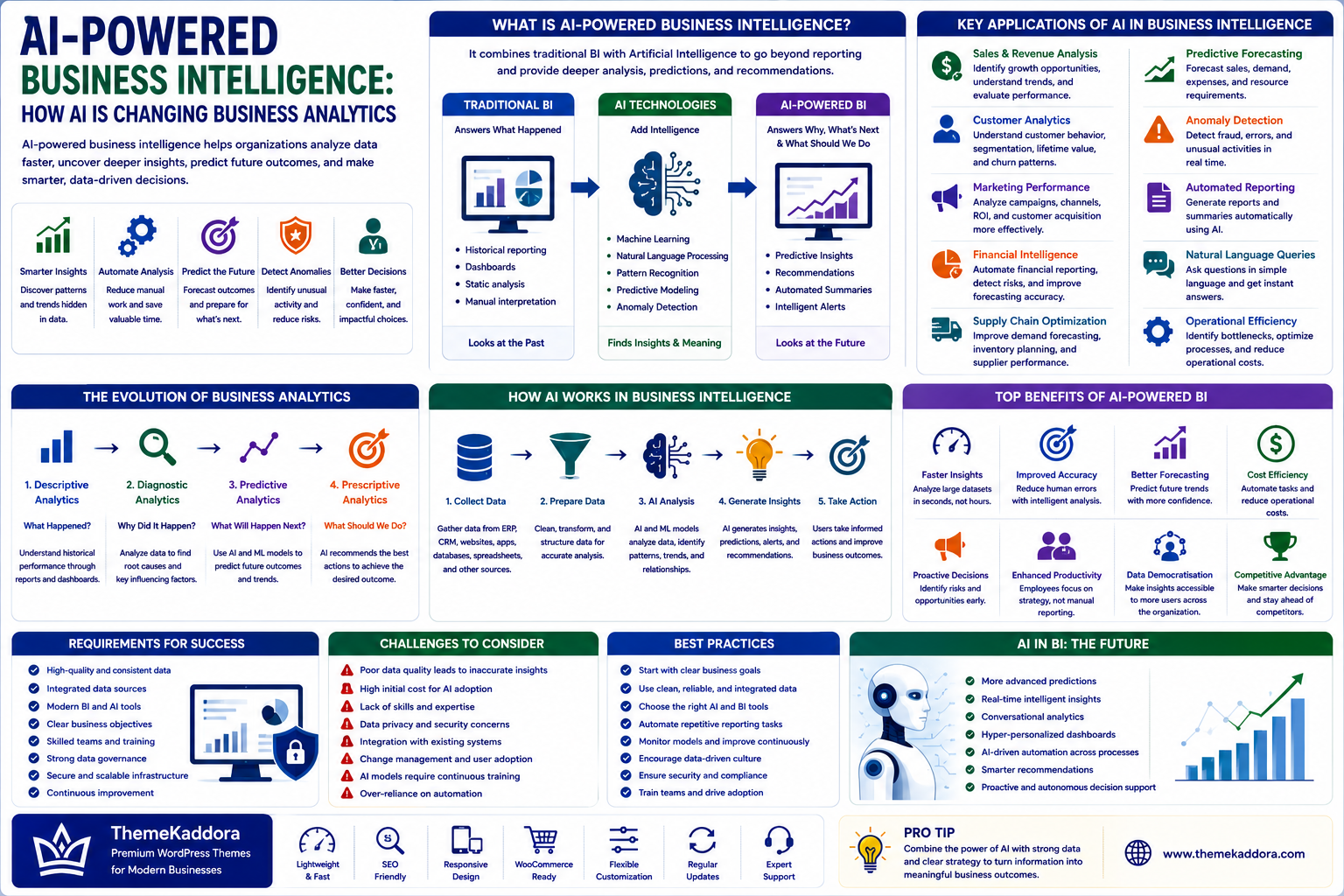
AI-Powered Business Intelligence: How AI Is Changing Business Analytics
Introduction
Businesses generate more data than ever before.
Every sale, customer interaction, payment, website visit, inventory movement, employee activity, and marketing campaign can create valuable information.
The challenge is no longer simply collecting data.
The real challenge is understanding it quickly enough to make better decisions.
Traditional business intelligence tools help organizations transform raw information into dashboards, reports, charts, and metrics.
However, many traditional BI processes still require employees to manually create reports, identify trends, interpret data, and investigate unusual changes.
Artificial Intelligence is changing this process.
AI-powered business intelligence combines traditional business intelligence with artificial intelligence and machine learning technologies to help businesses analyze information more efficiently.
Instead of simply showing that sales decreased, an AI-powered analytics platform may help identify which products, locations, customer segments, or channels contributed to the decline.
Instead of only displaying historical information, AI can also help businesses identify patterns and support forecasting.
This can make business intelligence more proactive, accessible, and useful.
In this guide, we'll explore what AI-powered business intelligence means, how it works, its major applications, benefits, challenges, and how businesses can prepare for an AI-driven analytics environment.
1. What Is AI-Powered Business Intelligence?
AI-powered business intelligence combines traditional BI capabilities with Artificial Intelligence.
Traditional BI typically helps businesses answer:
What happened?
How much did we sell?
Which products performed best?
What were our expenses?
Which region generated the most revenue?
AI can extend these capabilities by helping answer:
Why did it happen?
What is likely to happen next?
Which factors are influencing the result?
What should we investigate?
Which trends require attention?
This changes business analytics from simple reporting toward more intelligent analysis.
For example:
Traditional BI:
"Sales decreased by 12% this month."
AI-powered BI:
"Sales decreased by 12%, with the largest decline coming from Product Category A and the Northern region."
The second insight provides more context for decision-making.
2. How AI Is Changing Business Analytics
Traditional analytics often depends on predefined dashboards.
Users select filters, generate reports, and manually interpret the results.
AI can make analytics more dynamic.
Modern AI-powered BI systems can help with:
Pattern recognition
Trend detection
Predictive analysis
Anomaly detection
Automated summaries
Natural-language queries
Data classification
Forecasting
This means users can spend less time searching through reports and more time acting on insights.
3. From Descriptive to Predictive Analytics
Business analytics can generally be divided into several levels.
Descriptive Analytics
Descriptive analytics explains what happened.
Examples:
Revenue increased by 15%.
Website traffic decreased.
Inventory increased.
Customer churn increased.
Diagnostic Analytics
Diagnostic analytics helps investigate why something happened.
For example:
Why did revenue decline?
The system may examine:
Product performance
Customer segments
Regions
Sales channels
Pricing
Seasonal changes
Predictive Analytics
Predictive analytics focuses on what may happen next.
For example:
What could sales look like next month?
AI can analyze historical patterns and other relevant data to support forecasting.
Prescriptive Analytics
Prescriptive analytics goes a step further by helping evaluate potential actions.
For example:
Which products should receive additional inventory?
AI can analyze available information and provide recommendations for consideration.
Businesses should still apply human judgment, particularly for important decisions.
4. Natural-Language Business Analytics
One of the most noticeable changes AI brings to BI is natural-language interaction.
Traditional analytics often requires users to understand:
Dashboards
Filters
Data models
Reporting tools
Query systems
AI can allow users to ask questions in everyday language.
For example:
"Which products generated the highest revenue this quarter?"
Or:
"Show me the regions where sales declined."
Or:
"What caused the increase in operating expenses?"
Instead of building a report manually, users can interact with data conversationally.
This can make analytics more accessible to non-technical employees.
5. AI-Powered Automated Reporting
Preparing regular reports can consume significant employee time.
Organizations may need:
Daily reports
Weekly reports
Monthly reports
Financial summaries
Sales reports
Inventory reports
Marketing reports
AI can help automate portions of the reporting process.
For example, instead of simply generating a monthly sales chart, an AI system could provide a summary such as:
Revenue increased compared with the previous period, while several product categories experienced declining sales.
Automated summaries can help executives focus on important changes rather than reviewing every data point manually.
6. AI for Anomaly Detection
Businesses need to know when something unusual happens.
Anomaly detection can help identify unexpected patterns in business data.
Examples include:
Sudden revenue changes
Unusual expenses
Unexpected inventory movements
Abnormal customer activity
Unusual transaction values
Sudden changes in website traffic
For example, if a company normally processes orders within a particular range and suddenly sees an unusual spike, the system can flag the event for investigation.
AI can help identify these patterns across large datasets faster than manual review.
7. AI-Powered Sales Analytics
Sales teams generate large amounts of valuable information.
AI-powered BI can analyze:
Revenue
Sales volume
Conversion rates
Customer segments
Product performance
Sales representatives
Geographic performance
Pipeline activity
Managers can use these insights to identify high-performing products and areas requiring attention.
AI can also support sales forecasting by analyzing historical sales patterns and other available business information.
Forecasts should not be treated as guarantees, but they can support planning.
8. AI for Customer Analytics
Customer data is another major source of business intelligence.
AI can help identify patterns involving:
Customer purchases
Engagement
Retention
Churn
Product preferences
Customer value
For example, businesses can analyze which customer segments generate the highest revenue or identify customers whose purchasing behavior has changed.
These insights can support:
Customer retention
Personalization
Marketing campaigns
Sales strategies
Product planning
The objective should be to use customer information responsibly and transparently.
9. AI-Powered Marketing Analytics
Marketing teams manage information from many channels.
These may include:
Search engines
Social media
Paid advertising
Websites
Content marketing
AI can help combine and analyze this information.
Businesses can evaluate:
Campaign performance
Conversion rates
Customer acquisition
Marketing costs
Engagement
Channel performance
Instead of reviewing every marketing report independently, teams can use AI-assisted analysis to identify important patterns across channels.
10. AI for Financial Analytics
Financial data is one of the most valuable sources of business intelligence.
AI-powered analytics can help analyze:
Revenue
Expenses
Profitability
Cash flow
Accounts receivable
Accounts payable
Budget performance
AI can help identify unusual financial patterns and support forecasting.
For example, a business could analyze historical cash-flow data to identify periods where liquidity may become more challenging.
This can help financial teams plan more effectively.
11. AI for Inventory and Supply Chain Analytics
Inventory and supply chain operations produce complex datasets.
AI can analyze:
Product demand
Inventory levels
Supplier performance
Delivery times
Purchase history
Warehouse activity
This can help identify:
Slow-moving inventory
Potential stockouts
Supplier delays
Demand changes
Purchasing trends
Businesses can use these insights to improve inventory planning and supply-chain visibility.
12. AI-Powered Executive Dashboards
Executives typically need a high-level view of business performance.
Traditional dashboards may contain dozens of metrics.
The challenge is determining which metrics require immediate attention.
AI-powered dashboards can help prioritize information.
For example, an executive dashboard could highlight:
Revenue: Positive
Inventory: Attention Required
Customer Retention: Declining
Operating Expenses: Above Expected Level
This allows decision-makers to focus on the areas that may require investigation.
13. Benefits of AI-Powered Business Intelligence
AI-powered BI can provide several potential advantages.
Faster Insights
AI can process large amounts of information quickly.
Reduced Manual Reporting
Automated analysis and summaries can reduce repetitive reporting work.
Better Forecasting
AI can identify patterns that may help businesses plan for future conditions.
Improved Decision-Making
Managers can access more relevant information when evaluating decisions.
Greater Accessibility
Natural-language interfaces can make analytics easier for non-technical users.
Early Problem Detection
Anomaly detection can help identify unusual business activity sooner.
Improved Productivity
Employees can spend less time collecting and formatting data and more time acting on insights.
14. AI Business Intelligence for Small Businesses
AI-powered analytics is not limited to large corporations.
Small businesses can also benefit from simpler applications.
For example, a small business could use AI to analyze:
Monthly sales
Product performance
Customer purchases
Expenses
Inventory
Marketing results
Instead of hiring a dedicated data analyst, a business owner may use AI-assisted tools to understand business trends more efficiently.
However, small businesses should start with practical use cases.
The goal should not be to create complicated dashboards.
The goal should be to answer important business questions.
15. AI-Powered BI for Large Organizations
Large organizations generate enormous amounts of business data.
Information may come from:
ERP systems
CRM platforms
E-commerce platforms
HR systems
Marketing platforms
Financial applications
Supply-chain systems
Customer support platforms
Websites and mobile applications
Analyzing all this information manually can be difficult.
AI-powered business intelligence can help organizations process and interpret large datasets more efficiently.
For example, an organization operating across multiple regions could analyze sales performance by:
Country
Region
Product
Customer segment
Sales channel
Business unit
AI can help identify patterns across these dimensions and highlight areas that deserve attention.
This can be particularly valuable for organizations with complex operations and large reporting requirements.
16. Data Sources for AI-Powered Business Intelligence
AI-powered BI is only as useful as the data available to it.
Businesses may connect information from many sources.
ERP Data
ERP systems can provide:
Sales
Finance
Inventory
Procurement
Employees
Operations
CRM Data
CRM systems can provide:
Leads
Customers
Opportunities
Sales activities
Customer interactions
E-Commerce Data
Online stores can provide:
Orders
Products
Revenue
Customer behavior
Conversion data
Marketing Data
Marketing systems can provide:
Campaign performance
Advertising costs
Traffic
Leads
Conversions
Website Analytics
Web analytics can provide:
Visitors
Traffic sources
Engagement
Conversion activity
User behavior
Combining these sources can create a more complete view of business performance.
17. Data Quality and Governance
AI analytics requires reliable information.
If the underlying data is incorrect, incomplete, duplicated, or inconsistent, AI-generated insights may also become unreliable.
Businesses should establish clear data governance practices.
Important areas include:
Data Accuracy
Information should accurately represent real business activity.
Data Consistency
The same information should follow consistent formats across systems.
Data Completeness
Important fields should not be unnecessarily missing.
Data Ownership
Organizations should define who is responsible for maintaining different datasets.
Data Access
Employees should only access information appropriate for their roles.
Strong data governance creates a better foundation for AI analytics.
18. AI Analytics Security and Privacy
Business intelligence systems can contain sensitive information.
Examples include:
Financial records
Customer information
Employee data
Sales performance
Supplier information
Business strategies
AI systems that process this information should be designed with security in mind.
Businesses should consider:
Role-based access
Authentication
Encryption
Audit logs
Data retention
API security
Permission management
Organizations should also understand how data is processed by third-party AI services when external AI models are used.
Sensitive information should not be exposed unnecessarily.
A strong AI strategy includes security and privacy from the beginning rather than treating them as an afterthought.
19. AI BI vs Traditional BI
Traditional BI and AI-powered BI are not competitors in every situation.
They can complement each other.
Traditional BI
AI-Powered BI
Dashboards
Intelligent dashboards
Scheduled reports
Automated insights
Manual analysis
AI-assisted analysis
Fixed queries
Natural-language queries
Historical reporting
Historical + predictive analysis
Manual anomaly detection
Automated anomaly detection
Static visualization
Dynamic analysis
User-driven investigation
Proactive insights
Traditional BI remains valuable.
Businesses still need accurate dashboards, metrics, reports, and visualizations.
AI extends these capabilities by helping users interpret information more intelligently.
20. Common Challenges of AI-Powered BI
AI-powered business intelligence can provide significant value, but implementation is not always simple.
Poor Data Integration
If important systems are disconnected, AI may not have access to all relevant information.
Inconsistent Data
Different departments may use different definitions and formats.
For example, one department may define a "customer" differently from another.
This can create inaccurate analysis.
Lack of Employee Skills
Employees may need training to understand AI-generated insights and use new analytics tools effectively.
Overdependence on AI
AI recommendations should not automatically replace human judgment.
Business leaders should understand the limitations of AI-generated outputs.
Implementation Costs
Organizations may need to invest in:
Software
Infrastructure
Integration
Data preparation
Training
Security
The expected business value should therefore be evaluated before implementation.
21. How to Implement AI-Powered Business Intelligence
Businesses can approach AI analytics in stages.
Step 1: Define Business Objectives
Start by identifying the questions the organization wants to answer.
Examples:
Why are sales declining?
Which products are most profitable?
Which customers are at risk?
What inventory may be required?
Where are operational costs increasing?
Clear questions create better use cases.
Step 2: Identify Data Sources
Determine where the required information currently exists.
This may include:
ERP
CRM
E-commerce
Accounting
Marketing
HR
Customer support
Step 3: Clean the Data
Remove or correct:
Duplicate records
Incorrect values
Missing information
Inconsistent formats
Outdated records
Step 4: Connect the Systems
Use appropriate integrations, APIs, data warehouses, or other data pipelines to bring relevant information together.
Step 5: Start With a Focused Use Case
Do not attempt to implement AI analytics across the entire organization immediately.
Start with one valuable problem.
For example:
Sales forecasting
or
Inventory anomaly detection
or
Automated financial reporting
A focused implementation makes it easier to measure results.
Step 6: Validate AI Results
Compare AI-generated insights with known business information.
Employees should verify whether recommendations and summaries make sense.
This is especially important during the early stages of deployment.
Step 7: Expand Gradually
Once the initial use case produces reliable results, businesses can expand AI analytics into additional departments.
22. Measuring the ROI of AI-Powered BI
Implementing AI should ultimately create measurable business value.
Useful metrics can include:
Reporting time
Employee productivity
Forecast accuracy
Revenue growth
Cost reduction
Inventory efficiency
Customer retention
Decision-making speed
For example, if employees previously spent 20 hours every month preparing reports and automation reduces this to 5 hours, the organization can measure the time saved.
Similarly, improved forecasting may reduce inventory waste or help businesses respond faster to demand changes.
ROI should be evaluated using business outcomes rather than simply counting the number of AI features implemented.
23. Human Judgment Still Matters
AI-powered analytics can provide valuable recommendations, but it does not understand every business context perfectly.
For example, an AI system may identify a sudden sales decline.
However, a business manager may know that the decline occurred because a product was intentionally discontinued.
This is why AI should support human decision-making.
A practical model is:
Data → AI analysis → Human interpretation → Business decision
This combines the speed of AI with human experience and context.
24. Future of AI-Powered Business Intelligence
The future of business intelligence is likely to become increasingly conversational and proactive.
Instead of opening a dashboard and searching for problems, managers may receive automatic alerts about important changes.
For example:
"Revenue is below the expected trend for the current period."
Or:
"Inventory for several high-demand products may become insufficient."
Or:
"Customer churn has increased in one segment."
AI may also make business analytics more conversational.
Managers could ask:
"Why did profit decrease?"
Then follow up with:
"Which product categories contributed most to the decline?"
Then:
"What happened in those categories last month?"
This creates a more natural way of interacting with business data.
Over time, AI-powered BI may evolve from a reporting tool into a more proactive business decision-support system.
25. AI Agents and Business Intelligence
The next stage of AI analytics may involve AI agents that can perform multiple steps.
For example:
Identify sales decline → Analyze products → Compare regions → Identify likely causes → Generate report → Notify manager.
Instead of simply displaying information, an AI agent could potentially coordinate multiple analytical tasks.
However, organizations will need strong controls around:
Permissions
Data access
Validation
Auditability
Human approval
The more autonomous an AI system becomes, the more important governance becomes.
26. AI-Powered BI and ERP Integration
AI-powered business intelligence becomes especially valuable when connected with ERP systems.
ERP provides operational information.
BI provides analysis.
AI provides intelligent interpretation.
Together, they can create a connected decision-making environment.
For example:
ERP → Business transactions
BI → Business dashboards
AI → Insights, predictions, and recommendations
This combination can help organizations move from simply recording business activity toward continuously analyzing it.
27. Why Choose ThemeKaddora?
At ThemeKaddora, we believe modern business software should help organizations do more than store information.
It should help businesses understand their operations and make better decisions.
AI-powered solutions can support areas such as:
Business analytics
ERP
CRM
Sales
Finance
Inventory
HR
Customer management
Workflow automation
However, successful AI adoption should always begin with a real business requirement.
The objective is not to add AI everywhere.
The objective is to use AI where it can create measurable value.
ThemeKaddora focuses on practical digital solutions designed to help businesses improve efficiency, automation, performance, and customer experiences.
Conclusion
AI-powered business intelligence is changing how organizations understand and use business data.
Traditional BI provides valuable dashboards, reports, metrics, and visualizations.
AI extends these capabilities by helping organizations identify patterns, detect anomalies, generate summaries, forecast future conditions, and interact with data using natural language.
From sales and marketing to finance, inventory, customer management, and operations, AI-powered analytics can support better decision-making across an organization.
However, successful implementation requires more than advanced technology.
Businesses need:
High-quality data
Reliable integrations
Strong security
Clear objectives
Employee training
Human oversight
Measurable goals
The most effective approach is to start with a specific business problem, measure the results, and expand gradually.
The future of business intelligence is not simply about showing businesses more data. It is about helping them understand what that data means and what they can do next.
Frequently Asked Questions
1. What is AI-powered business intelligence?
AI-powered business intelligence combines traditional BI with Artificial Intelligence to analyze business data, identify patterns, generate insights, support forecasting, and assist decision-making.
2. How is AI BI different from traditional BI?
Traditional BI primarily focuses on reporting and visualization. AI-powered BI adds capabilities such as natural-language analysis, anomaly detection, predictive insights, automated summaries, and intelligent recommendations.
3. Can small businesses use AI-powered BI?
Yes. Small businesses can use AI analytics for sales reporting, customer analysis, inventory monitoring, financial insights, marketing analytics, and forecasting.
4. Does AI replace business analysts?
AI can automate parts of data analysis, but human analysts remain valuable for understanding business context, validating results, designing strategies, and making complex decisions.
5. What data does AI-powered BI need?
AI-powered BI can use information from ERP, CRM, accounting, e-commerce, marketing, HR, websites, customer support, and other business systems.
6. Is AI-powered business intelligence secure?
It can be implemented securely with appropriate access controls, authentication, encryption, monitoring, data governance, and privacy practices.
7. Can AI predict future sales?
AI can analyze historical patterns and other available information to generate sales forecasts. However, forecasts are estimates rather than guarantees.
8. How can AI improve business reporting?
AI can automate report generation, summarize important changes, identify anomalies, and allow employees to interact with business data using natural-language questions.
9. What is the biggest challenge with AI business intelligence?
Data quality is one of the most important challenges. Inaccurate or inconsistent data can reduce the reliability of AI-generated insights.
10. What is the future of AI-powered BI?
AI-powered BI is likely to become more conversational, predictive, automated, and proactive, helping businesses identify important changes and opportunities faster.
Comments (0)