
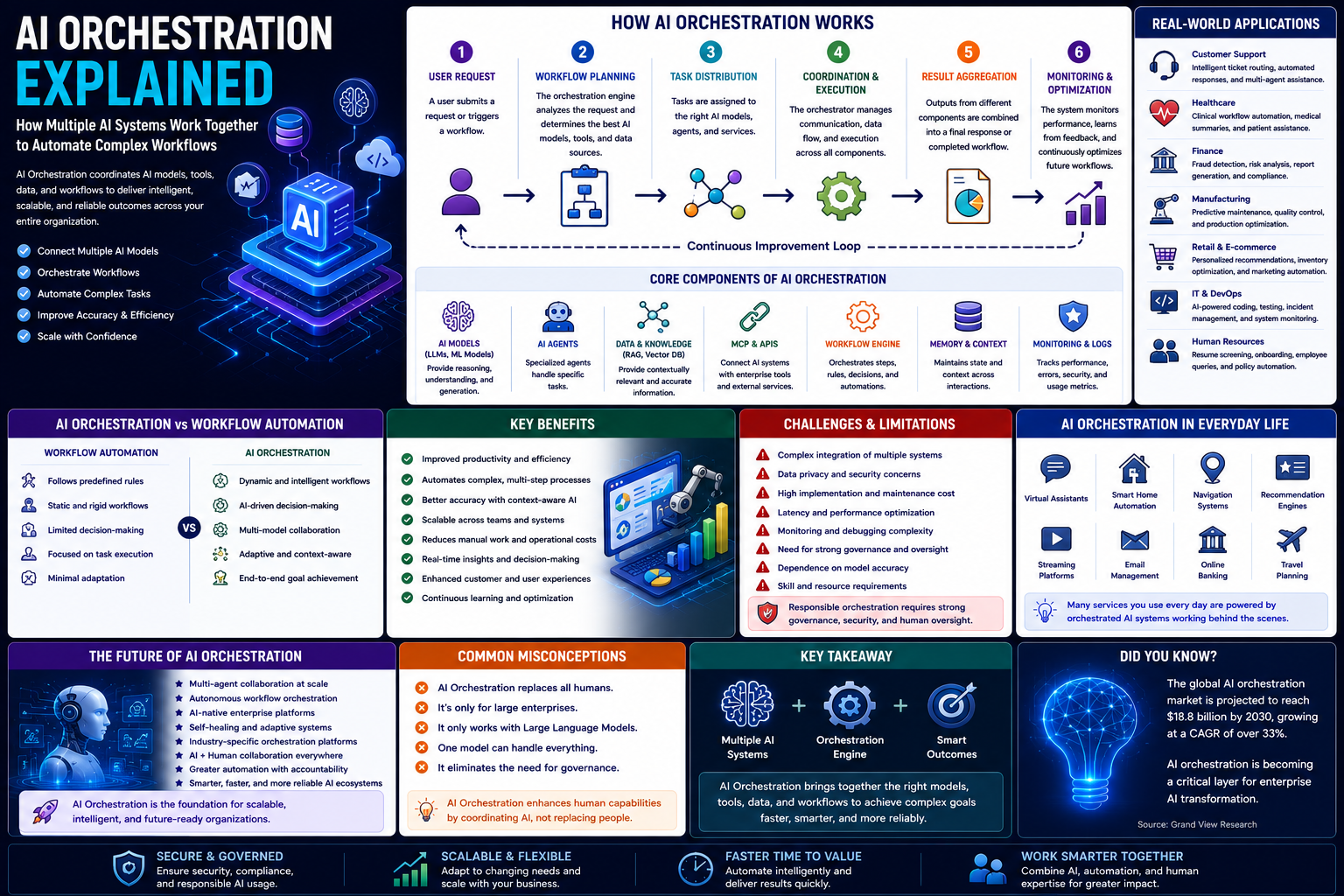
AI Orchestration Explained: How Multiple AI Systems Work Together to Automate Complex Workflows
Introduction
Modern Artificial Intelligence applications rarely rely on a single AI model. Instead, they combine multiple AI models, databases, APIs, automation tools, enterprise applications, and business workflows to solve increasingly complex problems.
Managing these interconnected systems requires a structured approach known as AI Orchestration.
AI Orchestration coordinates how different AI components communicate, exchange data, execute tasks, and make decisions. Rather than operating independently, AI models collaborate through orchestrated workflows that improve efficiency, scalability, and reliability.
From enterprise copilots and customer service automation to healthcare systems and intelligent manufacturing, AI orchestration enables organizations to build powerful, end-to-end AI solutions.
What Is AI Orchestration?
AI Orchestration is the process of coordinating multiple AI models, software tools, APIs, databases, and automation workflows into a unified system that performs complex tasks efficiently.
Instead of relying on a single AI model, orchestration manages how different components interact to complete business objectives.
An orchestrated AI system can:
Route requests
Retrieve knowledge
Call APIs
Execute workflows
Coordinate AI agents
Monitor performance
Handle errors
Optimize task execution
AI Orchestration serves as the central control layer for modern AI applications.
Why AI Orchestration Matters
Enterprise AI systems often involve dozens of connected services.
Without orchestration, organizations may face:
Fragmented workflows
Duplicate processing
Poor scalability
Integration complexity
Higher operational costs
Inconsistent outputs
Difficult monitoring
Reduced productivity
AI Orchestration ensures all components work together efficiently.
How AI Orchestration Works
Most orchestration platforms follow a structured workflow.
1. User Request
A user submits a request such as:
Generate a report
Analyze sales
Answer customer questions
Process invoices
Create marketing content
2. Workflow Planning
The orchestration engine determines which systems and AI models are required.
Examples include:
Large Language Models
Vector databases
Knowledge graphs
Enterprise APIs
CRM systems
ERP software
Workflow automation tools
3. Task Distribution
Individual tasks are assigned to specialized AI models or services.
For example:
One model retrieves documents.
Another summarizes information.
Another generates recommendations.
Another executes business workflows.
4. Coordination
The orchestration engine manages communication between components, ensuring data flows correctly throughout the process.
5. Result Aggregation
Outputs from multiple AI services are combined into a final response or completed workflow.
6. Monitoring and Optimization
The system continuously tracks:
Performance
Latency
Errors
Resource usage
Workflow efficiency
This enables ongoing optimization.
Core Components of AI Orchestration
Several technologies work together.
Large Language Models (LLMs)
Provide reasoning and content generation.
AI Agents
Perform specialized tasks.
Workflow Engines
Coordinate business processes.
Model Context Protocol (MCP)
Connects AI to enterprise tools.
Retrieval-Augmented Generation (RAG)
Retrieves relevant information.
APIs
Enable communication with external services.
Monitoring Systems
Track workflow performance and reliability.
AI Orchestration vs Workflow Automation
Workflow Automation
AI Orchestration
Automates predefined tasks
Coordinates intelligent systems
Rule-based workflows
AI-driven decision making
Limited adaptability
Dynamic workflow optimization
Minimal reasoning
Advanced reasoning capabilities
Task execution
End-to-end AI coordination
AI Orchestration extends traditional automation by integrating intelligent decision-making into workflows.
Real-World Applications
AI Orchestration powers many industries.
Customer Support
Intelligent ticket routing
Multi-agent assistance
Automated knowledge retrieval
Healthcare
Clinical workflow coordination
Medical documentation
Diagnostic assistance
Finance
Fraud detection pipelines
Regulatory reporting
Investment analysis
Manufacturing
Predictive maintenance
Supply chain optimization
Production monitoring
Retail
Personalized shopping
Inventory management
Marketing automation
Software Development
AI coding assistants
Automated testing
CI/CD intelligence
Benefits of AI Orchestration
Organizations gain many advantages.
Benefits include:
Improved productivity
Better scalability
Faster automation
Reduced operational costs
Higher AI accuracy
Better resource utilization
Simplified integration
Enhanced customer experiences
AI Orchestration enables enterprise-scale AI deployment.
Challenges and Limitations
Despite its advantages, orchestration introduces challenges.
These include:
Complex integrations
Security management
Workflow monitoring
Model coordination
Latency optimization
Data governance
Infrastructure costs
Cross-platform compatibility
Successful orchestration requires careful planning and governance.
AI Orchestration in Everyday Life
Many modern AI services already use orchestration.
Examples include:
AI copilots
Virtual assistants
Smart customer support
Enterprise search
Recommendation engines
Financial assistants
Healthcare platforms
Intelligent business dashboards
Users often experience orchestration without realizing it.
Future of AI Orchestration
Future developments include:
Multi-agent collaboration
Autonomous workflow orchestration
Self-healing AI systems
Industry-specific orchestration platforms
Cross-enterprise AI ecosystems
AI-native operating systems
Smarter resource optimization
Fully autonomous enterprise workflows
AI Orchestration will become a core technology for next-generation intelligent enterprises.
Common Misconceptions
Several myths surround AI Orchestration.
Common misconceptions include:
AI Orchestration replaces workflow automation.
It only works with Large Language Models.
Only large enterprises need orchestration.
AI Orchestration eliminates human oversight.
One AI model can replace orchestration.
In reality, orchestration enhances AI by enabling multiple systems to collaborate efficiently while maintaining governance and human oversight.
Final Thoughts
AI Orchestration is becoming the backbone of enterprise Artificial Intelligence by enabling multiple AI systems, business applications, and automation platforms to work together seamlessly. Rather than relying on isolated AI models, orchestration creates intelligent ecosystems capable of handling sophisticated workflows, improving operational efficiency, and delivering more reliable outcomes.
As organizations expand their AI initiatives, AI Orchestration will play a vital role in building scalable, secure, and intelligent business processes that maximize the value of Artificial Intelligence.
Frequently Asked Questions
What is AI Orchestration?
AI Orchestration is the coordination of multiple AI models, tools, workflows, and enterprise systems to complete complex tasks efficiently.
Why is AI Orchestration important?
It improves scalability, automation, integration, and collaboration between AI components.
What technologies are used in AI Orchestration?
Large Language Models, AI agents, workflow engines, APIs, RAG, Model Context Protocol, vector databases, and enterprise software.
Which industries use AI Orchestration?
Healthcare, finance, manufacturing, retail, software development, telecommunications, logistics, and government.
Is AI Orchestration the same as workflow automation?
No. Workflow automation follows predefined rules, while AI Orchestration coordinates intelligent systems capable of reasoning, adaptation, and dynamic decision-making.
Comments (0)