AI Observability Explained: How Organizations Understand, Diagnose, and Improve Production AI Systems
Introduction
Deploying an Artificial Intelligence model is only the beginning of its operational lifecycle. Once an AI system begins processing real-world data, its behavior can be influenced by changing user expectations, new data patterns, software updates, external APIs, infrastructure issues, prompt variations, and business conditions.
Traditional monitoring can alert a team when a metric crosses a predefined threshold. However, an alert does not always explain why the problem occurred.
For example, a customer-support chatbot may suddenly generate less relevant answers. The cause could be outdated documents, retrieval failures, prompt changes, model updates, increased latency, incorrect permissions, or a third-party API problem.
This is where AI Observability becomes essential.
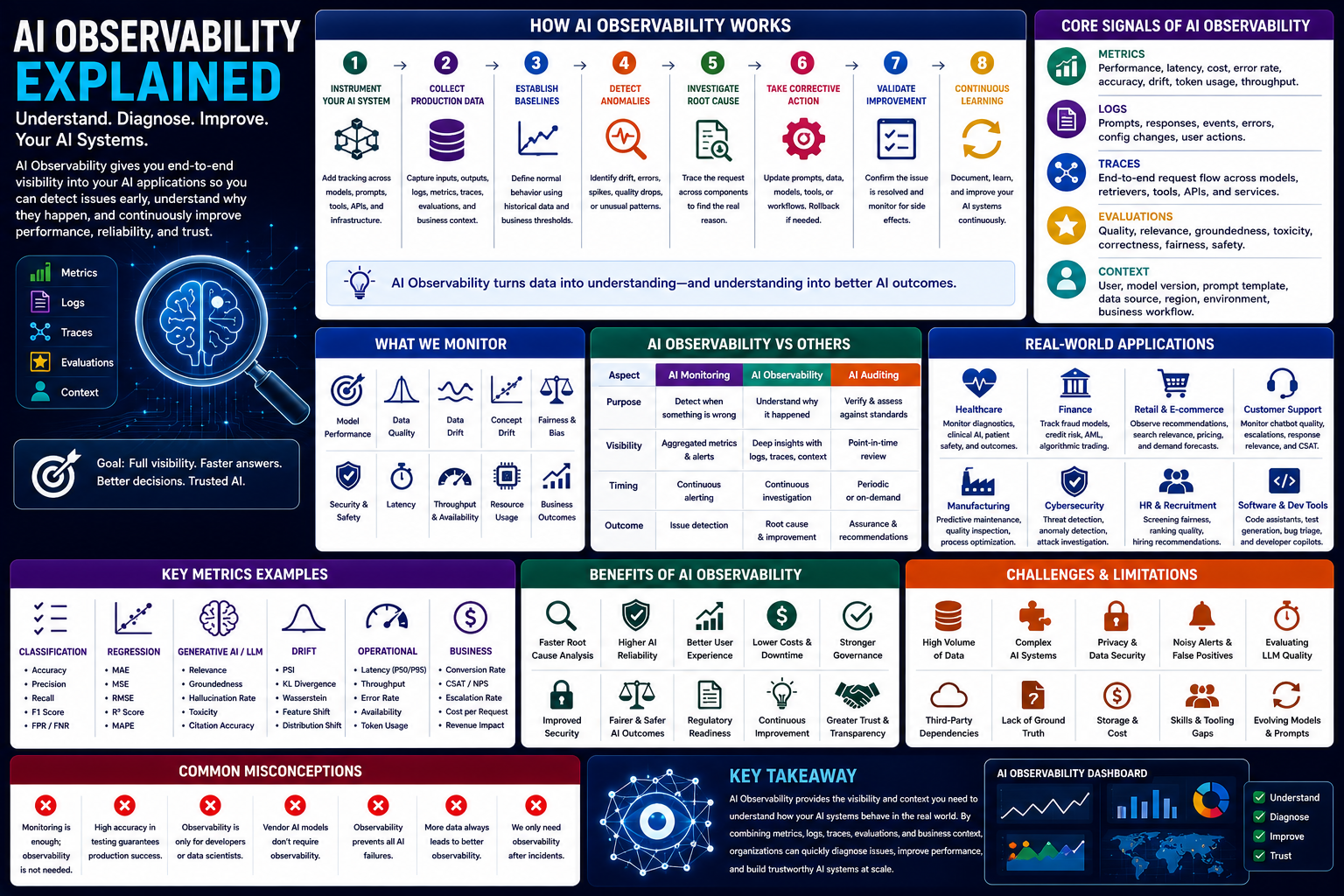
AI Observability gives organizations the detailed signals, context, and diagnostic tools needed to understand how an AI system behaves from input to output. It combines metrics, logs, traces, evaluations, model data, infrastructure telemetry, and business outcomes to help teams identify root causes and improve reliability.
What Is AI Observability?
AI Observability is the ability to understand the internal behavior and operational health of an Artificial Intelligence system by analyzing the information it generates during production use.
It helps teams investigate questions such as:
Why did the model produce this output?
Which data or prompt influenced the response?
Did retrieval return the correct information?
Is the model experiencing drift?
Did an external tool or API fail?
Why has latency increased?
Which model version generated the result?
Are users receiving safe and relevant responses?
Is the AI supporting its intended business objective?
AI Observability provides deeper diagnostic visibility than basic performance monitoring.
Why AI Observability Matters
Modern AI applications often combine many interconnected components.
These may include:
Foundation models
Embedding models
Vector databases
Retrieval systems
Prompts
AI agents
External tools
APIs
Guardrails
Business workflows
Cloud infrastructure
A failure in any component can affect the final result.
AI Observability helps organizations:
Diagnose production problems
Improve AI reliability
Reduce downtime
Detect hallucinations
Understand model behavior
Identify retrieval failures
Investigate security incidents
Optimize costs and latency
Improve user experiences
Support governance and compliance
Without observability, teams may know that an AI system is failing but not understand why.
Core Signals of AI Observability
AI Observability typically combines several categories of operational data.
Metrics
Metrics provide numerical measurements of system behavior.
Examples include:
Accuracy
Latency
Throughput
Error rate
Token usage
Cost per request
Hallucination rate
Retrieval relevance
User satisfaction
Logs
Logs record important events and system activity.
Examples include:
User prompts
Model responses
API calls
Authentication events
Guardrail actions
Errors
Configuration changes
Model-version changes
Traces
Traces show the complete path of a request across multiple components.
A trace may include:
User query
→ Prompt processing
→ Embedding generation
→ Vector search
→ Document retrieval
→ Model inference
→ Guardrail validation
→ Final response
Evaluations
Evaluations measure the quality and safety of model outputs.
Examples include:
Relevance
Accuracy
Groundedness
Toxicity
Helpfulness
Completeness
Citation quality
Policy compliance
Context
Context connects technical signals with information such as:
User type
Model version
Prompt template
Data source
Geographic region
Business workflow
Deployment environment
How AI Observability Works
Most AI Observability systems follow a continuous process.
1. Instrument the AI System
Add tracking across models, prompts, retrieval pipelines, tools, APIs, and infrastructure.
2. Capture Production Events
Collect information about:
Inputs
Outputs
Model versions
Retrieved documents
Tool calls
Latency
Errors
Costs
User feedback
3. Connect the Signals
Combine metrics, logs, traces, evaluations, and business context into a unified view.
4. Detect Anomalies
Identify unexpected behavior such as:
Higher hallucination rates
Lower retrieval relevance
Increased latency
Cost spikes
Tool failures
Prompt injection attempts
Output-quality degradation
5. Investigate Root Causes
Trace the issue across the complete AI application.
6. Take Corrective Action
Possible actions include:
Updating prompts
Fixing retrieval pipelines
Changing model versions
Rebuilding indexes
Adjusting guardrails
Restricting tool permissions
Retraining models
Rolling back deployments
7. Validate the Improvement
Confirm that the corrective action resolved the issue without introducing new problems.
AI Observability vs AI Model Monitoring
AI Observability
AI Model Monitoring
Explains why problems occur
Detects when metrics change
Combines logs, traces, metrics, and context
Tracks predefined indicators
Supports root-cause analysis
Supports alerting
Covers complete AI applications
Often focuses on model health
Investigates unknown failure modes
Detects known failure patterns
Provides request-level visibility
Provides aggregate performance views
Monitoring tells teams that something is wrong. Observability helps them understand the cause.
AI Observability vs Traditional Software Observability
AI Observability
Traditional Software Observability
Evaluates output quality and meaning
Evaluates system availability and performance
Tracks prompts and responses
Tracks application requests and errors
Measures hallucinations and relevance
Measures exceptions and response codes
Monitors models and retrieval systems
Monitors services and infrastructure
Handles probabilistic outputs
Handles mostly deterministic behavior
Includes human and model evaluations
Primarily uses technical telemetry
AI applications require traditional infrastructure observability plus model- and content-specific evaluation.
Key Areas of AI Observability
Organizations may observe several layers of an AI system.
Data Observability
Tracks data quality, schema changes, missing values, lineage, and distribution shifts.
Model Observability
Tracks model performance, confidence, fairness, drift, and output behavior.
Prompt Observability
Tracks prompt versions, templates, variables, and their effect on response quality.
Retrieval Observability
Evaluates search queries, retrieved documents, ranking, relevance, and groundedness.
Agent Observability
Tracks planning steps, tool selection, memory, actions, retries, and failures.
Infrastructure Observability
Tracks servers, GPUs, APIs, databases, networks, latency, and resource usage.
Business Observability
Connects AI performance with conversion rates, customer satisfaction, escalations, revenue, and other outcomes.
Observability for Generative AI and LLMs
Generative AI systems require specialized visibility.
Organizations may track:
Prompt and response pairs
Token consumption
Model version
Response relevance
Groundedness
Hallucination rate
Toxicity
Refusal behavior
Citation correctness
Prompt injection attempts
Tool-call success
User ratings
Cost per interaction
Because generative outputs can vary between requests, evaluation often combines automated metrics with human review.
Observability for AI Agents
AI agents introduce additional complexity because they can plan and perform actions across external tools.
Agent observability may track:
Goal received
Planning steps
Tools selected
API calls
Permissions used
Memory accessed
Decisions made
Retries
Execution failures
Human approvals
Final outcome
This traceability helps organizations determine why an agent took a particular action and whether it followed established policies.
Real-World Applications
AI Observability supports many industries.
Customer Support
Diagnose irrelevant chatbot responses
Track retrieval failures
Monitor escalation quality
Healthcare
Investigate clinical recommendations
Track data and model versions
Monitor diagnostic reliability
Finance
Trace credit decisions
Monitor fraud models
Investigate unusual predictions
Retail
Analyze recommendation quality
Track personalization performance
Diagnose search problems
Manufacturing
Investigate predictive-maintenance failures
Monitor sensor and model behavior
Track automation decisions
Software Development
Observe coding assistants
Track tool calls
Diagnose inaccurate code generation
Enterprise AI Assistants
Monitor document retrieval
Track access permissions
Evaluate response accuracy and citations
Benefits of AI Observability
Organizations gain many advantages.
Benefits include:
Faster root-cause analysis
More reliable AI systems
Reduced downtime
Better output quality
Lower operational costs
Improved security
Greater transparency
Better regulatory readiness
Faster incident response
Improved customer experiences
Observability helps teams move from reactive troubleshooting to proactive AI operations.
Challenges and Limitations
Implementing AI Observability can be difficult.
Common challenges include:
Large telemetry volumes
Sensitive prompts and responses
Privacy requirements
Evaluation subjectivity
Complex multi-model systems
Third-party model limitations
High storage costs
Incomplete traces
Rapid prompt and model changes
Connecting technical metrics to business outcomes
Organizations must balance visibility with privacy, security, cost, and data-retention requirements.
AI Observability in Everyday Business
AI Observability may operate behind applications such as:
Customer-service chatbots
Enterprise knowledge assistants
Product recommendation engines
Fraud-detection systems
Recruitment tools
Medical decision-support systems
AI coding assistants
Autonomous business workflows
It helps teams understand individual interactions as well as broader production trends.
Future of AI Observability
Future developments include:
Automated root-cause analysis
AI-generated incident summaries
Real-time LLM evaluations
Agent-specific tracing standards
Cross-model observability
Automated prompt optimization
Continuous compliance evidence
Business-aware anomaly detection
Autonomous remediation
Integrated AI governance dashboards
As AI applications become more complex and autonomous, observability will become a central part of enterprise AI infrastructure.
Common Misconceptions
Several myths surround AI Observability.
Common misconceptions include:
Observability and monitoring are the same.
Infrastructure logs are enough for AI applications.
Only developers need observability data.
Vendor-hosted AI systems do not require observability.
Observability automatically prevents hallucinations.
Tracking every prompt guarantees transparency.
Observability is only necessary after an incident.
In reality, AI Observability supports continuous understanding, diagnosis, improvement, governance, and prevention.
Final Thoughts
AI Observability gives organizations the visibility needed to understand complex Artificial Intelligence systems in production. While monitoring shows when performance changes, observability connects metrics, logs, traces, evaluations, model behavior, and business context to explain why those changes occurred.
Effective AI Observability helps teams diagnose failures, improve output quality, control costs, investigate security events, support compliance, and build more reliable AI applications.
As generative AI, autonomous agents, and enterprise AI workflows become more sophisticated, observability will be essential for operating these systems safely, transparently, and at scale.
Frequently Asked Questions
What is AI Observability?
AI Observability is the ability to understand and diagnose the behavior of production AI systems using metrics, logs, traces, evaluations, context, and business outcomes.
Why is AI Observability important?
It helps organizations identify why AI systems fail, detect quality problems, improve reliability, reduce costs, investigate incidents, and maintain user trust.
How is AI Observability different from Model Monitoring?
Model Monitoring tracks predefined metrics and alerts, while AI Observability combines multiple signals to explain the root cause of known and unknown problems.
What should organizations observe in generative AI systems?
Organizations may track prompts, outputs, model versions, retrieved context, relevance, groundedness, hallucinations, token usage, latency, costs, safety, and user feedback.
Does AI Observability include infrastructure monitoring?
Yes. AI Observability includes infrastructure telemetry but also adds model, prompt, retrieval, agent, evaluation, and business-level visibility.
Is AI Observability required for AI agents?
It is especially valuable for AI agents because agents can plan, call tools, access data, and perform actions that require detailed traceability.
Comments (0)