
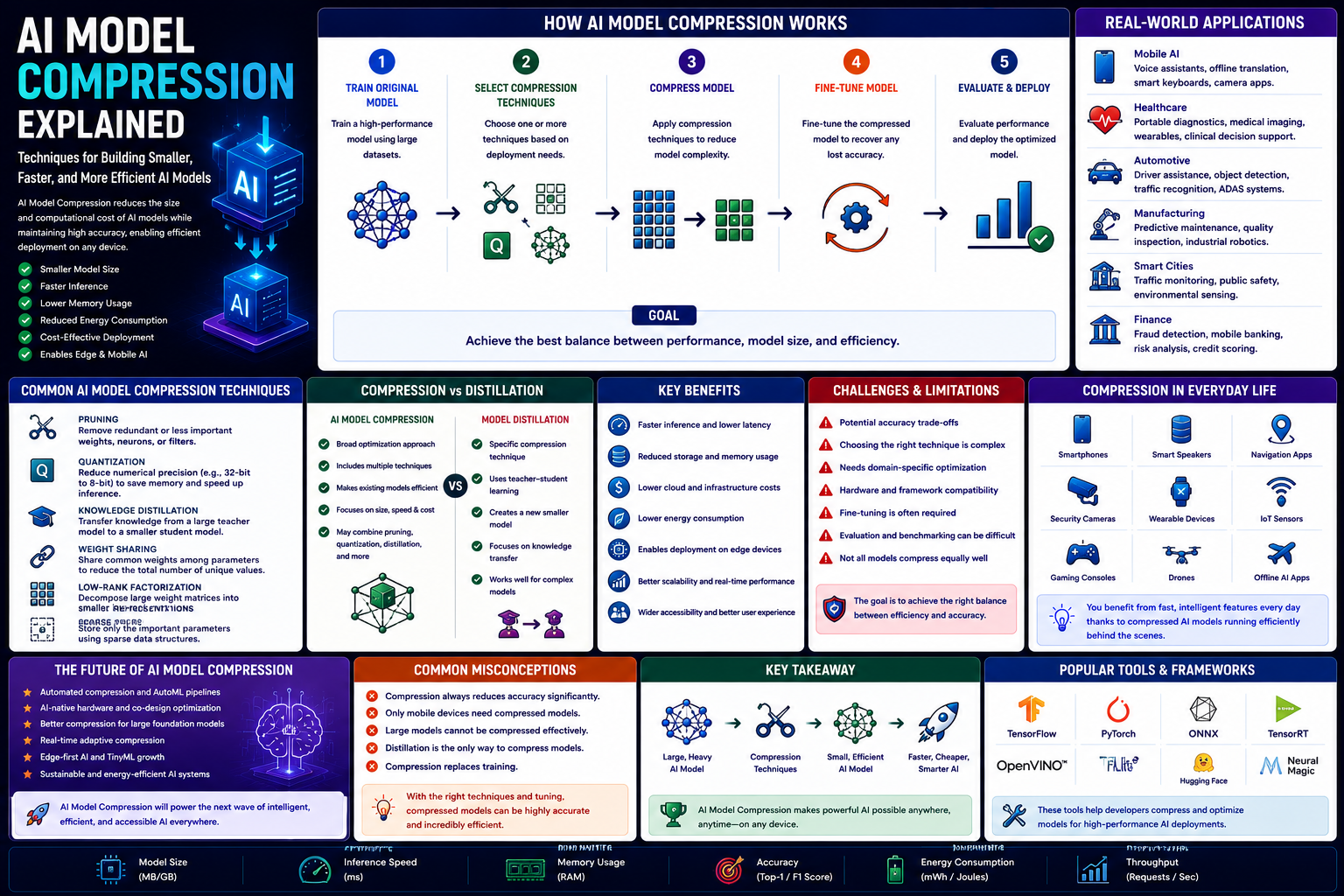
AI Model Compression Explained: Techniques for Building Smaller, Faster, and More Efficient AI Models
Introduction
Modern Artificial Intelligence models continue to grow in size and capability. While these large models deliver exceptional accuracy, they also demand substantial computing power, storage, memory, and energy. Deploying such models on smartphones, IoT devices, embedded systems, or cost-sensitive cloud environments can be difficult.
AI Model Compression addresses this challenge by reducing the size and computational requirements of AI models while preserving as much predictive performance as possible.
Through techniques such as pruning, quantization, knowledge distillation, weight sharing, and low-rank factorization, developers can create lightweight AI models that run faster, cost less to operate, and consume significantly fewer resources.
What Is AI Model Compression?
AI Model Compression is the process of reducing the size, memory footprint, and computational complexity of an AI model while maintaining acceptable levels of accuracy.
Rather than changing what the model is designed to accomplish, compression focuses on making the model more efficient for deployment.
Compressed AI models are widely used in:
Mobile applications
Edge AI devices
Robotics
Autonomous vehicles
Smart cameras
Embedded systems
Cloud inference services
Industrial automation
Why AI Model Compression Matters
Large AI models are expensive to deploy and maintain.
Model compression helps organizations:
Reduce storage requirements
Lower cloud infrastructure costs
Improve inference speed
Decrease memory usage
Enable edge AI
Reduce energy consumption
Improve scalability
Support real-time AI applications
Compression makes advanced AI practical across many environments.
How AI Model Compression Works
Most AI model compression workflows follow these steps.
1. Train the Original Model
A high-performance model is first trained using standard machine learning techniques.
2. Select Compression Techniques
Developers choose one or more optimization methods depending on deployment goals.
3. Compress the Model
Techniques such as pruning, quantization, or knowledge distillation reduce model complexity.
4. Fine-Tune the Model
The compressed model is retrained to recover any lost accuracy.
5. Evaluate Performance
Developers measure:
Accuracy
Latency
Memory usage
Storage size
Power consumption
Throughput
Common AI Model Compression Techniques
Pruning
Removes unnecessary neurons, layers, or weights.
Quantization
Reduces numerical precision, such as converting 32-bit values to 8-bit integers.
Knowledge Distillation
Transfers knowledge from a large teacher model to a smaller student model.
Weight Sharing
Allows multiple parameters to reuse shared values.
Low-Rank Factorization
Breaks large matrices into smaller components for faster computation.
Sparse Representations
Stores only important model parameters to reduce memory usage.
AI Model Compression vs Model Distillation
AI Model Compression
Model Distillation
Broad optimization category
One compression technique
Includes pruning and quantization
Uses teacher–student learning
Optimizes existing models
Creates a new smaller model
Focuses on efficiency
Focuses on knowledge transfer
May combine multiple techniques
Usually one training strategy
Knowledge Distillation is one important technique within AI Model Compression.
Real-World Applications
AI Model Compression enables efficient AI across many industries.
Mobile AI
Voice assistants
Offline translation
AI cameras
Healthcare
Portable diagnostics
Medical imaging
Wearable health devices
Automotive
Driver assistance
Object detection
Traffic recognition
Manufacturing
Predictive maintenance
Visual inspection
Industrial robotics
Finance
Fraud detection
Mobile banking AI
Credit risk analysis
Smart Cities
Traffic monitoring
Public safety
Environmental sensing
Benefits of AI Model Compression
Organizations gain numerous advantages.
Benefits include:
Faster inference
Lower deployment costs
Reduced storage requirements
Lower power consumption
Improved scalability
Better edge AI performance
Faster response times
Wider accessibility
Compression enables powerful AI on devices with limited resources.
Challenges and Limitations
Despite its benefits, AI Model Compression introduces challenges.
These include:
Potential accuracy loss
Compression complexity
Hardware compatibility
Fine-tuning requirements
Evaluation difficulty
Balancing speed and accuracy
Framework limitations
Deployment testing
Careful optimization is essential for achieving the best results.
AI Model Compression in Everyday Life
Compressed AI models are already used in many familiar technologies.
Examples include:
Smartphones
Smart speakers
Security cameras
Navigation apps
Wearable devices
Smart TVs
Autonomous drones
IoT sensors
Users benefit from faster AI experiences with lower battery consumption.
Future of AI Model Compression
Future developments include:
AI-native compression algorithms
Automated compression pipelines
Compression for multimodal models
Edge-first AI deployment
Energy-efficient AI computing
TinyML advancements
Hardware-aware optimization
Sustainable AI infrastructure
AI Model Compression will become increasingly important as AI models continue to grow.
Common Misconceptions
Several myths surround AI Model Compression.
Common misconceptions include:
Compression always reduces accuracy dramatically.
Only mobile devices need compressed models.
Compression replaces model training.
Quantization is the only compression method.
Large models cannot be compressed effectively.
In reality, modern compression techniques often retain high accuracy while significantly reducing computational costs.
Final Thoughts
AI Model Compression is a critical technology for making modern Artificial Intelligence practical, scalable, and cost-effective. By reducing model size, memory usage, and computational requirements, organizations can deploy advanced AI across cloud platforms, mobile devices, edge systems, and embedded hardware without sacrificing meaningful performance.
As AI continues to expand into every industry, Model Compression will remain a cornerstone of efficient, sustainable, and accessible intelligent computing.
Frequently Asked Questions
What is AI Model Compression?
AI Model Compression is the process of reducing an AI model's size and computational requirements while maintaining acceptable performance.
Why is AI Model Compression important?
It enables faster inference, lower infrastructure costs, reduced energy usage, and deployment on mobile, edge, and embedded devices.
What techniques are used in AI Model Compression?
Common methods include pruning, quantization, knowledge distillation, weight sharing, low-rank factorization, and sparse representations.
Which industries use AI Model Compression?
Healthcare, automotive, finance, manufacturing, robotics, telecommunications, consumer electronics, and smart city applications.
Does AI Model Compression always reduce accuracy?
Not necessarily. Properly optimized compressed models often maintain most of the original model's accuracy while greatly improving efficiency.
Comments (0)