
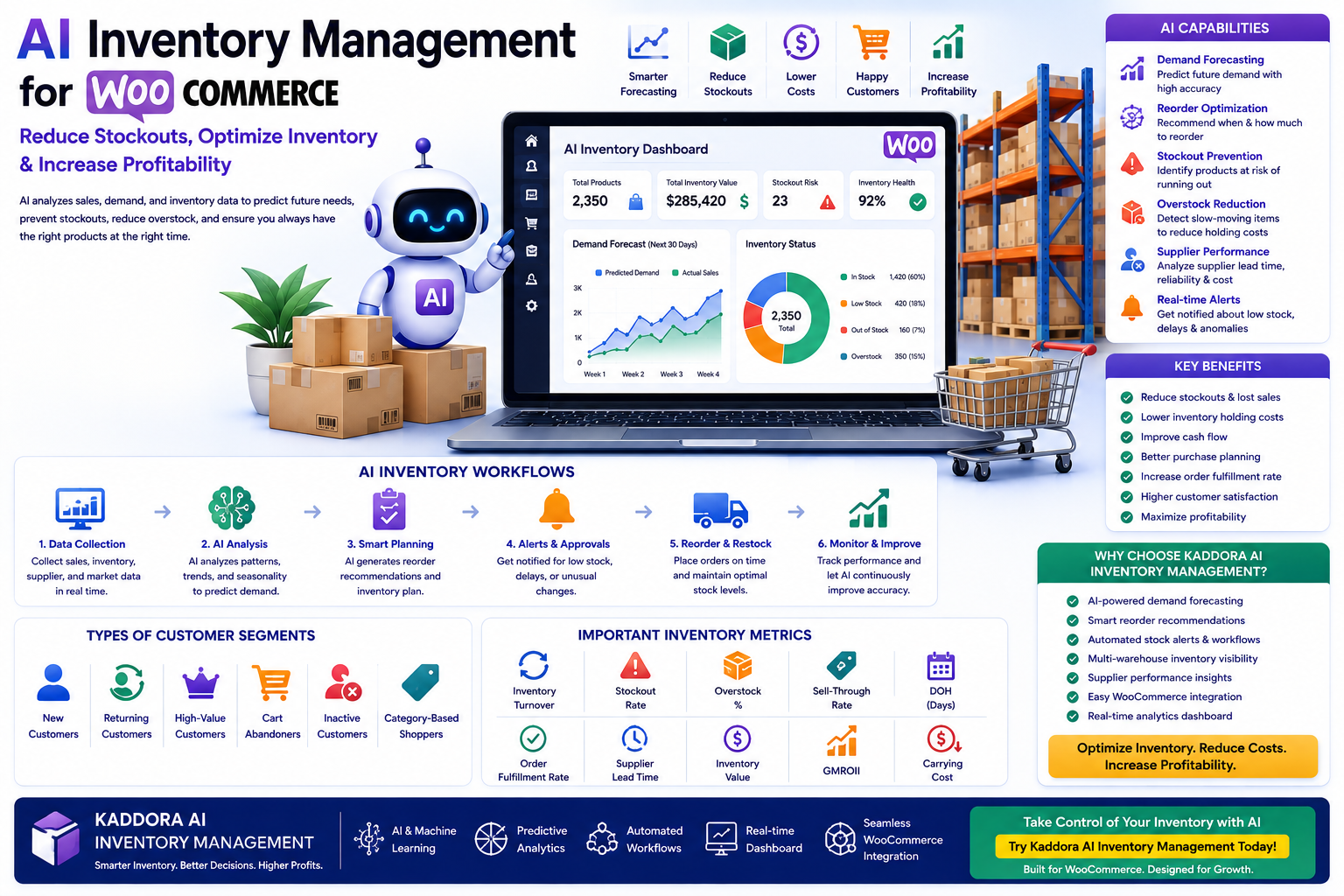
AI Inventory Management for WooCommerce: Reduce Stockouts, Optimize Inventory & Increase Profitability
Introduction
Inventory management is one of the biggest challenges for WooCommerce store owners. Having too much inventory ties up valuable capital, while running out of stock can result in lost sales, disappointed customers, and lower search visibility for popular products.
Traditional inventory management often relies on manual spreadsheets or simple stock alerts. As your product catalog grows, this approach becomes difficult to maintain.
Artificial Intelligence (AI) brings a smarter approach to inventory management. By analyzing historical sales, customer demand, seasonal trends, supplier performance, and inventory movement, AI helps businesses maintain the right stock levels at the right time.
Whether you're managing a small WooCommerce store or a large ecommerce business with thousands of products, AI inventory management can improve efficiency, reduce costs, and increase profitability.
What Is AI Inventory Management?
AI inventory management uses machine learning, predictive analytics, and automation to monitor, analyze, and optimize inventory.
Instead of simply tracking stock quantities, AI can answer questions such as:
Which products will sell next week?
Which items are likely to become out of stock?
Which products are moving too slowly?
When should new inventory be ordered?
Which products generate the highest profit?
AI continuously updates its recommendations as new sales and inventory data become available.
Why Inventory Management Matters
Good inventory management helps businesses:
Reduce stockouts
Prevent overstocking
Improve cash flow
Lower storage costs
Increase customer satisfaction
Improve order fulfillment
Maximize profitability
Inventory is one of the largest investments for many ecommerce businesses, making optimization essential.
Common Inventory Challenges
Many WooCommerce businesses experience:
Unexpected stock shortages
Excess inventory
Slow-moving products
Manual inventory updates
Seasonal demand fluctuations
Inaccurate stock forecasting
Supplier delays
Human errors
AI helps identify these issues before they become costly problems.
Benefits of AI Inventory Management
1. Demand Forecasting
AI analyzes historical sales, promotions, holidays, and seasonal trends to estimate future product demand.
This helps businesses prepare inventory before demand increases.
2. Smart Reorder Recommendations
Instead of using fixed reorder levels, AI recommends when and how much inventory should be reordered based on predicted demand and supplier lead times.
3. Stockout Prevention
AI identifies products that may run out of stock soon and sends proactive alerts.
This helps prevent lost sales and improves customer satisfaction.
4. Overstock Reduction
Holding excessive inventory increases storage costs and ties up working capital.
AI identifies slow-moving products and helps optimize purchasing decisions.
5. Seasonal Planning
Many industries experience seasonal demand changes.
Examples include:
Holiday shopping
Festival sales
Back-to-school products
Winter clothing
Summer accessories
AI helps businesses prepare inventory for these predictable demand shifts.
6. Multi-Warehouse Visibility
For businesses with multiple warehouses, AI can provide a centralized view of inventory across all locations, helping improve stock distribution and fulfillment efficiency.
7. Supplier Performance Analysis
AI can monitor supplier metrics such as:
Delivery times
Order accuracy
Lead time consistency
Purchase costs
These insights support better purchasing decisions.
AI Inventory Workflows
Daily Stock Monitoring
Automatically track inventory changes and highlight unusual activity.
Automated Reorder Alerts
Notify managers when inventory reaches predicted reorder levels.
Slow-Moving Product Reports
Identify products that require promotions or purchasing adjustments.
Seasonal Demand Reports
Forecast inventory needs before major shopping events.
Inventory Health Dashboard
Provide a centralized overview of stock performance, inventory value, and turnover.
Best Practices
To get the most value from AI inventory management:
Maintain accurate product data.
Regularly update supplier information.
Review AI recommendations before major purchasing decisions.
Audit inventory periodically.
Integrate inventory with sales and marketing data.
Monitor inventory KPIs consistently.
AI performs best when supported by high-quality business data.
Inventory Metrics to Monitor
Track these important metrics:
Inventory Turnover Ratio
Stockout Rate
Overstock Percentage
Sell-Through Rate
Average Inventory Value
Days of Inventory on Hand (DOH)
Order Fulfillment Rate
Supplier Lead Time
Gross Margin Return on Inventory Investment (GMROII)
Inventory Carrying Cost
Monitoring these metrics helps identify opportunities for continuous improvement.
Common Mistakes to Avoid
Avoid:
Relying solely on manual stock updates
Ordering inventory without demand analysis
Ignoring seasonal buying patterns
Overstocking low-demand products
Delaying inventory audits
Using outdated sales data
Ignoring supplier performance
AI Inventory Management and WooCommerce SEO
Inventory management also affects SEO and user experience.
Maintaining accurate stock information helps:
Prevent customers from landing on permanently unavailable products.
Improve trust by displaying reliable stock status.
Support better product page management.
Reduce customer frustration during checkout.
For discontinued products with search traffic, consider redirecting visitors to relevant alternatives rather than deleting pages immediately.
Why Choose Kaddora AI Commerce Intelligence Suite?
The Kaddora AI Commerce Intelligence Suite helps WooCommerce businesses make smarter inventory decisions through AI-powered insights.
AI Demand Forecasting
Predict future product demand using historical sales and seasonal trends.
Intelligent Reorder Suggestions
Receive recommendations on when to replenish inventory based on projected demand.
Inventory Health Dashboard
Monitor inventory performance, turnover, and stock levels from one centralized dashboard.
Slow-Moving Product Analysis
Identify products that require promotions or inventory adjustments.
Supplier Performance Insights
Track supplier reliability, lead times, and purchasing trends.
WooCommerce Integration
Manage inventory insights directly inside your WordPress dashboard without requiring complex third-party reporting tools.
Combined with Kaddora AI SEO Suite, Kaddora AI Marketing Suite, and Kaddora AI ChatBot, the Kaddora ecosystem helps businesses optimize operations, improve customer experiences, and support long-term ecommerce growth.
Future of AI Inventory Management
Inventory management continues to evolve with technologies such as:
Real-time inventory forecasting
Automated purchasing recommendations
Smart warehouse optimization
Predictive supply chain analytics
AI-assisted procurement
Intelligent fulfillment planning
Businesses adopting these innovations will be better positioned to respond to changing customer demand and market conditions.
Conclusion
AI inventory management enables WooCommerce store owners to move beyond basic stock tracking toward intelligent inventory optimization.
By forecasting demand, preventing stockouts, reducing overstock, and providing actionable insights, AI helps businesses operate more efficiently while improving customer satisfaction.
The best results come from combining AI-powered recommendations with accurate business data, experienced decision-making, and ongoing performance monitoring.
Frequently Asked Questions
What is AI inventory management?
AI inventory management uses artificial intelligence to monitor stock levels, forecast demand, recommend reorder quantities, and optimize inventory performance.
How does AI help WooCommerce inventory?
AI analyzes sales history, customer demand, seasonal trends, and inventory movement to provide smarter inventory recommendations.
Can AI prevent stockouts?
AI can identify products that are likely to run out of stock and provide early alerts, helping businesses replenish inventory before shortages occur.
Is AI inventory management useful for small businesses?
Yes. Small WooCommerce stores can benefit from improved inventory planning, reduced waste, and better purchasing decisions.
What data is used for inventory forecasting?
Common data includes sales history, seasonal trends, supplier lead times, inventory movement, promotions, and customer demand.
Does AI reduce overstocking?
AI helps identify slow-moving products and supports more informed purchasing decisions, which can reduce unnecessary inventory.
Why choose Kaddora AI Commerce Intelligence Suite?
It provides AI-powered demand forecasting, inventory health dashboards, reorder recommendations, supplier insights, and WooCommerce integration in one platform.
How often should inventory forecasts be reviewed?
Review forecasts regularly, especially before seasonal events, promotions, and major purchasing cycles.
Does inventory management affect SEO?
Yes. Accurate stock information improves user experience, while proper handling of unavailable products helps maintain valuable search traffic.
What is the future of AI inventory management?
Future developments include real-time forecasting, intelligent procurement, warehouse automation, predictive supply chain analytics, and deeper integration with ecommerce platforms.
Comments (0)