
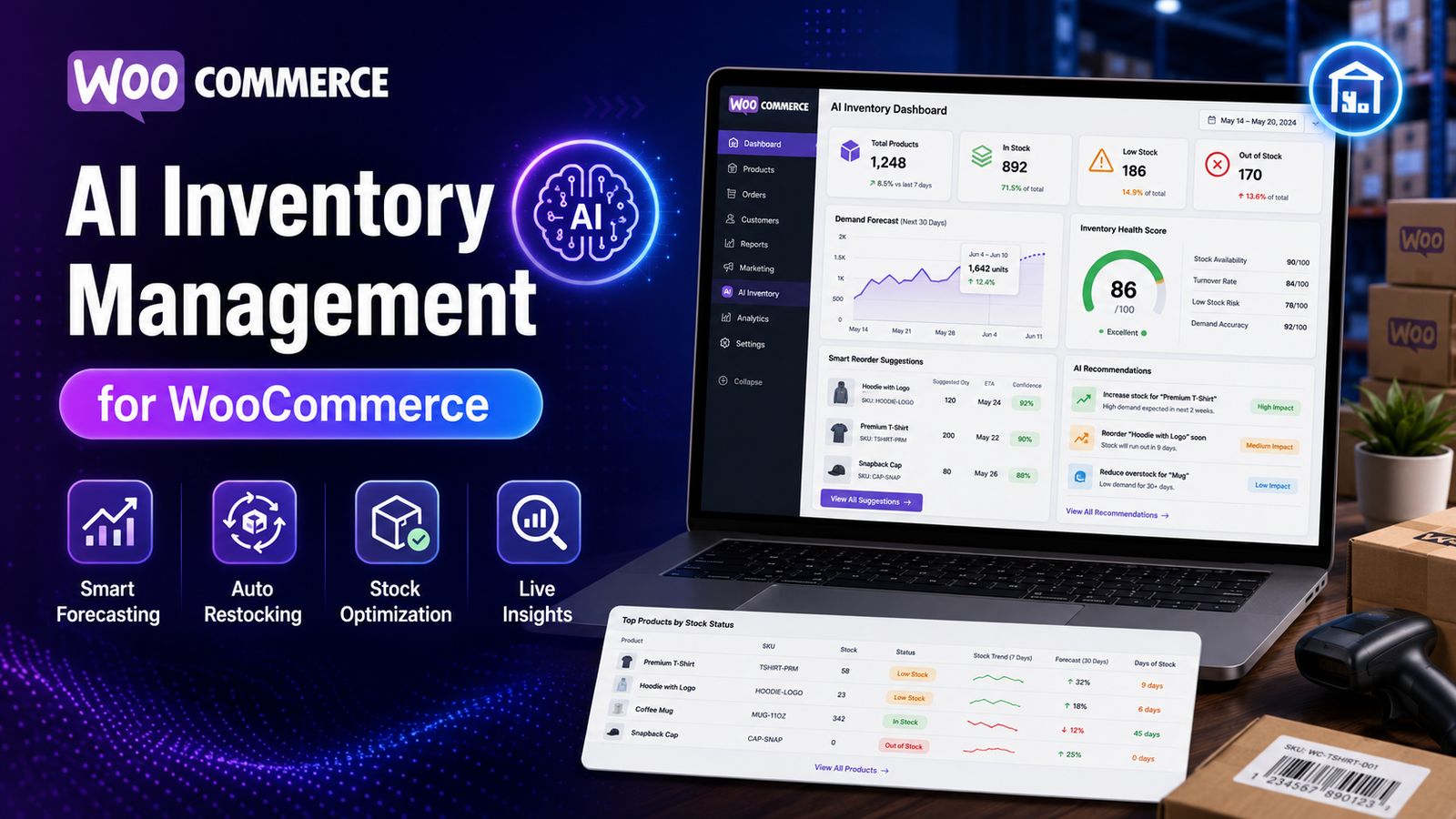
AI Inventory Management for WooCommerce
Managing inventory becomes increasingly complex as an online store grows. More products, higher order volumes, seasonal demand, and changing customer preferences make manual inventory management difficult and time-consuming.
Artificial Intelligence (AI) is changing how WooCommerce businesses manage inventory. Instead of relying only on historical reports or manual calculations, AI can analyze large volumes of data, identify patterns, and provide recommendations that help businesses make more informed inventory decisions.
While AI doesn't replace human judgment, it can reduce repetitive work and provide valuable insights that support inventory planning.
In this guide, you'll learn what AI inventory management is, how it works, its benefits, and how WooCommerce stores can use AI to improve inventory efficiency.
Quick Answer
What is AI inventory management for WooCommerce?
AI inventory management uses artificial intelligence to analyze inventory data, sales history, customer demand, and stock movement. It helps WooCommerce businesses optimize stock levels, improve forecasting, reduce stockouts, and support better inventory planning through data-driven insights.
Why Traditional Inventory Management Has Limits
Basic inventory systems work well for many stores, but as businesses expand they often encounter challenges such as:
Manual stock updates
Overstocking
Unexpected stockouts
Difficulty predicting demand
Slow inventory reporting
Time-consuming purchasing decisions
AI helps address these challenges by processing data continuously and highlighting useful patterns.
How AI Supports Inventory Management
AI analyzes multiple data sources, including:
Historical sales
Product performance
Seasonal demand
Inventory movement
Customer purchasing behavior
Order trends
Stock availability
Based on these inputs, AI can generate insights that support better inventory decisions.
Benefits of AI Inventory Management
Smarter Demand Forecasting
AI can identify historical patterns and seasonal trends to estimate future product demand, helping businesses plan inventory more effectively.
Reduced Stockouts
By highlighting products that may require replenishment soon, AI supports timely purchasing decisions.
Lower Overstocking Risk
AI helps identify slow-moving inventory, allowing businesses to reduce unnecessary stock and free up working capital.
Better Purchasing Decisions
Inventory recommendations based on historical trends can assist purchasing teams in ordering more efficiently.
Faster Inventory Analysis
Instead of manually reviewing spreadsheets, AI summarizes large amounts of inventory data into actionable insights.
Improved Operational Efficiency
Automation reduces repetitive inventory tasks, allowing teams to focus on higher-value business activities.
Key AI Features to Look For
A modern AI-powered inventory solution may include:
Inventory Forecasting
Estimate future stock requirements using historical sales data.
Inventory Dashboards
View inventory health, stock levels, and important KPIs in one place.
Low-Stock Intelligence
Receive prioritized alerts for products that may require immediate attention.
Product Performance Analysis
Identify high-performing and slow-moving products using inventory and sales data.
Inventory Trend Analysis
Understand long-term inventory patterns and seasonal demand changes.
Automated Reporting
Generate inventory summaries without manually compiling reports.
Best Practices for AI Inventory Management
Keep Inventory Data Accurate
AI performs best when inventory records are complete and regularly updated.
Combine AI with Human Oversight
AI provides recommendations, but purchasing decisions should also consider supplier reliability, market conditions, and business strategy.
Monitor Forecast Accuracy
Compare AI-generated forecasts with actual sales to improve future planning.
Review Inventory KPIs Regularly
Track metrics such as inventory turnover, stock availability, low-stock items, and product demand.
Common Mistakes to Avoid
Avoid these common misconceptions:
❌ Assuming AI predicts the future with certainty
❌ Ignoring data quality
❌ Relying only on automation
❌ Failing to review inventory reports
❌ Making purchasing decisions without business context
AI should be viewed as a decision-support tool rather than a replacement for sound inventory management practices.
How Kaddora WooCommerce Inventory Management Helps
Growing WooCommerce businesses often need deeper inventory visibility than standard stock management tools provide.
Kaddora WooCommerce Inventory Management Plugin combines inventory management with intelligent reporting to help businesses organize stock more efficiently.
Key Features
Centralized inventory dashboard
Real-time inventory tracking
Low-stock monitoring
Inventory performance reports
SKU management
Bulk inventory updates
Inventory insights
WooCommerce integration
By bringing inventory data into one centralized dashboard, the plugin helps businesses monitor stock levels, analyze inventory performance, and support informed inventory decisions.
AI Inventory Management Checklist
✅ Maintain accurate inventory data
✅ Monitor inventory reports regularly
✅ Review demand trends
✅ Track inventory turnover
✅ Analyze slow-moving products
✅ Configure low-stock alerts
✅ Review forecasting recommendations
✅ Combine AI insights with business experience
Frequently Asked Questions
What is AI inventory management?
AI inventory management uses artificial intelligence to analyze inventory and sales data, helping businesses optimize stock levels, forecast demand, and improve inventory planning.
Can AI prevent stockouts?
AI can help identify products that may require replenishment sooner by analyzing historical demand and inventory trends, but purchasing decisions still depend on business processes and supplier availability.
Is AI inventory management suitable for small WooCommerce stores?
Yes. Smaller stores can also benefit from AI-assisted inventory insights, especially as their product catalog and order volume grow.
Does AI replace inventory managers?
No. AI supports inventory management by providing recommendations and analysis, while human expertise remains essential for final business decisions.
Which WooCommerce plugin supports AI-powered inventory management?
Businesses looking for centralized dashboards, inventory reporting, stock monitoring, and intelligent inventory insights can evaluate Kaddora WooCommerce Inventory Management Plugin.
Final Thoughts
AI is transforming inventory management by helping businesses move beyond reactive stock control toward more informed planning.
By combining accurate inventory data with AI-powered analysis, WooCommerce store owners can improve stock visibility, reduce inventory risks, and make better purchasing decisions.
If your store is growing and you need more than basic inventory tools, Kaddora WooCommerce Inventory Management Plugin provides centralized inventory management, real-time monitoring, and intelligent insights to help you manage inventory more efficiently.
Comments (0)