
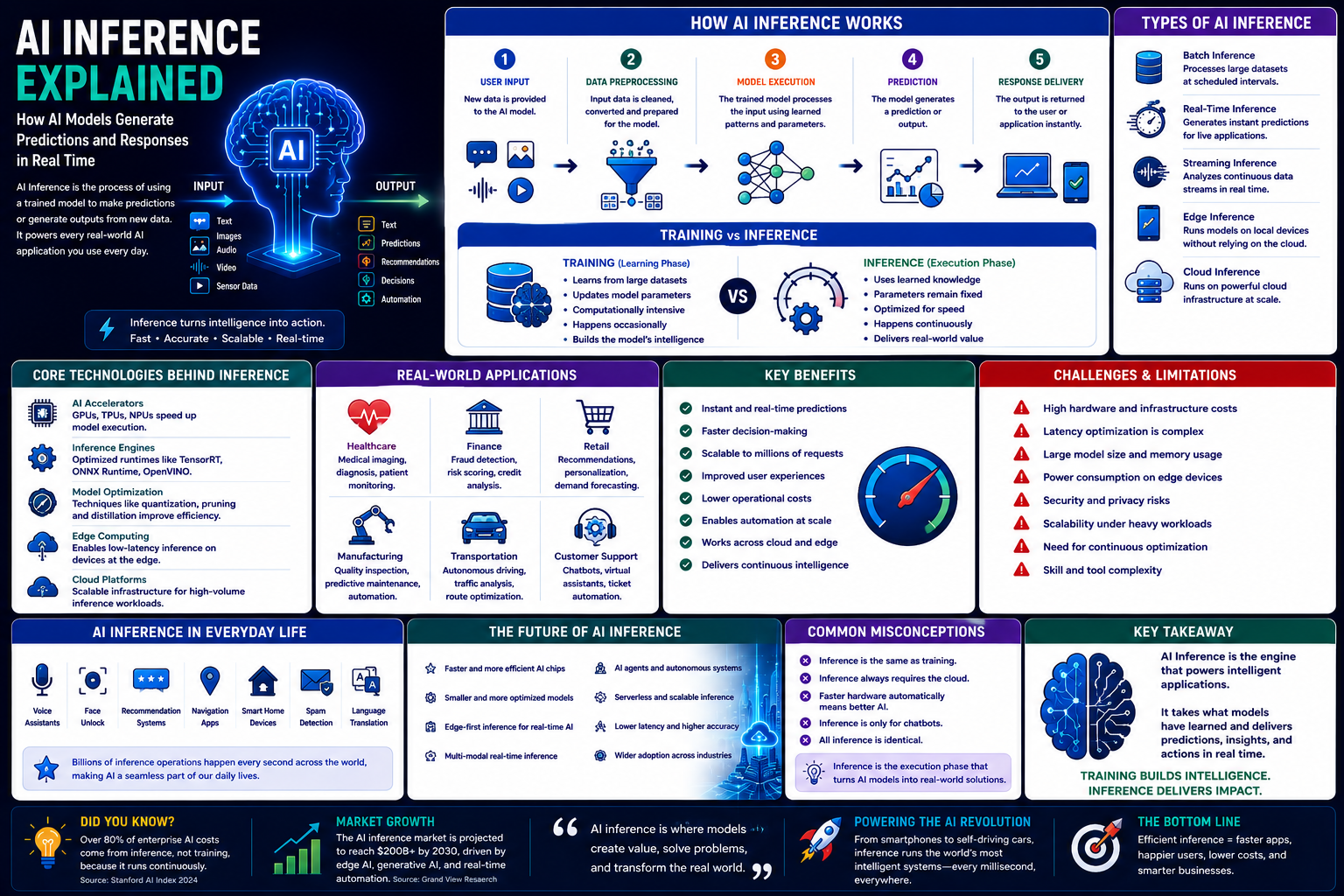
AI Inference Explained: How Artificial Intelligence Generates Predictions and Responses in Real Time
Introduction
Artificial Intelligence systems perform two major tasks throughout their lifecycle:
Learning from data
Using that knowledge to make predictions
The learning process is called training, while the process of using the trained model to generate answers, predictions, recommendations, or decisions is known as AI Inference.
Every time you ask an AI chatbot a question, unlock your smartphone using facial recognition, receive product recommendations, translate text, or use voice assistants, AI inference is happening.
Although training AI models requires enormous computational resources, inference happens continuously and powers billions of real-time AI interactions every day.
As Generative AI becomes increasingly integrated into business and consumer applications, understanding AI inference is essential for developers, businesses, and technology professionals.
What Is AI Inference?
AI Inference is the process of using a trained Artificial Intelligence model to make predictions or generate outputs from new input data.
During inference, the model does not learn new information. Instead, it applies the knowledge gained during training to solve real-world problems.
AI inference powers tasks such as:
Answering questions
Image recognition
Voice recognition
Language translation
Product recommendations
Fraud detection
Medical diagnosis support
Autonomous driving
Inference is the operational phase of an AI model.
AI Training vs AI Inference
AI Training
AI Inference
Learns from data
Uses learned knowledge
Requires large datasets
Uses new input data
Updates model parameters
Parameters remain fixed
Computationally intensive
Optimized for speed
Happens occasionally
Happens continuously
Training builds the intelligence, while inference delivers it to users.
How AI Inference Works
Most AI inference systems follow a structured workflow.
1. User Input
A user or application submits data.
Examples include:
Text prompts
Images
Voice recordings
Videos
Sensor data
2. Data Preprocessing
The input is prepared for the model.
Examples include:
Tokenization
Image resizing
Feature extraction
Audio processing
3. Model Execution
The trained AI model processes the input using its learned parameters.
This stage performs mathematical computations to identify patterns and generate predictions.
4. Prediction
The model produces an output.
Examples include:
Text generation
Image classification
Speech recognition
Recommendations
Risk scores
Object detection
5. Response Delivery
The final result is returned to the user or connected application.
Inference often completes in milliseconds.
Types of AI Inference
Different applications require different inference methods.
Batch Inference
Processes large datasets at scheduled intervals.
Real-Time Inference
Produces immediate predictions for live applications.
Streaming Inference
Continuously analyzes incoming data streams.
Edge Inference
Runs AI models directly on local devices without relying entirely on cloud servers.
Cloud Inference
Processes requests using powerful cloud infrastructure.
Core Technologies Behind AI Inference
Several technologies support efficient inference.
AI Accelerators
Specialized hardware such as GPUs, NPUs, and TPUs.
Inference Engines
Software optimized for running trained models efficiently.
Model Optimization
Techniques including quantization, pruning, and compilation improve speed and reduce resource usage.
Edge Computing
Supports low-latency inference on local devices.
Cloud Platforms
Provide scalable infrastructure for high-volume inference workloads.
Real-World Applications
AI inference powers countless applications.
Healthcare
Medical image analysis
Disease prediction
Clinical decision support
Finance
Fraud detection
Credit scoring
Risk analysis
Retail
Product recommendations
Demand forecasting
Personalized shopping
Manufacturing
Quality inspection
Predictive maintenance
Robotics
Transportation
Autonomous driving
Traffic analysis
Fleet management
Customer Support
AI chatbots
Virtual assistants
Intelligent routing
Benefits of AI Inference
AI inference provides many advantages.
Benefits include:
Instant predictions
Faster decision-making
Scalable AI deployment
Improved customer experiences
Lower operational costs
Better automation
Increased productivity
Real-time intelligence
Organizations rely on efficient inference to deliver responsive AI services.
Challenges and Limitations
Despite its advantages, inference presents challenges.
These include:
Hardware costs
Latency optimization
Power consumption
Model size
Scalability
Security concerns
Resource limitations
Continuous optimization
Advances in hardware and software continue improving inference performance.
AI Inference in Everyday Life
Many common technologies depend on inference.
Examples include:
AI chatbots
Voice assistants
Smartphone cameras
Recommendation systems
Navigation apps
Smart home devices
Face unlock
Spam detection
Billions of AI inference operations occur every day across consumer and enterprise systems.
Future of AI Inference
Future developments include:
Faster AI chips
Energy-efficient inference
Edge-first AI
Real-time multimodal inference
AI copilots
Autonomous AI agents
Smaller optimized models
Enterprise AI acceleration
Inference will remain one of the most important technologies enabling practical AI adoption.
Common Misconceptions
Several myths surround AI inference.
Common misconceptions include:
Inference trains the AI model.
Inference always requires cloud servers.
Faster hardware always guarantees better AI.
Inference is only for chatbots.
AI inference is identical across all models.
In reality, inference is the execution phase of AI and can occur in the cloud, at the edge, or within enterprise infrastructure.
Final Thoughts
AI inference is the engine that brings Artificial Intelligence to life. While model training builds knowledge, inference is what allows AI to answer questions, recognize images, recommend products, detect fraud, and automate countless tasks in real time.
As AI adoption continues accelerating across industries, efficient inference will remain essential for delivering fast, reliable, scalable, and cost-effective intelligent applications.
Frequently Asked Questions
What is AI Inference?
AI inference is the process of using a trained AI model to generate predictions, classifications, recommendations, or responses from new input data.
What is the difference between training and inference?
Training teaches the model using large datasets, while inference uses the trained model to make real-time predictions.
Where is AI inference used?
Healthcare, finance, manufacturing, retail, autonomous vehicles, AI assistants, recommendation systems, cybersecurity, and many other industries.
Can AI inference run offline?
Yes. Edge AI enables inference directly on local devices without requiring continuous internet connectivity.
Why is AI inference important?
Inference allows AI models to deliver practical value by generating predictions and responses in real-world applications.
Comments (0)