
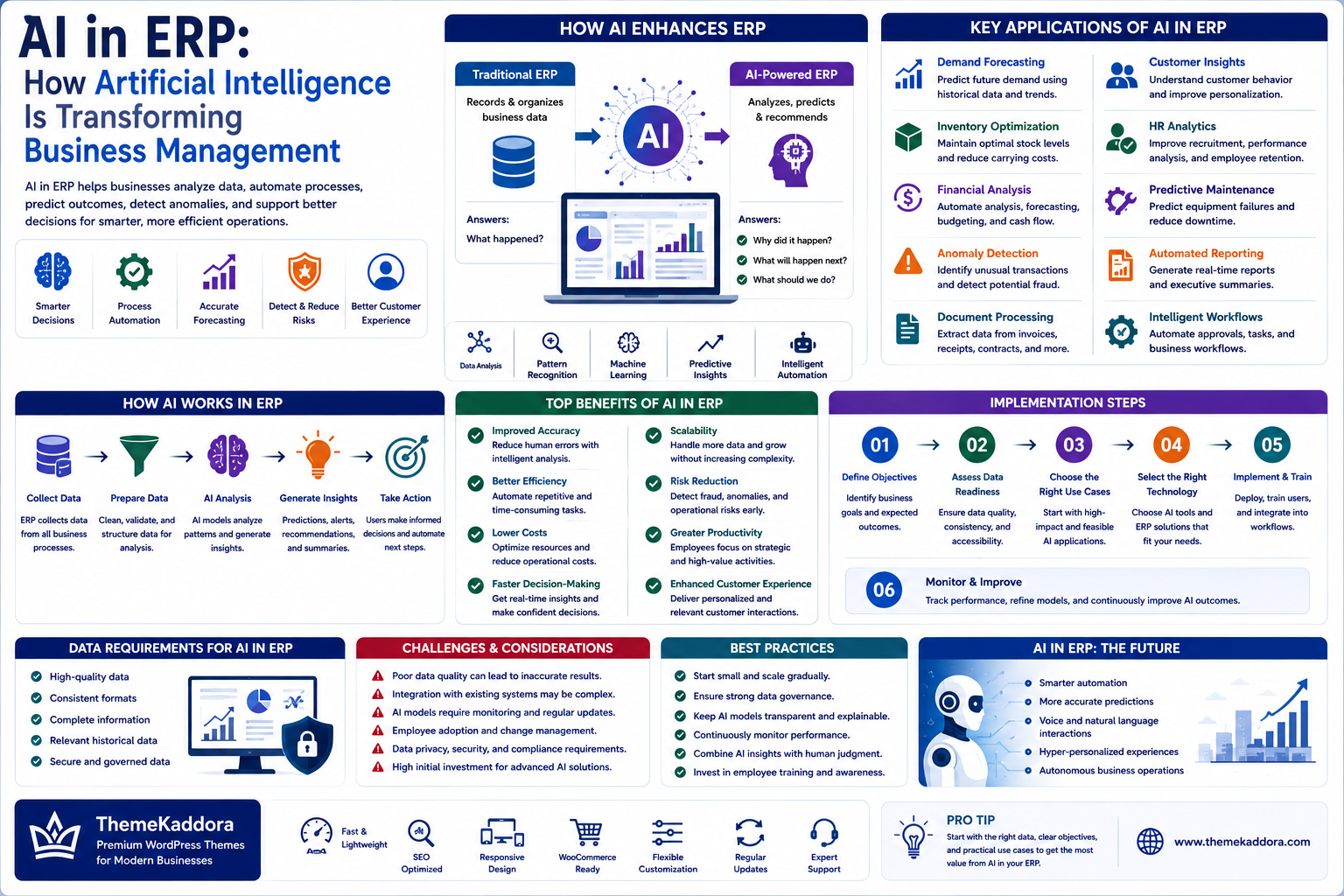
AI in ERP: How Artificial Intelligence Is Transforming Business Management
Introduction
Enterprise Resource Planning (ERP) systems have become an important part of modern business operations.
They help organizations manage finance, inventory, sales, purchasing, human resources, customer information, projects, and other core processes through connected systems.
However, traditional ERP software primarily records and organizes business information.
The next evolution is making that information intelligent.
This is where Artificial Intelligence (AI) is becoming increasingly important.
AI can analyze large amounts of business data, identify patterns, generate predictions, automate repetitive tasks, detect unusual activity, and assist employees with decision-making.
Instead of simply asking an ERP system:
"What happened?"
Businesses can increasingly ask:
"Why did it happen?"
"What is likely to happen next?"
"What should we do about it?"
This shift can transform ERP from a system of record into a more intelligent business management platform.
AI-powered ERP can help organizations improve forecasting, automate workflows, optimize inventory, analyze financial information, support customer management, and provide faster access to business insights.
However, implementing AI in ERP is not simply about adding an AI feature.
Businesses need reliable data, appropriate workflows, strong security, clear objectives, and responsible implementation.
In this guide, we'll explore what AI in ERP means, how it works, its major applications, its benefits, challenges, and how businesses can prepare for AI-powered ERP systems.
1. What Is AI in ERP?
AI in ERP refers to the use of Artificial Intelligence technologies within enterprise resource planning systems to analyze information, automate processes, generate insights, and support business decisions.
Traditional ERP systems collect and process structured business data.
For example:
Sales transactions
Purchase orders
Inventory records
Employee information
Invoices
Payments
Customer records
AI can use this information to identify patterns and generate useful predictions or recommendations.
For example, an ERP system may show:
"Product A sold 1,200 units last month."
An AI-powered ERP could go further and identify:
"Demand for Product A is likely to increase next month based on historical sales, seasonal patterns, and recent order activity."
This difference is important.
Traditional ERP primarily helps businesses record and manage information.
AI-enhanced ERP can help businesses interpret information and act on it.
2. How AI Is Changing Traditional ERP Systems
Traditional ERP workflows often depend on predefined rules.
For example:
If inventory falls below 100 units → generate a reorder alert.
This type of automation can be useful, but it depends on fixed conditions.
AI can introduce more adaptive analysis.
Instead of looking only at a fixed inventory threshold, an AI system could consider:
Historical demand
Seasonal changes
Sales trends
Supplier lead times
Current inventory
Upcoming orders
Product popularity
It could then help estimate when inventory may become insufficient.
This moves ERP automation from simple rule-based automation toward more intelligent, data-driven decision support.
AI can also help employees interact with ERP systems using natural language.
For example, instead of manually creating a complex report, a manager could ask:
"Which products generated the highest revenue this month?"
An AI-enabled system could interpret the request and return relevant information from the ERP database.
3. Key Applications of AI in ERP
AI can be applied across many ERP functions.
Some of the most valuable applications include:
Demand forecasting
Inventory optimization
Financial analysis
Anomaly detection
Document processing
Customer insights
HR analytics
Predictive maintenance
Automated reporting
Intelligent workflow automation
Let's examine these applications in more detail.
4. AI-Powered Demand Forecasting
Forecasting demand is one of the most useful applications of AI in ERP.
Businesses need to determine how much inventory they may require in the future.
Traditional forecasting methods may rely heavily on historical averages.
AI can analyze multiple data points simultaneously.
These may include:
Historical sales
Seasonal trends
Product demand
Customer behavior
Promotional activity
Order patterns
Inventory levels
For example, if a business sells seasonal products, AI can identify recurring demand patterns and help estimate future requirements.
Better forecasting can help businesses:
Reduce overstocking
Avoid stockouts
Improve purchasing
Reduce inventory costs
Improve customer satisfaction
AI forecasting does not eliminate uncertainty, but it can provide additional insights for planning.
5. Intelligent Inventory Management
Inventory management is another area where AI can provide significant value.
Traditional ERP systems can show current stock levels.
AI can analyze inventory behavior and identify potential problems.
For example, an AI system might identify:
Products with declining demand
Items likely to run out soon
Slow-moving inventory
Unusual purchasing patterns
Seasonal demand changes
It could also help prioritize which products require attention.
Instead of reviewing thousands of inventory records manually, managers could focus on the products that require immediate action.
This can be particularly valuable for businesses with large product catalogs or multiple warehouses.
6. AI for Financial Management
Financial departments process large amounts of structured information.
AI can help analyze:
Transactions
Expenses
Invoices
Payments
Cash-flow patterns
Financial trends
For example, AI can help identify unusual transactions or spending patterns that may require review.
It can also assist with forecasting.
Instead of simply showing historical revenue, an AI-powered ERP could analyze historical performance and provide an estimated future trend.
AI can also assist with document processing.
Invoices, receipts, and other financial documents can potentially be processed automatically, reducing repetitive manual entry.
However, financial AI systems should always be designed with appropriate controls and human oversight.
7. AI-Based Anomaly Detection
Businesses generate thousands of transactions and operational events.
Manually reviewing every transaction for unusual activity can be difficult.
AI can help identify patterns that differ significantly from normal behavior.
For example, an ERP system could flag:
An unusually large transaction
Unexpected purchasing activity
Unusual expense behavior
Sudden inventory changes
Irregular payment activity
The purpose is not necessarily to automatically classify every unusual event as fraud.
Instead, AI can help identify transactions that deserve human review.
This can make monitoring more efficient.
8. Automated Document Processing
Businesses deal with many documents, including:
Invoices
Purchase orders
Receipts
Contracts
Employee documents
Shipping documents
Traditionally, employees may need to manually read documents and enter information into ERP systems.
AI-powered document processing can extract relevant information and reduce manual data entry.
For example:
Invoice → AI extraction → ERP record → Approval workflow → Accounting
This can reduce repetitive administrative work and improve processing speed.
The quality of the result depends heavily on document quality, data validation, system configuration, and appropriate review processes.
9. AI-Powered Business Reporting
ERP systems already provide reports and dashboards.
AI can make business reporting more interactive.
Instead of searching through multiple reports, managers could ask questions using natural language.
For example:
"Show me the sales trend for the last six months."
Or:
"Which region had the highest growth?"
Or:
"Why did operating expenses increase?"
An AI-enabled ERP could help retrieve relevant information and explain patterns in business data.
This can make business intelligence more accessible to employees who may not have advanced technical or analytical skills.
10. AI for Customer Insights
ERP and CRM systems contain valuable customer information.
AI can analyze customer behavior and identify patterns such as:
Purchase frequency
Customer value
Product preferences
Order trends
Changes in buying behavior
Businesses can use these insights to improve customer engagement.
For example, AI could help identify customers whose purchasing activity has declined and flag them for follow-up.
It could also help sales teams prioritize opportunities based on historical information.
The goal is not to replace customer relationships.
Instead, AI can give employees better information to support those relationships.
11. AI in Human Resources
AI can also support HR processes within ERP platforms.
Potential applications include:
Workforce analytics
Employee attendance analysis
Workforce planning
Recruitment assistance
Employee trend analysis
Leave pattern analysis
For example, an organization could analyze workforce data to identify staffing trends or recurring operational issues.
However, HR applications require particularly careful handling because employee information can be sensitive.
AI should support responsible decision-making rather than automatically making important employment decisions without appropriate human review.
12. AI-Powered Predictive Maintenance
For manufacturing and asset-intensive businesses, equipment downtime can be expensive.
Traditional maintenance often follows fixed schedules.
For example:
Service equipment every 1,000 operating hours.
AI can analyze information such as:
Equipment usage
Historical failures
Maintenance records
Sensor data
Performance changes
This can help identify potential maintenance requirements before a major failure occurs.
Predictive maintenance can potentially reduce unexpected downtime and improve asset utilization.
13. Benefits of AI-Powered ERP
AI can transform ERP from a system primarily used for recording transactions into a platform that can help businesses analyze information, automate processes, and make more informed decisions.
Some of the most important benefits include the following.
Improved Decision-Making
Business leaders often need to make decisions using large amounts of information.
AI can analyze business data and identify patterns that may be difficult to detect manually.
For example, AI can help identify:
Revenue trends
Changing customer behavior
Inventory risks
Cost increases
Operational inefficiencies
Unusual transactions
This can give decision-makers better information when planning business activities.
Reduced Manual Work
Many ERP processes involve repetitive tasks.
AI and automation can help reduce manual work such as:
Data entry
Document processing
Report preparation
Invoice processing
Data classification
Notification management
Employees can then spend more time on activities that require judgment, communication, creativity, and strategic thinking.
Faster Business Insights
Traditional reporting may require employees to collect information from different departments and prepare reports manually.
AI-powered ERP can help make information available more quickly.
Managers can potentially ask questions about:
Sales
Expenses
Inventory
Customers
Employees
Procurement
Financial performance
This can reduce the time required to turn raw data into useful information.
Better Forecasting
AI can analyze historical data and identify patterns that can support forecasting.
Potential forecasting areas include:
Sales
Inventory
Cash flow
Customer demand
Workforce requirements
Procurement
Forecasting is not guaranteed to be accurate, but AI can provide additional data-driven insights for planning.
Improved Operational Efficiency
AI can identify bottlenecks and repetitive processes.
For example, if an approval process consistently takes several days, ERP analytics may help identify where delays occur.
Businesses can then redesign the workflow or introduce automation.
Over time, this can improve operational efficiency.
14. AI Automation vs Traditional ERP Automation
Traditional ERP automation and AI-powered automation are related but different.
Rule-Based Automation
Traditional automation typically follows predefined rules.
For example:
If inventory < 50 → send notification.
The system performs an action when a specific condition is met.
AI-Powered Automation
AI can analyze multiple variables before recommending or performing an action.
For example, an AI system could consider:
Current inventory
Historical sales
Seasonal demand
Supplier lead time
Pending orders
Recent sales trends
It may then identify a potential future inventory shortage.
The difference can be summarized as:
Traditional automation follows predefined rules.
AI-powered automation can use data and patterns to support more adaptive decisions.
Businesses can use both approaches together.
Simple repetitive tasks can use traditional automation, while complex prediction and analysis can use AI.
15. AI in ERP for Small Businesses
AI is not limited to large enterprises.
Small businesses can also benefit from AI-enabled ERP functionality.
Potential applications include:
Automated invoice processing
Sales forecasting
Inventory alerts
Customer insights
Automated reports
Expense analysis
Workflow automation
For example, a small business owner may not have a dedicated data analyst.
An AI-enabled ERP can help make business information easier to understand by providing automated summaries and insights.
However, small businesses should avoid implementing AI simply because it is popular.
The best approach is to identify specific business problems first.
For example:
Problem: Employees spend hours processing invoices.
Potential solution: AI-powered document processing.
Problem: Inventory frequently runs out.
Potential solution: AI-assisted demand forecasting.
This problem-first approach can help businesses achieve more practical results.
16. AI in ERP for Large Organizations
Large organizations can have thousands or millions of transactions.
They may also operate across:
Multiple departments
Multiple locations
Multiple warehouses
Different regions
Different currencies
Multiple business units
This creates large volumes of operational data.
AI can help analyze this information at scale.
Potential applications include:
Predictive analytics
Supply-chain forecasting
Financial anomaly detection
Workforce analytics
Customer segmentation
Procurement optimization
Predictive maintenance
Automated reporting
Large organizations may also combine ERP data with information from CRM, e-commerce, manufacturing, logistics, and external systems.
This can create more comprehensive business intelligence.
17. Challenges of Implementing AI in ERP
Although AI provides significant opportunities, implementation also creates challenges.
Poor Data Quality
AI depends heavily on data.
If ERP data contains:
Duplicate records
Missing information
Incorrect values
Outdated records
Inconsistent formats
AI-generated results may become less reliable.
This is why data quality should be addressed before implementing advanced AI functionality.
Integration Complexity
AI may need access to information from multiple systems.
Businesses may need to integrate:
ERP
CRM
HRMS
E-commerce
Accounting
Data warehouses
External APIs
Poor integration can limit the usefulness of AI.
Security and Privacy
ERP systems contain sensitive information.
AI systems may process:
Financial information
Customer data
Employee records
Business transactions
Supplier information
Businesses must carefully control access and understand how data is processed.
Employee Adoption
AI can change how employees perform their jobs.
Employees may initially be concerned about:
New workflows
Automation
Job responsibilities
Accuracy
System complexity
Training and communication are therefore essential.
AI should be introduced as a tool that helps employees work more effectively rather than simply as a replacement for human judgment.
18. Data Quality and AI
One of the most important principles of AI implementation is:
Better data generally leads to better AI results.
Before introducing AI into an ERP environment, businesses should review their existing data.
Important areas include:
Data Accuracy
Are records correct?
Data Completeness
Are important fields missing?
Data Consistency
Are the same values represented consistently across systems?
Duplicate Records
Are customers, suppliers, products, or employees duplicated?
Historical Data
Is historical information available and reliable enough for analysis?
Data cleaning may not be the most exciting part of an AI project, but it can have a major impact on the quality of the results.
19. AI Security and Privacy Considerations
AI implementation should include strong security controls.
Businesses should evaluate:
Who can access AI features?
What ERP information can the AI system access?
Where is data processed?
How is information protected?
How long is data retained?
Are sensitive fields restricted?
How are AI actions logged?
Role-based permissions can help ensure that employees only access information relevant to their responsibilities.
For example, an employee working in sales may need customer and order information but should not automatically have access to confidential payroll records.
AI should follow the same security principles as the underlying ERP system.
20. Human Oversight Is Still Important
AI can provide predictions, recommendations, summaries, and automated actions.
However, businesses should not assume that every AI output is automatically correct.
Human review can be particularly important for high-impact areas such as:
Financial decisions
Employee decisions
Security alerts
Compliance
Large transactions
Strategic decisions
A practical approach is:
AI analyzes → AI recommends → Human reviews → Business acts
As confidence in the system increases, organizations can determine which lower-risk processes can be automated further.
21. How to Prepare Your Business for AI-Powered ERP
Businesses preparing for AI should start with the fundamentals.
Step 1: Identify Business Problems
Do not begin with the technology.
Start with questions such as:
What takes too much manual time?
Where are errors occurring?
Which decisions require better information?
Which processes are difficult to forecast?
Step 2: Improve Data Quality
Clean and standardize important ERP information.
This may include:
Customer records
Product records
Supplier information
Financial data
Inventory records
Employee information
Step 3: Automate Simple Processes First
Not every process needs AI.
Start with predictable tasks that can be automated using standard ERP workflows.
Then consider AI for processes involving:
Prediction
Classification
Pattern detection
Natural language
Complex analysis
Step 4: Define Security Rules
Determine which information AI systems can access.
Use appropriate:
Permissions
Authentication
Access controls
Logging
Data protection
Step 5: Train Employees
Employees should understand:
What the AI system does
What it does not do
How to interpret recommendations
When human review is required
How to report incorrect results
AI adoption is as much a people challenge as it is a technology challenge.
22. The Future of AI and ERP
The relationship between AI and ERP is likely to become increasingly important.
Future ERP systems may become more conversational and proactive.
Instead of waiting for users to open reports, systems may identify important events automatically.
For example:
"Sales for Product A are declining significantly compared with the previous period."
Or:
"Inventory for Product B may become insufficient within the next two weeks."
Or:
"Operating expenses increased significantly this month. The largest change occurred in procurement."
ERP interfaces may also become increasingly natural-language driven.
Employees could interact with business systems using conversational requests rather than navigating through complex menus.
AI agents may eventually assist with multi-step workflows, although businesses will still need strong controls, permissions, auditing, and human oversight.
The broader direction is clear:
ERP is moving from simply recording business activity toward helping businesses understand, predict, and respond to it.
23. Why Choose ThemeKaddora?
At ThemeKaddora, we believe AI should solve real business problems rather than exist simply as a technology feature.
Businesses may benefit from AI-powered solutions across:
ERP
CRM
HRMS
Inventory
Sales
Finance
Customer support
Workflow automation
Business intelligence
The right AI strategy depends on the organization's processes, data, technology environment, and goals.
For some businesses, the best starting point may be simple workflow automation.
For others, predictive analytics or AI-powered reporting may provide greater value.
A practical approach is to identify the highest-value business problem and then determine where AI can provide measurable improvement.
Conclusion
AI is changing how businesses think about ERP software.
Traditional ERP systems primarily help organizations record transactions, manage processes, and centralize information.
AI can extend those capabilities by helping businesses analyze information, identify patterns, forecast future conditions, detect anomalies, automate repetitive work, and make better-informed decisions.
From demand forecasting and inventory optimization to financial analysis, document processing, customer insights, and predictive maintenance, AI can influence almost every area of business management.
However, successful AI implementation requires more than technology.
Businesses need:
Reliable data
Clear objectives
Strong security
Appropriate integrations
Employee training
Human oversight
Measurable business goals
The most successful organizations will not adopt AI simply because it is available.
They will identify where AI can create meaningful business value and implement it carefully.
The future of ERP is not just about managing business data. It is about turning that data into useful intelligence.
Frequently Asked Questions
1. What is AI in ERP?
AI in ERP refers to integrating Artificial Intelligence technologies into ERP systems to analyze business data, automate processes, generate predictions, identify patterns, and support decision-making.
2. How does AI improve ERP?
AI can improve ERP by providing forecasting, anomaly detection, automated document processing, intelligent reporting, customer insights, inventory analysis, and workflow automation.
3. Can AI automate ERP processes?
Yes. AI can support automation of tasks involving document processing, classification, prediction, reporting, notifications, and other workflows.
4. Can small businesses use AI-powered ERP?
Yes. Small businesses can use AI for practical applications such as invoice processing, forecasting, inventory analysis, automated reporting, and customer insights.
5. Is AI in ERP expensive?
The cost depends on the ERP platform, AI functionality, data requirements, integrations, implementation, and scale of deployment. Businesses should evaluate potential ROI rather than focusing only on implementation cost.
6. Does AI replace ERP software?
No. AI generally enhances ERP functionality rather than replacing the ERP itself. The ERP remains the system that manages core business processes and data.
7. Why is data quality important for AI?
AI relies on data to identify patterns and generate outputs. Inaccurate, incomplete, or inconsistent data can reduce the reliability of AI results.
8. Is AI in ERP secure?
AI in ERP can be implemented securely, but businesses must establish appropriate access controls, data protection, authentication, monitoring, and governance.
9. Should businesses trust AI decisions automatically?
No. Human oversight remains important, particularly for financial, employee, compliance, security, and other high-impact decisions.
10. What is the future of AI-powered ERP?
ERP systems are likely to become increasingly predictive, conversational, automated, and proactive, helping businesses understand current conditions and anticipate future opportunities and risks.
Comments (0)