
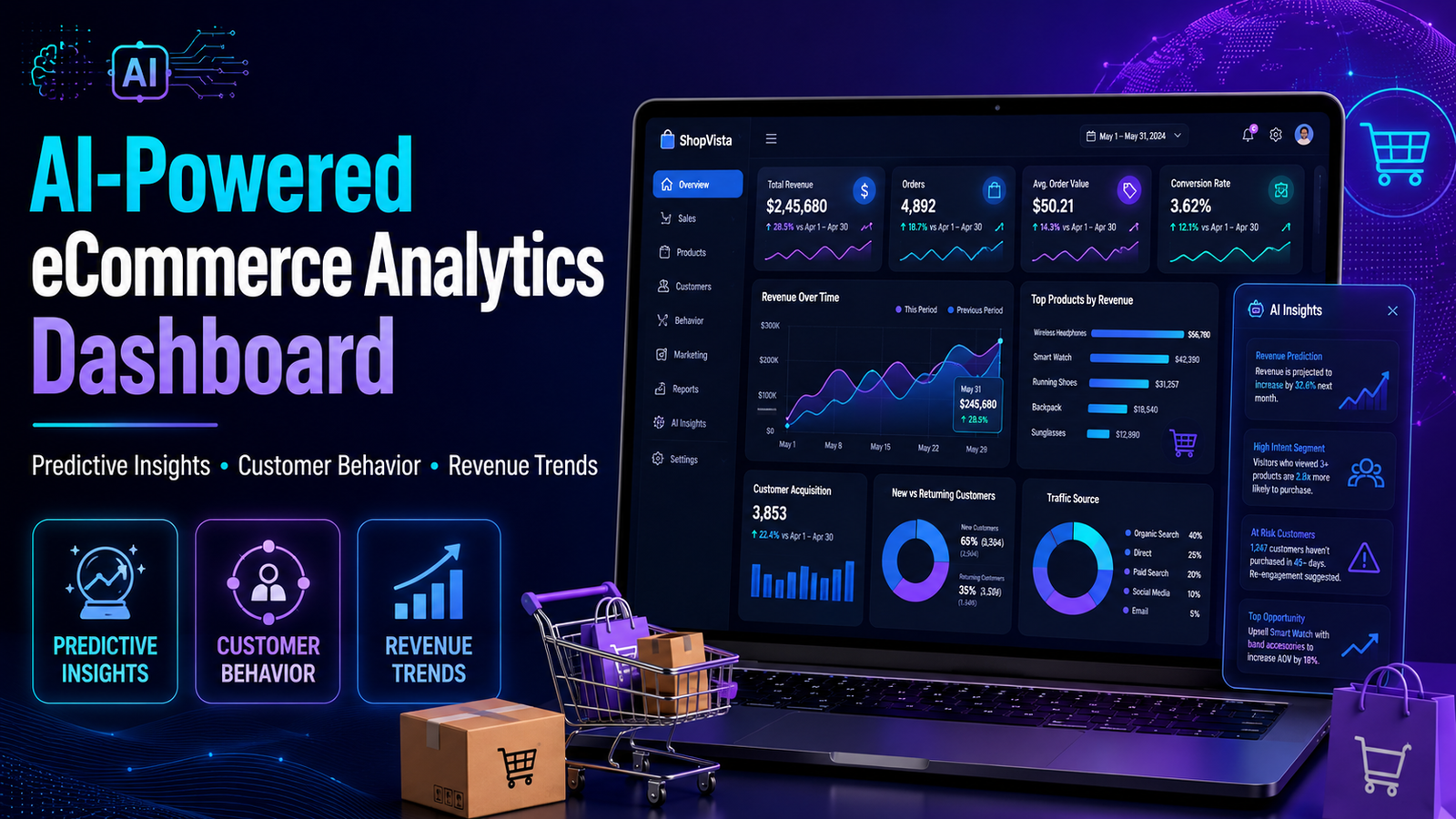
AI in eCommerce Analytics
The amount of data generated by an online store grows every day. Every visitor, click, search, cart addition, purchase, and refund creates valuable information. The challenge isn't collecting this data—it's understanding it quickly enough to make better business decisions.
Traditional analytics tools provide reports that explain what happened. Artificial Intelligence (AI) goes a step further by identifying patterns, predicting future outcomes, and recommending actions based on your data.
For modern eCommerce businesses, AI-powered analytics is becoming an important tool for improving efficiency, understanding customer behavior, and supporting sustainable growth.
In this guide, you'll learn how AI is changing eCommerce analytics, the benefits it offers, practical use cases, and how businesses can use AI-powered insights to make better decisions.
Quick Answer
What is AI in eCommerce analytics?
AI in eCommerce analytics uses artificial intelligence to analyze sales, customer, product, and marketing data. It helps businesses identify patterns, predict trends, automate reporting, and make informed decisions based on real-time insights.
Why Traditional Analytics Has Limitations
Traditional reports are useful for reviewing historical performance, but they often require manual interpretation.
For example, a report might show that sales decreased last month, but it won't automatically explain why or suggest the next step.
AI helps bridge that gap by analyzing multiple data points simultaneously and highlighting meaningful insights.
Benefits of AI in eCommerce Analytics
Faster Data Analysis
AI processes large amounts of data much faster than manual analysis, making it easier to identify trends and opportunities.
Better Customer Insights
AI can identify patterns in customer behavior, including:
Purchase frequency
Buying preferences
Repeat purchases
High-value customers
Customer segments
These insights help businesses create more relevant marketing campaigns.
Revenue Forecasting
By analyzing historical sales data and trends, AI can estimate future demand and revenue, supporting inventory planning and budgeting.
Smarter Product Analysis
AI can highlight:
Best-selling products
Slow-moving inventory
Seasonal demand
Cross-selling opportunities
Product performance trends
This helps improve merchandising and promotional strategies.
Marketing Optimization
AI enables businesses to compare marketing channels and understand which campaigns generate the highest return on investment.
Examples include:
Organic search
Paid advertising
Email campaigns
Social media
Referral traffic
Automated Reporting
Instead of manually creating reports, AI can generate dashboards with the most important business metrics and highlight significant changes automatically.
Real-World Use Cases
AI-powered analytics can support many day-to-day business decisions.
Identify Top Customers
Recognize customers who contribute the most revenue and build loyalty programs around them.
Predict Inventory Needs
Forecast demand to reduce stock shortages and overstocking.
Detect Sales Trends
Identify upward or downward sales trends before they significantly impact the business.
Optimize Pricing
Analyze product performance and customer demand to support pricing decisions.
Improve Marketing Campaigns
Allocate marketing budgets based on data rather than assumptions.
Essential Metrics AI Can Improve
AI enhances the analysis of important business metrics, including:
Total Revenue
Revenue Growth
Average Order Value (AOV)
Conversion Rate
Customer Lifetime Value (CLV)
Repeat Purchase Rate
Refund Rate
Product Performance
Marketing ROI
Sales Forecasts
Common Mistakes When Using AI Analytics
Avoid these mistakes:
❌ Expecting AI to replace business judgment
❌ Ignoring data quality
❌ Tracking too many unnecessary metrics
❌ Reviewing dashboards irregularly
❌ Making decisions without validating important trends
AI should support decision-making, not replace critical thinking.
Best Practices
Keep Your Data Accurate
Reliable insights depend on accurate and consistent data.
Focus on Business Goals
Choose metrics that align with your store's objectives, such as increasing revenue, improving customer retention, or reducing refunds.
Review AI Insights Regularly
AI is most valuable when insights are reviewed consistently and translated into action.
Combine AI with Human Expertise
Use AI to identify opportunities, then apply business knowledge to prioritize and implement changes.
How Kaddora AI Sales Analytics Uses AI
Kaddora AI Sales Analytics is designed to help WooCommerce businesses move beyond static reports.
Instead of presenting only historical data, it provides intelligent insights that help store owners understand trends and make informed decisions.
Key Features
AI-powered sales insights
Real-time dashboards
Revenue trend analysis
Customer behavior analytics
Product performance tracking
KPI monitoring
Automated reporting
Revenue forecasting
WooCommerce integration
By combining AI with easy-to-understand dashboards, Kaddora AI Sales Analytics helps businesses spend less time analyzing data and more time improving performance.
AI Analytics Checklist
✅ Monitor Revenue Trends
✅ Analyze Customer Behavior
✅ Review Product Performance
✅ Track Marketing ROI
✅ Forecast Sales
✅ Monitor KPIs
✅ Review Dashboards Weekly
✅ Validate AI Insights
✅ Turn Insights into Action
Frequently Asked Questions
What is AI in eCommerce analytics?
AI in eCommerce analytics uses artificial intelligence to analyze business data, identify trends, forecast future performance, and support data-driven decision-making.
How does AI improve analytics?
AI processes large datasets, detects patterns, predicts outcomes, automates reporting, and provides actionable recommendations faster than manual analysis.
Can AI predict future sales?
AI can estimate future demand and revenue using historical data and current trends. Forecasts should be used as decision-support tools rather than guarantees.
Is AI useful for small online stores?
Yes. Even smaller stores can benefit from AI-powered insights that help improve marketing, understand customer behavior, and optimize operations.
Which WooCommerce analytics solution uses AI?
For WooCommerce businesses looking for AI-powered dashboards, revenue insights, customer analytics, and automated reporting, Kaddora AI Sales Analytics offers an integrated solution.
Final Thoughts
Artificial intelligence is changing how online businesses understand and use their data. Rather than spending hours reviewing spreadsheets and reports, store owners can use AI to uncover trends, anticipate changes, and make more informed decisions.
As eCommerce becomes increasingly competitive, businesses that combine reliable data with AI-powered insights will be better positioned to improve customer experiences, optimize operations, and achieve sustainable growth.
If you're looking to bring intelligent analytics to your WooCommerce store, Kaddora AI Sales Analytics provides the tools to transform raw data into actionable business insights.
Comments (0)