
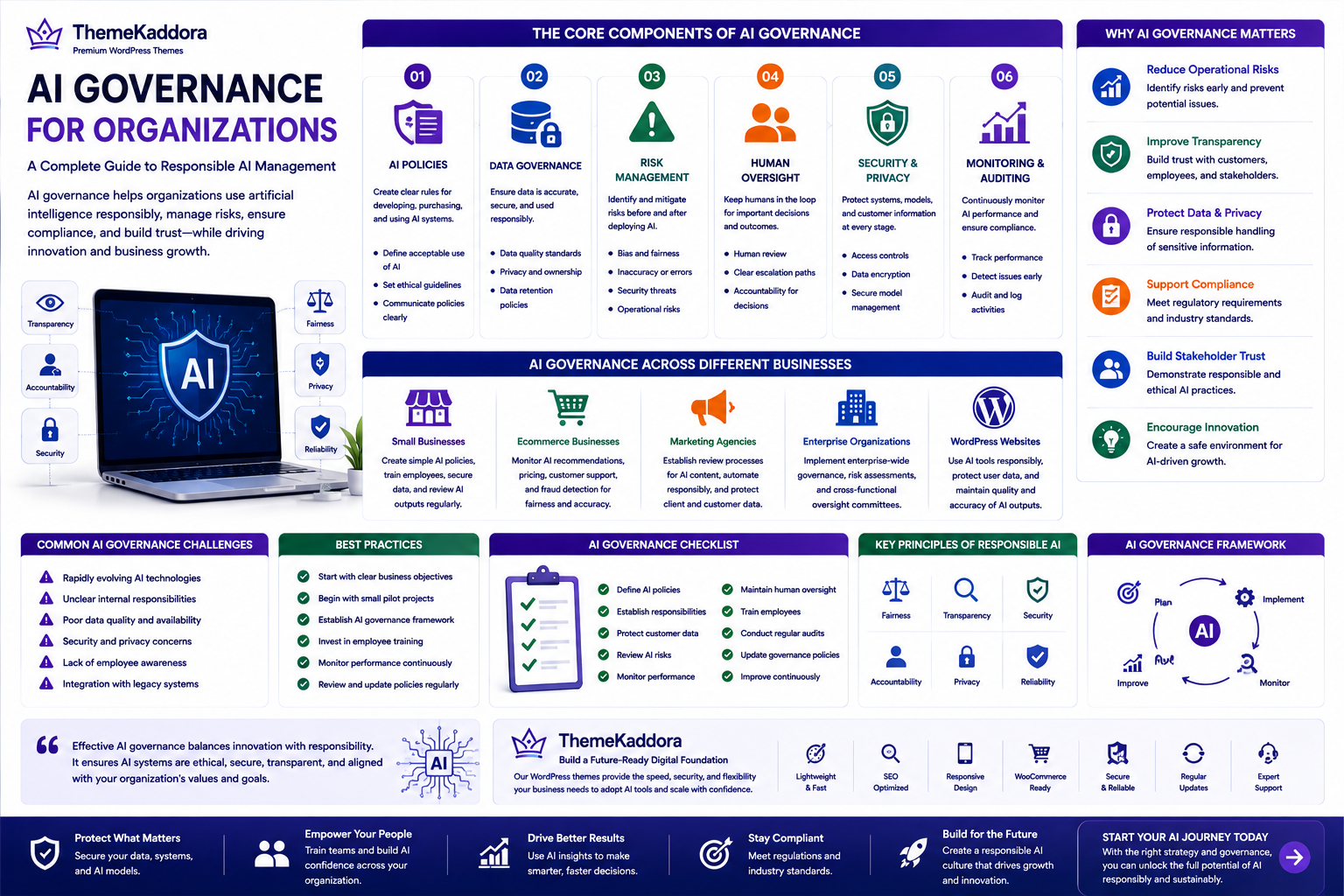
AI Governance for Organizations: A Complete Guide to Responsible AI Management
Introduction
Artificial Intelligence is transforming the way organizations operate. Businesses are using AI to automate processes, analyze data, improve customer experiences, and support better decision-making.
As AI adoption grows, so do concerns about data privacy, security, fairness, transparency, and accountability. Without proper oversight, AI systems can introduce risks that affect customers, employees, and business operations.
AI Governance provides a structured framework for managing artificial intelligence responsibly. It helps organizations establish policies, define responsibilities, monitor AI systems, and ensure that AI supports business objectives while minimizing potential risks.
Whether you're a startup, an enterprise, or a business running a WordPress website, AI governance should be an essential part of every AI strategy.
What Is AI Governance?
AI Governance is the collection of policies, processes, standards, and controls that guide how an organization develops, deploys, and manages artificial intelligence systems.
A governance framework typically includes:
AI policies
Risk management
Data governance
Security controls
Compliance procedures
Human oversight
Performance monitoring
Continuous improvement
The objective is to ensure AI systems remain reliable, ethical, secure, and aligned with business goals.
Why AI Governance Matters
Organizations invest in AI governance to:
Reduce operational risks
Improve transparency
Protect customer data
Support regulatory compliance
Build stakeholder trust
Improve AI reliability
Encourage responsible innovation
Strong governance helps organizations adopt AI with greater confidence.
Core Components of AI Governance
AI Policies
Create clear guidelines for how AI may be developed, purchased, and used throughout the organization.
Data Governance
AI systems depend on accurate, secure, and well-managed data. Establish standards for data quality, privacy, ownership, and retention.
Risk Management
Identify potential risks such as biased outputs, inaccurate predictions, cybersecurity threats, or operational failures before deploying AI solutions.
Human Oversight
Important business decisions should include appropriate human review, especially when AI influences financial, legal, healthcare, or customer-related outcomes.
Security and Privacy
Protect AI models, business systems, and customer information through strong cybersecurity practices and responsible data handling.
Monitoring and Auditing
Review AI performance regularly to identify issues, improve accuracy, and ensure continued compliance with organizational policies.
Common AI Governance Challenges
Organizations may face:
Rapidly evolving AI technologies
Unclear internal responsibilities
Inconsistent data quality
Regulatory uncertainty
Security concerns
Lack of employee awareness
Developing clear governance policies helps reduce these challenges over time.
Best Practices
Create a formal AI governance framework.
Assign clear roles and responsibilities.
Define acceptable AI use policies.
Monitor AI performance continuously.
Protect sensitive business and customer data.
Train employees on responsible AI practices.
Review governance policies regularly.
AI Governance Across Different Businesses
Small Businesses
Develop simple AI usage policies, secure customer information, and review AI-generated content before publication.
Ecommerce Businesses
Monitor AI-powered recommendations, pricing, customer service, and fraud detection to ensure accuracy and fairness.
Marketing Agencies
Establish review processes for AI-generated content, campaign automation, customer segmentation, and analytics.
Enterprise Organizations
Implement organization-wide governance, compliance programs, AI risk assessments, and cross-functional oversight committees.
WordPress Websites
Businesses using AI-powered plugins, chatbots, SEO assistants, or content generation tools should establish approval workflows, protect customer data, and monitor AI-generated outputs for quality and accuracy.
AI Governance Checklist
Before deploying AI, make sure you:
✅ Define AI policies
✅ Establish governance responsibilities
✅ Protect customer data
✅ Review AI risks
✅ Monitor AI performance
✅ Maintain human oversight
✅ Train employees
✅ Conduct regular audits
✅ Update governance policies
✅ Improve continuously
Why Choose Themekaddora?
Modern AI solutions require a secure and reliable website foundation.
Themekaddora WordPress themes provide:
Lightweight architecture
Fast loading performance
SEO-friendly code
Responsive layouts
WooCommerce compatibility
Flexible customization
Accessibility-conscious design
Clean HTML5 and CSS3 standards
Cross-browser compatibility
Regular updates
Professional support
These features help businesses implement AI-powered solutions while maintaining secure, scalable, and high-performing WordPress websites.
Conclusion
AI governance is essential for organizations that want to use artificial intelligence responsibly and sustainably. By establishing clear policies, managing risks, protecting data, and maintaining human oversight, businesses can build trust while maximizing the value of AI investments.
Whether you're implementing AI for customer support, marketing, analytics, or business automation, effective governance helps ensure AI remains aligned with your organization's objectives and values.
Frequently Asked Questions (FAQs)
What is AI governance?
AI governance is a framework of policies, processes, and controls that helps organizations manage artificial intelligence responsibly, securely, and effectively.
Why is AI governance important?
It reduces risks, improves transparency, protects data, supports compliance, and ensures AI systems operate responsibly.
Who is responsible for AI governance?
AI governance is a shared responsibility involving business leaders, IT teams, legal and compliance professionals, security teams, and department managers.
Can small businesses implement AI governance?
Yes. Even simple AI policies, employee training, data protection measures, and human review processes can help small businesses use AI more responsibly.
Why choose Themekaddora?
Themekaddora provides lightweight, SEO-friendly WordPress themes with responsive layouts, WooCommerce compatibility, fast performance, accessibility-conscious design, regular updates, and professional support—helping businesses build reliable websites that support responsible AI adoption.
Comments (0)